
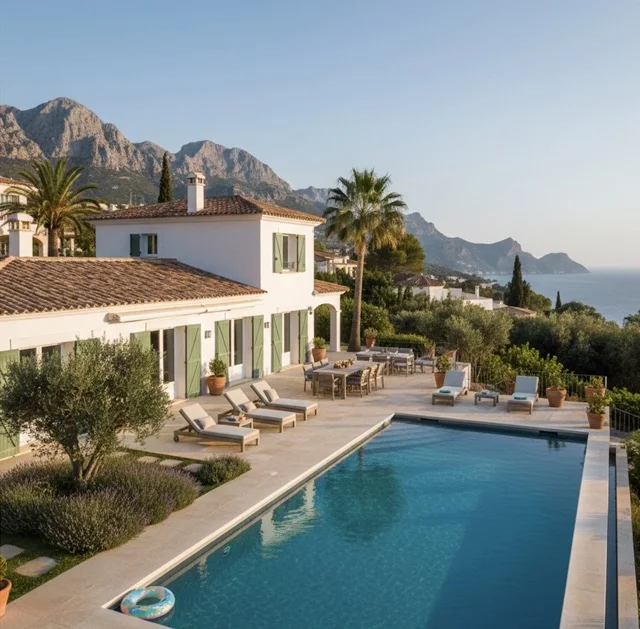
Mallorca offers sophisticated lifestyle infrastructure for UHNWI families relocating from international markets, combining Mediterranean climate with excellent international education, modern healthcare, established expatriate communities, and comprehensive cultural amenities. Southwest Mallorca concentrates premium services within 10-15 minute access from luxury property developments, with 19 international schools, private healthcare facilities, Michelin-starred restaurants, and year-round sporting amenities serving the island’s €1.5-3 million+ property buyers.
British families comprise the largest expatriate demographic, creating established communities in Port d’Andratx (German/British marina lifestyle), Costa d’en Blanes/Portals Nous (60-70% foreign residents, international schools proximity), and Santa Ponsa (large German community, golf focus). These areas provide familiar English-language environments while maintaining authentic Mediterranean character through architecture, cuisine, and local Spanish integration opportunities.
Monthly living costs for UHNWI families average €11,750-21,400 (£10,000-18,200 approximately) including groceries, restaurants, domestic staff, utilities, transportation, private healthcare (€400-600 monthly for four), school fees (€1,300-2,200 per child monthly), and entertainment. Property-related expenses add €1,550-3,600 monthly for community fees, property tax, insurance, and garden/pool maintenance. Total annual lifestyle costs: €160,000-300,000 for comfortable UHNWI living in €2 million Southwest Mallorca villa, positioning the island 25-40% below equivalent luxury destinations (French Riviera, Swiss lakeside, London) while delivering superior climate and lifestyle quality.
On Spanish income to EUR 600K
Year of arrival + 5 following
Official sources cited
Dividends, gains, rentals abroad
Last updated: 10 June 2026
By: Alexander Thornbury
Contents
- Which international schools serve luxury property areas?
- How does the healthcare system work for foreign residents?
- What does luxury lifestyle cost in Mallorca monthly?
- Where are the established expat communities?
- What cultural activities and amenities exist?
- What’s the climate like throughout the year?
- How’s transportation and connectivity to major cities?
- Do I need to speak Spanish to live comfortably?
- What are the day-to-day practicalities for UHNWI families?
Which international schools serve luxury property areas?
Mallorca hosts 19 international schools offering British, American, German, Swedish, and French curricula, with concentrations in Southwest Mallorca (Calvià, Andratx corridor) and Palma serving the island’s luxury property markets. UHNWI families purchasing €1.5-3 million properties prioritise school proximity alongside property selection, with many Southwest developments marketed explicitly on their 10-15 minute access to top international schools.
Southwest Mallorca International Schools
Bellver International College (Cala Major, Palma) Britain’s oldest international school in Spain, established 1950. Located where the Spanish royal family summers, adjacent to Marivent Palace. The school follows British National Curriculum from ages 3-18, with GCSE and A-Level qualifications preparing students for UK universities.
Key Details:
- Student body: 250 pupils, 40+ nationalities
- Curriculum: British (Cambridge/Edexcel examination boards)
- Languages: English primary instruction, plus Spanish, Catalan, French, German
- Annual fees: €7,650-€12,750 (2024/25, increases typical 3-5% annually)
- Uniform: Yes (traditional British school uniform)
- Facilities: Sports fields, science laboratories, theatre, music facilities
- University placement: 99% of sixth form leavers progress to university
Location advantages for Southwest property owners: Bellver sits 10 minutes from Port d’Andratx, 8 minutes from Portals Nous, 12 minutes from Costa d’en Blanes. Families in €2-4 million Southwest villas use this as their primary school, avoiding longer commutes to other international options.
The school maintains rigorous academic standards, consistently achieving above-UK-average GCSE and A-Level results. Teaching staff are predominantly British-qualified, ensuring authentic curriculum delivery. Spanish and Catalan instruction meets requirements for students wanting dual Spanish-British qualifications, enabling university access in both countries.
Baleares International College (Sant Agustí/Sa Porrassa) Two-campus British school serving ages 2-18 across convenient Southwest locations. Sant Agustí campus (just outside Palma) and Sa Porrassa campus (between Magaluf and Santa Ponsa) provide geographic flexibility for families based throughout Southwest Mallorca’s luxury zones.
Key Details:
- Student body: 650+ pupils across both campuses
- Curriculum: British National Curriculum to GCSEs and A-Levels
- Languages: English-medium instruction, Spanish/Catalan compulsory
- Annual fees: €7,650-€12,750 approximately
- Uniform: Yes
- Facilities: Purpose-built modern facilities, extensive sports amenities, technology integration
- Notable: British-owned, British-managed, predominantly British teaching staff
BIC’s dual-campus structure suits families uncertain about exact residential location when initially relocating. Starting at Sant Agustí (closer to Palma) allows flexibility to later shift to Sa Porrassa if purchasing property further west in Calvià municipality. Both campuses deliver identical curriculum standards, making transfers seamless for families relocating within the region.
The school emphasises pastoral care and individual attention, with smaller class sizes than Spanish state schools (18-20 pupils per class versus 25-30 in state sector). This personalised approach appeals to UHNWI families seeking attentive educational environments where teachers know each child personally.
Queen’s College (Palma-Bonanova) Secular international school in tranquil Bonanova district, offering British curriculum through GCSEs and A-Levels with optional Spanish Selectividad pathway for dual qualifications. Smaller than BIC or Academy, with 400 students creating close family community atmosphere.
Key Details:
- Student body: 400 pupils
- Curriculum: British National Curriculum, optional Spanish Selectividad
- Languages: English primary, Spanish/Catalan integrated
- Annual fees: €7,650-€12,750 range
- Uniform: Yes
- Facilities: Green space campus, outdoor learning areas
- Accreditation: NABSS (National Association of British Schools in Spain) member
- University track: Both UK universities via A-Levels and Spanish universities via Selectividad
Queen’s College suits families wanting smaller school environment with strong pastoral care focus. The school explicitly markets itself as intimate community where staff know every family personally. Academic results match larger competitors while maintaining boutique feel appealing to families prioritising personal attention over institutional scale.
Northern Mallorca International Schools
Mallorca International School (Sa Pobla) British curriculum school serving Northern Mallorca (Pollença, Alcúdia, Artà regions). Established 2015, rapidly growing but maintaining small class sizes (maximum 21 pupils per class). Particularly valuable for families purchasing luxury properties in Northeast coastal areas where other international schools require 45-60 minute commutes.
Key Details:
- Student body: 230 pupils, ages 3-16
- Curriculum: British National Curriculum
- Languages: English-medium, Spanish/Catalan/German additional
- Annual fees: Information not publicly listed
- Uniform: Yes
- Location: Rural setting surrounded by hills and forests
- Class sizes: Capped at 21 students maximum
The school addresses a gap in international education provision for Northern Mallorca luxury property owners. Previously, families in Pollença or Alcúdia faced choosing between hour-long commutes to Palma international schools or compromising on curriculum preferences. MIS now offers British education locally, making Northern locations more viable for British families with school-age children.
However, the school currently stops at age 16, lacking sixth form provision for A-Level years. Families must plan for children to transfer elsewhere for final pre-university education—typically to Bellver or BIC’s sixth forms in Southwest Mallorca, or to boarding schools in UK. This limitation affects decision-making for families with children approaching secondary school transition points.
Palma-Based International Schools
The Academy (Marratxi, near Palma) American curriculum international school preparing students for US university system through American High School Diploma and SAT examinations. Smaller institution (150+ students) offering alternative to British-dominated Mallorcan international education market.
Key Details:
- Student body: 150+ pupils, ages 3-14 currently
- Curriculum: American
- Languages: English-medium instruction
- Annual fees: Not publicly disclosed
- University pathway: US colleges and universities via American High School Diploma
The Academy particularly suits American families relocating to Mallorca who want children prepared for US higher education system. American curriculum differs substantially from British approach, with continuous assessment rather than terminal examinations, and broader liberal arts foundation versus British specialist focus in later years. Families committed to American university track find The Academy maintains appropriate preparation.
However, the school’s smaller size and limited age range (currently to age 14) create constraints. Families need contingency plans for older children’s education, potentially returning to US for high school years or transferring to larger international schools offering IB Diploma (closer equivalent to American approach than British A-Levels).
School Fee Structures and Hidden Costs
Published annual fees (€7,650-€12,750 for most British schools) represent core tuition only. Total education costs include multiple additional expenses:
| Cost Category | Annual Amount | Notes |
| Core tuition | €7,650-€12,750 | Increases 3-5% annually typically |
| Registration fee | €1,500-3,000 | One-time, non-refundable upon application |
| Annual matriculation | €800-1,200 | Paid each September in addition to tuition |
| Uniforms | €400-800 | Full uniform sets, PE kit, winter/summer variants |
| School trips | €500-1,500 | Residential trips, foreign exchanges, field studies |
| Extra-curricular activities | €300-1,000 | Music lessons, sports clubs, drama, languages |
| School meals | €900-1,500 | If using school catering services |
| School bus | €1,200-2,000 | If requiring transport from Southwest properties |
| Books and materials | €300-600 | Textbooks, digital resources, art supplies |
| Examination fees | €400-800 | GCSEs, A-Levels, external examination board charges |
Total annual cost per child: €12,000-€21,000 approximately, depending on age, school choice, and optional extras selected. Families with two children face €24,000-€42,000 annual education expenditure; three children €36,000-€63,000.
These costs significantly exceed UK state education (free) but prove cheaper than UK independent school fees (£15,000-£40,000 annually, or €17,000-€47,000). The comparison favourably positions Mallorcan international education for British families accustomed to private schooling costs.
School Selection Strategy for Property Buyers
Optimal school selection precedes property purchase decisions, not follows them. Many British families make costly errors buying beautiful Southwest villas before researching school commute times, discovering 40-minute drives exceeding acceptable daily schedules for young children.
Strategic Approach:
- Identify preferred schools based on curriculum, ethos, and children’s needs
- Map school locations and typical commute routes
- Define acceptable commute time limits (15-20 minutes for primary age, 25-30 minutes for secondary)
- Restrict property searches to areas within commute tolerance zones
- Visit schools during term time, observing drop-off/pick-up traffic flows
- Consider sibling scenarios—multiple school runs complicate logistics significantly
Southwest Mallorca properties command premiums partly due to superior school access. €2 million villas in Port d’Andratx or Costa d’en Blanes typically sit 10-15 minutes from multiple international school options. Equivalent €1.5 million properties in Pollença offer gorgeous settings but necessitate hour-long commutes to most international schools (except the smaller Mallorca International School locally).
These geographic trade-offs dramatically affect daily quality of life. Families underestimate how exhausting 90-minute daily school runs become when maintained five days weekly across multiple years. Property decisions significantly impact family stress levels and time availability—crucial considerations for luxury buyers seeking improved lifestyle quality as primary relocation motivation.
How does the healthcare system work for foreign residents?
Spain’s healthcare system ranks seventh globally according to WHO assessments, with Mallorca benefiting from modern hospitals, well-trained physicians, and comprehensive coverage options through both public and private systems. Foreign residents access healthcare through multiple pathways depending on residency status, employment circumstances, and insurance choices.
Public Healthcare Access (Sistema Nacional de Salud)
Spain’s public healthcare (SNS) provides universal coverage funded through social security contributions. The system operates via regional health authorities, with Balearic Islands managing Mallorcan healthcare independently from mainland regions. Standards remain consistently high across the system, though waiting times for non-urgent specialist appointments and elective procedures can extend weeks or months.
Eligibility for Public Healthcare:
Employed Residents: Anyone working in Spain and contributing social security payments automatically qualifies for public healthcare, covering employee and dependent family members. Employment contracts in Spain trigger automatic SNS enrollment through employer social security registrations.
Self-Employed/Freelance: Autónomos (self-employed individuals) pay monthly social security contributions (€294+ monthly minimum in 2025) including healthcare coverage. Many British property buyers establishing Spanish businesses or consultancy operations qualify through this route.
Pensioners: EU nationals receiving state pensions can access Spanish public healthcare via S1 certificates issued by home country social security systems. British state pensioners apply through NHS for S1 forms covering Spanish healthcare costs, with Spain reimbursed by UK government for treatment expenses.
Non-Contributors: Some regions, including Balearics, extend public healthcare to registered residents not contributing to social security, provided they meet income thresholds and lack private insurance alternatives. However, this coverage proves unreliable for foreigners and shouldn’t form primary healthcare strategy.
Healthcare Card (Tarjeta Sanitaria Individual): Once qualifying for public healthcare, residents receive TSI cards enabling appointment booking and pharmacy prescription collection. Registration requires visiting assigned health centres (Centres de Salut) with residency documentation, NIE numbers, and social security registration proof or S1 certificates.
Private Healthcare Insurance
Most UHNWI residents purchasing luxury property opt for private health insurance regardless of public healthcare eligibility. Private coverage eliminates waiting times, guarantees English-speaking physicians, enables direct specialist access without GP referrals, and provides single-room hospital accommodation versus shared public ward rooms.
Leading Private Healthcare Providers in Mallorca:
| Provider | Monthly Premium Range | Network Size | English-Speaking Staff | Notes |
| Sanitas | €50-€150 per person | 45,000+ professionals nationwide | Extensive | Market leader, comprehensive coverage |
| Asisa | €50-€120 per person | Large network | Good | Competitive pricing, reliable service |
| Adeslas | €50-€130 per person | Major facilities covered | Extensive | Part of SegurCaixa insurance group |
| DKV | €60-€140 per person | Growing network | Good | German-owned, strong international orientation |
| Mapfre | €50-€120 per person | Comprehensive | Moderate | Broad insurance group offering health products |
Premium calculations depend on age, pre-existing conditions, coverage levels, and deductible selections. A UHNWI family of four (parents aged 45/42, children aged 12/9) typically pays €300-€500 monthly for comprehensive private coverage with no deductibles and full specialist access.
Coverage Typically Includes:
- GP consultations without appointment delays
- Direct specialist access (cardiologists, orthopaedists, dermatologists, etc.)
- Diagnostic testing (blood work, imaging, scans)
- Hospital admissions in private facilities
- Surgical procedures (elective and emergency)
- Maternity care (prenatal, birth, postnatal)
- Paediatric care
- Emergency services
- Prescription medication (varying co-payment levels)
- Some policies include dental, optical, physiotherapy
Coverage Typically Excludes:
- Pre-existing conditions (at least initially—some insurers cover after waiting periods)
- Cosmetic procedures unless medically necessary
- Experimental treatments
- Some chronic condition management
- Mental health services (varying by policy)
Major Private Hospitals and Clinics in Mallorca
Hospital Quirónsalud Palmaplanas (Palma) Mallorca’s largest and most comprehensive private hospital, part of Quirónsalud Group (Spain’s premier private healthcare network). Located in Son Españolet district of Palma, 15 minutes from Southwest luxury property zones.
- Specialties: Oncology, cardiology, orthopaedics, neurology, maternity
- Facilities: 24-hour emergency department, intensive care units, advanced surgical theatres, diagnostic imaging
- Languages: English, German, French alongside Spanish
- Insurance: Accepts all major Spanish private insurers
Clínica Juaneda (Multiple locations: Palma, Muro) Established 1917, one of Mallorca’s oldest private healthcare institutions. Juaneda Miramar in central Palma provides comprehensive hospital services; Juaneda Muro serves Northern Mallorca.
- Specialties: General medicine, surgery, maternity, paediatrics, geriatrics
- Facilities: Hospital beds, outpatient clinics, diagnostic services
- Languages: Multilingual staff including English speakers
- Insurance: Widely accepted across private insurance providers
Clínica Rotger (Palma) Modern private clinic focusing on day surgery, diagnostic procedures, and specialist consultations. Particularly strong in orthopaedics, ophthalmology, and ENT (ear, nose, throat) services.
- Specialties: Orthopaedics, ophthalmology, plastic surgery, dermatology
- Facilities: Surgical suites, diagnostic imaging, specialist consultation rooms
- Languages: English-speaking consultants in most departments
- Insurance: Major insurers accepted
Healthcare for Different Resident Categories
Non-Lucrative Visa Holders Non-Lucrative Visa requirements mandate comprehensive private health insurance with zero co-payments and unlimited coverage. Policies must be from Spanish-authorised insurers, covering all medical services including hospitalisation and emergency care. Sanitas, Asisa, and other major providers offer specific “visa-compliant” policies meeting these requirements, typically costing €60-€100 monthly for individuals under 60.
Digital Nomad Visa Holders Similar private insurance requirements apply, with policies needing comprehensive coverage documentation in Spanish language for visa applications. Many digital nomads maintain international coverage initially but transition to Spanish private insurance after arrival for better local facility access and cost efficiency.
Property Owners Visiting Occasionally British property owners spending under 183 days annually in Mallorca (thus not tax resident) should maintain travel insurance covering Spanish healthcare costs during visits. Post-Brexit, EHIC cards no longer cover British nationals, requiring private travel insurance. Annual multi-trip policies cost £150-£400 depending on age and coverage levels.
Alternatively, some UHNWI families maintain Spanish private health insurance year-round despite limited property usage, ensuring immediate healthcare access whenever visiting without travel insurance limitations or pre-existing condition exclusions.
Healthcare Costs Without Insurance
Medical tourism to Spain attracts patients globally due to quality-cost ratios considerably below Northern European and US levels. However, costs still prove substantial without insurance coverage:
| Service | Approximate Cost |
| GP consultation | €80-€150 |
| Specialist consultation | €150-€300 |
| Basic blood work | €80-€150 |
| X-ray | €60-€100 |
| MRI scan | €300-€600 |
| CT scan | €250-€500 |
| Minor surgery (day case) | €1,500-€4,000 |
| Major surgery (hospitalisation) | €8,000-€25,000+ |
| Emergency room visit | €200-€500 |
| Ambulance | €80-€200 |
| Dental check-up | €40-€80 |
| Dental crown | €400-€800 |
These costs substantially undercut UK private healthcare equivalents (consultant visits £200-£300, MRI scans £400-£800, surgeries £5,000-£40,000), yet they remain significant enough to make insurance essential for residents facing ongoing healthcare needs or emergency risks.
What does luxury lifestyle cost in Mallorca monthly?
UHNWI families maintaining luxury lifestyles in Southwest Mallorca properties face monthly expenditures of €8,000-€18,000 beyond property-related costs (mortgages, community fees, property tax). This range reflects variation between modest luxury (€1.5 million property, two children, moderate dining/entertainment) and high luxury (€3+ million property, larger family, frequent fine dining, domestic staff, premium services).
Monthly Cost Breakdown for Luxury Living
Family Profile for Cost Modeling:
- Property: €2 million villa, Southwest Mallorca (Port d’Andratx, Costa d’en Blanes, or Portals Nous)
- Family: Two adults (45/42), two children (12/9)
- Lifestyle: Upper-middle luxury—weekly fine dining, domestic cleaning service, children in international schools, private healthcare, quality grocery shopping
| Category | Monthly Cost | Annual Cost | Notes |
| Groceries | €1,200-1,800 | €14,400-21,600 | Quality supermarkets, fresh produce, some specialty items |
| Restaurants | €1,500-3,000 | €18,000-36,000 | 2-3 fine dining monthly, casual dining weekly |
| Domestic staff | €1,200-2,400 | €14,400-28,800 | Cleaner 2-3 days/week, occasional gardener |
| Utilities | €300-500 | €3,600-6,000 | Electricity, water, internet, phones |
| Transportation | €800-1,500 | €9,600-18,000 | Car lease/ownership, fuel, insurance, parking |
| Private healthcare | €400-600 | €4,800-7,200 | Family of four comprehensive coverage |
| School fees | €2,000-3,500 | €24,000-42,000 | Two children in international schools including extras |
| Entertainment/culture | €600-1,200 | €7,200-14,400 | Cinema, concerts, sporting events, memberships |
| Clothing/personal | €500-1,000 | €6,000-12,000 | Quality clothing, personal care, grooming |
| Sports/hobbies | €400-800 | €4,800-9,600 | Golf, tennis, sailing, gym memberships |
| Travel off-island | €800-1,500 | €9,600-18,000 | Flights to UK/mainland, short breaks |
| Miscellaneous | €500-1,000 | €6,000-12,000 | Unexpected expenses, gifts, general spending |
| TOTAL MONTHLY | €10,200-17,800 | €122,400-213,600 | Excluding property costs (see below) |
Additional Property-Related Costs (Not Included Above):
- Community fees: €400-1,500 monthly (€4,800-18,000 annually) depending on development amenities
- IBI property tax: €750-1,250 monthly (€9,000-15,000 annually) for €2 million property
- Property insurance: €200-350 monthly (€2,400-4,200 annually)
- Garden/pool maintenance: €200-500 monthly (€2,400-6,000 annually) if not included in community fees
- Property subtotal: €1,550-3,600 monthly (€18,600-43,200 annually)
Grand Total: €11,750-€21,400 monthly (€141,000-€256,800 annually) for maintaining luxury lifestyle in €2 million Mallorcan villa with family of four.
Cost Comparison: Mallorca vs Northern Europe
Mallorca’s cost structure typically runs 25-40% below comparable Northern European luxury destinations (French Riviera, Swiss lakeside, London suburbs) while delivering equivalent or superior lifestyle quality. The savings concentrate in domestic staff, dining, healthcare, and daily services rather than property costs (where Mallorca increasingly converges with international luxury markets).
Comparative Monthly Luxury Living Costs (Family of Four):
| Location | Monthly Cost | Annual Cost | Cost Index |
| Southwest Mallorca | €11,750-€21,400 | €141,000-€256,800 | 100 (baseline) |
| French Riviera (Nice/Cannes) | €16,000-€30,000 | €192,000-€360,000 | 136-140 |
| Geneva/Swiss lakeside | €18,000-€35,000 | €216,000-€420,000 | 153-164 |
| London (zones 1-2) | €15,000-€28,000 | €180,000-€336,000 | 128-131 |
| Copenhagen | €17,000-€32,000 | €204,000-€384,000 | 145-150 |
| Costa del Sol (Marbella) | €10,000-€19,000 | €120,000-€228,000 | 85-89 |
Mallorca’s value proposition lies in delivering luxury lifestyle elements—international schools, private healthcare, fine dining, cultural amenities, year-round climate—at Spanish cost structures while competing with far more expensive Northern European alternatives for resident appeal.
Domestic Staff Availability and Costs
Hiring domestic staff in Mallorca proves straightforward, with established agencies and individual service providers serving expatriate and wealthy Spanish households throughout Southwest corridor. Staff costs remain reasonable relative to property values and household budgets typical among luxury buyers.
Domestic Cleaner/Housekeeper
- Cost: €12-€18 per hour depending on experience and responsibilities
- Typical arrangement: 2-3 days per week, 4-6 hours per session
- Monthly cost: €400-€800 for twice-weekly cleaning
- Services: General cleaning, laundry, basic ironing, occasional cooking
- Sourcing: Agencies, recommendations from other expatriates, local advertisements
Live-In Housekeeper
- Cost: €1,500-€2,500 monthly salary plus accommodation/food
- Typical arrangement: Five or six days per week, full household management
- Total cost: €2,000-€3,500 monthly including employment costs and provisions
- Services: Comprehensive household management, cooking, cleaning, laundry, shopping
- Sourcing: Specialist agencies, expatriate networks, property management companies
Gardner/Pool Maintenance
- Cost: €15-€25 per hour for gardening, €80-€150 per monthly pool service
- Typical arrangement: Weekly or fortnightly garden visits, monthly pool chemical/filter checks
- Monthly cost: €240-€500 depending on garden size and pool complexity
- Services: Lawn maintenance, plant care, hedge trimming, pool cleaning and chemical balance
- Sourcing: Often included in community fees for developments; otherwise local garden centres, pool companies
Cook/Private Chef
- Cost: €150-€300 per dinner service for occasional private dining
- Typical arrangement: Hired for special occasions, dinner parties, family celebrations
- Services: Menu planning, grocery shopping, cooking, serving, cleanup
- Sourcing: Catering companies, hospitality agencies, recommendations from restaurants
Childcare/Nanny
- Cost: €10-€15 per hour for occasional babysitting, €1,200-€1,800 monthly for regular nanny
- Typical arrangement: After-school care, occasional evening babysitting, or full-time nanny
- Services: Childcare, school pick-ups, activity supervision, light meal preparation
- Sourcing: International schools often facilitate connections, au pair agencies, expatriate forums
Employment of domestic staff in Spain requires proper registration and social security contributions. Many expatriates initially hire staff informally (“cash in hand”) but expose themselves to legal risks and penalties. Proper employment contracts, payroll administration, and social security registration cost approximately 30-35% above gross wages but provide legal protection and staff benefits like healthcare and holiday entitlements.
Where are the established expat communities?
Mallorca hosts approximately 280,000 foreign residents among 1.18 million total population—nearly 24% of the island’s permanent inhabitants. British residents number approximately 20,000 registered (likely 30,000+ including unregistered/part-year residents), with Germans forming the largest expatriate group at 35,000-40,000 registered residents. These communities concentrate in specific geographic zones creating established international neighbourhoods with English/German-speaking services, international social networks, and familiar retail options.
Southwest Mallorca Expatriate Zones
Port d’Andratx/Puerto Andratx Heavily international harbour town with German and British residents dominating property ownership. The marina area features German bakeries, British pubs, international restaurants, and multilingual professional services. Walking through port areas reveals more German and English conversation than Spanish/Catalan, creating familiar environment for Northern European buyers.
Social infrastructure:
- British/German restaurants and cafés throughout marina area
- International real estate agencies with native-speaking agents
- Multilingual legal, medical, financial professionals
- Active sailing clubs and yacht owners’ associations attracting international membership
- Regular expatriate social events, networking groups
Andratx attracts quieter, often older expatriates seeking beautiful settings without Palma’s urban intensity. The community skews affluent (reflecting property prices), professionally successful, and lifestyle-focused rather than employment-dependent. Social life centres on sailing, dining, golf at nearby Andratx Golf Club, and small group gatherings rather than large expatriate organisation activities.
Costa d’en Blanes/Portals Nous Purpose-built luxury developments from 1970s-2000s creating international residential zones explicitly designed for foreign buyers. English-language schools, German doctors’ surgeries, British grocery imports, and multilingual services concentrate here, making it perhaps Mallorca’s most internationally-oriented residential area.
Community characteristics:
- Extremely high expatriate concentration (60-70% foreign residents in some developments)
- British/German/Scandinavian majority among foreign residents
- Young families with school-age children dominate demographics
- Proximity to international schools (Bellver, BIC, Academy) creates school-gate social networks
- Active tennis clubs, golf society connections (Real Golf Bendinat adjacent)
- Less Spanish integration—possible to live entirely in English/German linguistic bubble
The area functions almost as international enclave with limited Spanish cultural immersion. UHNWI families seeking familiar Northern European atmosphere with minimal adaptation requirements thrive here. However, those prioritising Spanish cultural integration and language acquisition find the environment perhaps too insulated from authentic local life.
Santa Ponsa/Calvià Large German expatriate community with British presence, creating bilingual German-Spanish rather than English-Spanish environment prevalent elsewhere. German bakeries, restaurants, golf club membership, and social organisations make this particularly comfortable for German-speaking buyers.
Community features:
- Golf Poniente club attracts German members heavily
- German-language services throughout commercial areas
- British residents cluster in specific developments
- More family-oriented than pure retirement destination
- Active community organisations, sports clubs, language exchanges
Palma The capital offers genuinely cosmopolitan environment rather than expatriate enclaves. International residents disperse throughout districts, integrating more fully with Spanish population. Palma attracts younger professionals, entrepreneurs, and families prioritising urban lifestyle with cultural activities, restaurant scenes, and authentic Spanish environment over purely expatriate comfort zones.
Expatriate profile:
- Diverse nationalities without single dominant group
- Younger average age than Southwest communities
- More employed expatriates (entrepreneurship, remote work, local employment)
- Greater Spanish language proficiency typical
- Less formal expatriate organisation structure; organic social networks via interests
Palma-based expatriates often view themselves as residents rather than “expats,” rejecting insular international community identification in favour of Spanish cultural integration. This philosophical difference creates distinct lifestyle experiences—Palma offers authenticity and cultural richness, Southwest areas provide comfort and familiarity.
Expatriate Social Infrastructure
Formal Organisations:
- Mallorca Daily Bulletin: English-language newspaper covering island news, events, property market
- British Consulate (Palma): Provides consular services, passport renewals, documentation
- German Consulate (Palma): Similar services for German nationals
- International Women’s Clubs: Social networking for expatriate women
- Business networking groups: Mallorca Business Group, various industry-specific associations
- Religious congregations: Anglican Church Palma, English-speaking Catholic masses, other denominations
Informal Networks:
- Facebook groups (Mallorca Expats, British in Mallorca, various neighbourhood-specific groups)
- International school parent networks creating automatic social connections
- Golf club memberships facilitating business and social relationships
- Sailing clubs and yacht clubs providing networking opportunities
- Language exchange meetups connecting expatriates with Spanish residents
The strength and formality of expatriate social infrastructure correlates with area concentration levels. Southwest Mallorca offers extensive formal organisations and easily accessible networks. Palma and Northern areas require more proactive networking but deliver more authentic Spanish integration opportunities.
What cultural activities and amenities exist?
Mallorca combines Mediterranean island charm with sophisticated cultural infrastructure rivalling mainland Spanish cities. The combination of year-round resident population, substantial tourism economy, and historical wealth creates cultural vitality unusual for island destinations, offering UHNWI residents diverse entertainment, artistic, and sporting options.
Arts and Cultural Venues
Auditorium de Palma Mallorca’s premier concert hall hosting classical music performances, opera, ballet, contemporary dance, and jazz. The resident Balearic Symphony Orchestra performs regular concert series throughout the season. International touring artists include Palma in Mediterranean circuit schedules, bringing world-class performances to the island.
- Season: September-June with reduced summer programming
- Programming: Classical orchestral concerts, chamber music, solo recitals, opera, dance
- Ticket prices: €20-€80 depending on performance and seating
- Location: Palma harbour area, adjacent to convention centre
Teatre Principal (Palma) Historic theatre dating 1857, hosting drama, opera, dance, and occasional concerts in ornate 19th-century venue. Mix of Spanish-language productions and occasional international touring shows. Particularly strong in Spanish theatre and contemporary dance programming.
CaixaForum (Palma) Contemporary art museum and cultural centre operated by La Caixa banking foundation. Rotating exhibitions featuring international contemporary artists, photography, design, and thematic historical exhibitions. Free admission encourages regular visits discovering new exhibitions.
Es Baluard Museum (Palma) Contemporary and modern art museum in converted historic fortification overlooking Palma harbour. Strong permanent collection of Spanish and Balearic artists plus rotating temporary exhibitions. Sculpture terrace provides stunning harbour views alongside outdoor art display.
Fundación Miró (Palma) Joan Miró studio and foundation in Cala Major, preserving the artist’s working environment and displaying permanent collection of sculptures, paintings, and graphics. The intimate setting provides insight into Miró’s creative process alongside finished artworks.
Sporting Facilities and Activities
Golf Mallorca offers 20+ golf courses ranging from championship-standard layouts to shorter executive courses. Southwest Mallorca concentrates multiple prestigious clubs within 30-minute drives:
- Real Golf Bendinat (Bendinat): Challenging 9-hole course in historic estate setting
- Golf de Andratx (Camp de Mar): 18-hole championship course, dramatic mountain/sea views
- Golf Santa Ponsa I, II, III (Santa Ponsa): Multiple 18-hole courses plus 9-hole options
- T-Golf Poniente (Calvià): Modern 18-hole layout with extensive practice facilities
Annual membership fees range €2,000-€8,000 depending on club prestige, with additional green fees for guest rounds. Most clubs welcome international members and operate in English/German alongside Spanish.
Tennis and Paddle Tennis and paddle tennis (padel) facilities exist throughout Mallorca, with many residential developments including courts in community amenities. Private clubs offer coaching, social leagues, and tournament programmes. The Rafa Nadal Academy in Manacor (40 minutes from Palma) provides professional-standard coaching and facilities for serious junior players.
Sailing and Watersports Southwest Mallorca’s marina infrastructure supports extensive sailing activities:
- Real Club Náutico (multiple locations): Traditional sailing clubs with racing programmes, social sailing, instruction
- Marinas: Port d’Andratx, Puerto Portals, Club de Mar (Palma) offer berths and services
- Yacht charter: Bareboat and crewed charter widely available
- Water sports: Windsurfing, kitesurfing, stand-up paddleboarding, kayaking
The sailing season runs March-November with peak activity May-October. Social racing programmes and regattas create competitive opportunities and networking channels. Many UHNWI residents purchase or charter yachts, making sailing significant lifestyle component.
Cycling Mallorca ranks among Europe’s premier cycling destinations, attracting professional teams for winter training camps. The Tramuntana mountains provide challenging climbs, coastal roads offer scenic flat routes, and dedicated cycle paths serve recreational riders. International cycling culture creates welcoming environment for serious amateur cyclists, with bike shops, mechanics, and fellow enthusiasts readily available.
Dining and Restaurant Scene
Mallorca’s restaurant scene evolved dramatically over recent decades, progressing from basic tourist-oriented establishments to sophisticated culinary destination featuring multiple Michelin-starred venues and innovative contemporary cuisine alongside traditional Mallorcan cooking.
Michelin-Starred Restaurants (2025):
- Es Racó d’es Teix (Deià): One Michelin star, mountain village setting, contemporary Mediterranean
- Zaranda (Es Capdellà): Two Michelin stars, Fernando P. Arellano’s creative cuisine
- Voro (Cala Ratjada): One Michelin star, Álvaro Salazar’s innovative approach
- DINS Santi Taura (Lloseta): One Michelin star, Mallorcan traditions reinterpreted
Beyond Michelin recognition, Palma and Southwest Mallorca offer extensive high-quality dining across international cuisines—Italian, Japanese, Asian fusion, French, contemporary Spanish, and traditional Mallorcan—with dinner for two at upscale restaurants costing €100-€250 including wine.
Shopping and Retail
Palma Centre: Historic centre features international luxury brands (Louis Vuitton, Hermès, Cartier, Loewe) alongside Spanish fashion retailers, independent boutiques, and local artisans. Paseo del Borne and Avenida Jaime III concentrate high-end shopping, while Santa Catalina market area offers bohemian alternatives.
Puerto Portals: Marina shopping complex with luxury boutiques, jewellery, fashion, and lifestyle retailers targeting yacht owners and affluent Southwest residents. Less extensive than Palma but convenient for Costa d’en Blanes/Portals Nous residents avoiding central Palma drives.
Supermarkets: Eroski, Mercadona, Carrefour, and Lidl provide standard grocery shopping. British import specialists (Iceland, British Corner Shop online) supplement Spanish supermarkets for homesick expatriates. Fresh food markets (Mercat de l’Olivar, Mercat de Santa Catalina in Palma; municipal markets throughout island) offer quality produce, fish, and meat at competitive prices.
What’s the climate like throughout the year?
Mallorca enjoys classic Mediterranean climate with hot dry summers, mild winters, and moderate rainfall concentrated in autumn and spring. The climate proves one of the island’s primary attractions for Northern European buyers, offering substantially more sunshine hours and warmer temperatures than UK, Scandinavia, or Northern Continental Europe year-round.
Monthly Climate Breakdown
| Month | Avg High/Low °C | Rainfall (mm) | Sunshine Hours | Sea Temperature °C | Notes |
| January | 15°C / 5°C | 40mm | 5 hours/day | 14°C | Coolest month, occasional rain |
| February | 15°C / 5°C | 35mm | 6 hours/day | 13°C | Winter ends, almond blossoms |
| March | 17°C / 7°C | 30mm | 7 hours/day | 14°C | Spring arrives, pleasant weather |
| April | 19°C / 9°C | 35mm | 8 hours/day | 15°C | Ideal outdoor activities |
| May | 23°C / 13°C | 30mm | 10 hours/day | 17°C | Summer begins, perfect weather |
| June | 27°C / 17°C | 15mm | 11 hours/day | 21°C | Hot, dry, peak season starts |
| July | 30°C / 20°C | 10mm | 11 hours/day | 24°C | Hottest month, very dry |
| August | 31°C / 21°C | 20mm | 10 hours/day | 26°C | Peak heat, highest sea temps |
| September | 27°C / 18°C | 50mm | 8 hours/day | 24°C | Warm, occasional rain returns |
| October | 23°C / 14°C | 75mm | 6 hours/day | 21°C | Autumn, more rainfall |
| November | 18°C / 9°C | 60mm | 5 hours/day | 18°C | Cooling, wetter period |
| December | 16°C / 6°C | 50mm | 5 hours/day | 15°C | Winter begins, mild temperatures |
Annual totals: 300+ sunshine days, 400-500mm total rainfall, average annual temperature 18-19°C.
Seasonal Lifestyle Patterns
Summer (June-September): Peak tourist season brings hotel capacity crowds, restaurant reservations essential, beach clubs fully booked, and prices elevated 30-50% across hospitality sector. UHNWI residents either embrace the energy and social opportunities or depart for cooler destinations. Many international school families travel July-August when schools close, avoiding peak tourist intensity.
Autumn (October-November): Perhaps Mallorca’s optimal season—warm weather (20-25°C daytime), reduced crowds, lower prices, and beautiful light conditions. The Tramuntana mountains showcase autumn colours, outdoor activities remain comfortable, and restaurant availability improves dramatically. This “secret season” attracts discerning residents and visitors valuing quality over peak summer intensity.
Winter (December-March): Mild by Northern European standards but definitely winter—temperatures rarely exceed 16-18°C, rainfall increases, and some restaurants/hotels close for renovation. Swimming becomes challenging (sea temps 13-15°C), though hardy swimmers continue year-round. Heating becomes necessary in properties, particularly stone-built historic houses lacking insulation.
However, winter days still frequently reach 15-18°C under sunshine, enabling outdoor lunches, golf, hiking, and cycling comfortably. The contrast with UK (5-8°C, grey, damp) or Scandinavia (-5°C to +5°C, dark) remains stark—many British retirees specifically purchase Mallorcan property for January-March residence, escaping UK winter entirely.
Spring (April-May): Delightful season as landscape greens from spring rains, wildflowers bloom, and temperatures climb toward summer levels. Ideal for outdoor activities before summer heat arrives. Tourism remains moderate, allowing resident-friendly access to beaches and restaurants without summer crowds.
How’s transportation and connectivity to major cities?
Mallorca’s transportation infrastructure combines excellent air connectivity with Europe (particularly UK, Germany, Scandinavia) with adequate road networks, limited but improving public transport, and car-dependent lifestyle outside Palma. The island’s compact size (100km end-to-end) makes most destinations accessible within an hour’s drive.
Air Connectivity
Palma de Mallorca Airport (PMI) Spain’s third-busiest airport, handling 31+ million passengers annually. The airport operates extensive European route network with particular strength in British, German, and Spanish connections.
Key Route Frequencies (High Season, May-October):
- London (multiple airports): 40+ daily flights
- Manchester: 15+ daily flights
- Birmingham: 8+ daily flights
- Berlin: 12+ daily flights
- Munich: 10+ daily flights
- Hamburg: 8+ daily flights
- Madrid: 20+ daily flights
- Barcelona: 15+ daily flights
Winter (November-April) frequencies reduce 40-60% but maintain daily service on major routes. Budget carriers (Ryanair, easyJet, Eurowings) dominate capacity alongside legacy airlines (British Airways, Lufthansa, Iberia). Business and first-class availability exists primarily on Iberia Madrid/Barcelona routes; most European flights offer economy only or premium economy maximum.
Private jet terminals serve UHNWI travellers avoiding commercial aviation:
- Aviación Privada: FBO (fixed-base operator) handling private jet arrivals/departures
- Jet Aviation: Competitor FBO with similar services
- Approximate costs: €4,000-€8,000 one-way London-Palma for light jets (6-8 passengers), €10,000-€18,000 for midsize/large cabin jets
Flight times prove convenient: 2.5 hours London, 2 hours Frankfurt/Munich, 1 hour Madrid, 45 minutes Barcelona. Day trips to mainland for business meetings remain feasible, though exhausting if attempted frequently.
Road Network and Driving
Mallorca’s roads divide into motorways (autovías), primary roads, and secondary/mountain roads. The motorway network circles Palma and extends to major towns, offering efficient high-speed routes. Mountain roads through Tramuntana range provide spectacular scenery but require patience navigating narrow hairpin curves.
Key Routes:
- Ma-1 (Southwest motorway): Palma to Andratx (32km, 25 minutes in light traffic)
- Ma-20 (Palma ring road): Circumnavigates Palma, connecting all major routes
- Ma-13 (Northwest motorway): Palma to Alcúdia (60km, 45 minutes)
- Ma-19 (Airport motorway): Palma centre to airport (9km, 12 minutes)
Driving in Mallorca proves straightforward by Mediterranean standards. Roads maintain good condition, signage is clear, and traffic flows reasonably outside peak summer congestion in tourist zones. Parking in Palma centre can challenge during business hours, but Southwest residential areas offer ample parking generally.
Car ownership proves essentially mandatory for Southwest Mallorca residents. While buses connect major towns, frequency and routing don’t support daily commuting or flexible lifestyle needs. Most UHNWI families maintain 2-3 vehicles: luxury SUVs for family transport, sports cars or convertibles for personal use, and occasionally additional vehicles for older children or household staff.
Driving Costs:
- Fuel: €1.40-€1.60 per litre petrol (€1.30-€1.50 diesel) as of late 2025
- Insurance: €800-€2,000 annually depending on vehicle value and driver profiles
- Annual road tax (impuesto de circulación): €80-€250 depending on vehicle engine size
- ITV inspection (MOT equivalent): €30-€50 every two years after vehicle reaches four years old
Public Transport
Buses: Palma operates EMT municipal bus network with frequent routes throughout the city. Interurban buses (TIB network) connect Palma with all major towns, offering affordable transport (€1.50-€5 journeys) but limited timetables outside commuter hours. English/German-speaking tourists find buses navigable, but services don’t suit daily UHNWI lifestyle requirements.
Metro: Palma’s metro operates two lines connecting University with Plaza España (city centre) and Marratxi. Limited geographic coverage makes it irrelevant for most Southwest residents, though convenient for Palma-based residents accessing specific areas.
Trains: Vintage railway line runs Palma to Sóller (45 minutes), offering scenic tourist journey through mountains but limited practical transport value. The Palma-Inca line provides commuter service to northern towns but doesn’t reach Southwest property zones.
Taxis: Widely available in Palma and tourist areas, less common in residential zones. Fares prove reasonable (€8-€15 for typical Palma journey, €40-€60 airport to Port d’Andratx). Uber doesn’t operate in Mallorca; Cabify provides limited app-based service in Palma only.
Do I need to speak Spanish to live comfortably?
Theoretically no, practically yes—the level of Spanish proficiency required correlates inversely with how comprehensively you’re willing to limit yourself to expatriate-oriented services and English-speaking professionals. UHNWI residents can exist entirely in English linguistic bubbles using British/German estate agents, multilingual lawyers, English-speaking medical professionals, international schools, and expatriate social circles. However, this approach constrains daily life significantly and prevents authentic cultural integration.
Language Reality in Different Contexts
International School Environments: Completely English-language, with Spanish taught as foreign language subject. Parent-teacher communications, school newsletters, social events operate in English. School gate conversations among British parents occur naturally in English, creating comfortable linguistic environment.
Private Healthcare: Major providers (Sanitas, Asisa, Quirónsalud hospitals) employ multilingual staff specifically to serve international clientele. Receptionists speak English, many doctors consult in English, and patient forms exist in English versions. Medical care proceeds smoothly in English.
Southwest Property Services: Estate agents, lawyers, architects, and property managers serving Port d’Andratx, Portals Nous, and Santa Ponsa areas almost universally offer English/German service. These professionals specifically target international clients and hire accordingly.
Palma Commerce: Central Palma shops, restaurants, and services cater to tourism and expatriate residents, with staff generally speaking functional English. High-end establishments (luxury boutiques, upscale restaurants) ensure English-speaking staff presence.
Daily Life Outside Tourist Zones: Spanish/Catalan become essential for: local government offices (town halls, registry offices), utility companies (electricity, water providers), traditional Spanish banks (international banks offer English services), local tradespeople (plumbers, electricians, builders), healthcare providers beyond major private systems, legal situations (police, courts), neighbourhood interactions, and authentic local restaurants/shops.
Spanish Language Learning Approaches
Formal Classes: Multiple language schools in Palma and major towns offer Spanish courses for foreigners, with prices typically €15-€30 per hour for group classes, €30-€50 per hour for private tuition. The British Council, Goethe Institut, and various private academies provide structured learning with qualified teachers.
Online Learning: Platforms like Duolingo, Babbel, and Rosetta Stone enable self-directed study, though discipline and practice opportunities prove challenging without immersive context.
Language Exchange: Tandem language learning pairs native Spanish speakers wanting to improve English with English speakers learning Spanish, creating free mutual learning opportunities. Various Facebook groups and apps facilitate connections.
Immersive Experience: Living in Spanish-dominant areas (Palma working-class neighbourhoods, small Mallorcan towns) accelerates learning through necessity. Expat enclave residents learn far slower through lack of necessity and limited Spanish exposure.
Children enrolled in international schools rarely achieve native Spanish fluency unless additional Spanish environment exposure occurs—friendships with Spanish children, Spanish after-school activities, or deliberate family commitment to Spanish language at home. The British National Curriculum Spanish instruction alone produces basic competence, not bilingualism.
What are the day-to-day practicalities for UHNWI families?
Beyond the headline attractions of weather, beaches, and lifestyle amenities, successful Mallorcan residence requires navigating numerous practical administrative, financial, and logistical considerations. Understanding these requirements before committing to purchase prevents unpleasant surprises and creates realistic expectations about daily life logistics.
Banking and Financial Services
Maintaining Spanish bank accounts proves essential for:
- Utility bill direct debits (electricity, water, internet)
- Community fee payments
- Property tax (IBI) automatic payments
- Spanish credit/debit cards widely accepted where international cards face issues
- Local cash withdrawals without foreign transaction fees
- Receiving rental income if letting property
Major international banks (HSBC, Santander, BBVA) offer expatriate banking services with English-language support, though premium account fees apply (€20-€50 monthly for accounts with sufficient services). Digital banking apps facilitate account management from anywhere, though some official procedures require in-branch appointments with physical presence.
Currency exchange between pounds/euros for property purchases, ongoing expenses, or repatriating Spanish income requires strategic planning. Banks provide convenience but unfavourable exchange rates; specialist currency brokers (Wise, CurrencyFair, TorFX) offer better rates saving 1-3% on large transfers. Forward contracts lock exchange rates months ahead, protecting against adverse currency movements between property purchase decision and completion.
Tax Compliance and Reporting
- Non-residents pay annual deemed rental income tax even when not actually renting
- Tax residents (183+ days annually in Spain) pay income tax on worldwide income
- Annual tax returns required by June 30th for prior year
- Wealth tax applicable to assets exceeding €700,000 (Balearics)
- Spanish tax authorities increasingly scrutinise foreign residents; compliance essential
Household Management
Internet and Communications: Fibre broadband widely available in populated areas (Palma, Southwest Mallorca) with speeds 100Mbps-600Mbps costing €30-€60 monthly. Remote/rural properties may face connectivity limitations requiring satellite solutions. Mobile networks provide excellent coverage; monthly plans cost €15-€40 for generous data allowances.
Utilities Setup: Electricity (Endesa, Iberdrola), water (municipal companies), and internet (Movistar, Vodafone, Orange) require NIE numbers, Spanish bank accounts, and occasionally in-person contracts. Estate agents or lawyers typically facilitate initial setups for international buyers, charging €200-€500 for utility transfer services.
Waste and Recycling: Municipal refuse collection operates frequently (daily in summer, 3-4x weekly off-season). Residents separate general waste, paper/cardboard, glass, and plastics into colour-coded bins. Bulk waste requires municipal collection booking or transfer station delivery.
Postal Services: Correos (Spanish postal service) operates reliably for domestic mail but international package delivery sometimes proves slow. Private couriers (DHL, UPS, FedEx) serve business and time-sensitive shipments, charging premium rates.
Cultural Adaptation Challenges
British residents commonly encounter cultural differences requiring adjustment:
Timetables: Spanish daily schedules differ substantially from British patterns. Lunch occurs 2pm-3:30pm with restaurants filling that window; dinner starts 9pm-10pm or later. Shops close 2pm-5pm for siesta in smaller towns (though major supermarkets and Palma maintain continuous opening). Banking hours end 2pm; professional offices might schedule appointments 8am-2pm only.
August Closure: Many Spanish businesses, particularly smaller restaurants and shops, close 2-3 weeks in August for owner vacations. This practice frustrates British residents expecting continuous service provision but reflects Spanish prioritisation of work-life balance and family holiday time.
Bureaucracy: Spanish administrative processes involve more paperwork, in-person appointments, and time than equivalent British procedures. Patience and acceptance become necessary virtues; fighting systems proves futile and stressful. Hiring gestors (administrative specialists) costs €500-€2,000 but provides sanity protection for complex procedures.
Social Customs: Spanish social interactions prove warmer and more personal than British reserve. Shopkeepers expect brief pleasantries before transactions; neighbours engage in conversation rather than polite nods; service encounters include personal exchange. British residents initially finding this intrusive eventually appreciate the genuine human connection versus transactional efficiency.
Work-Life Balance: Spanish culture prioritises family, leisure, and social connection over British/American career obsession and productivity maximisation. This difference proves refreshing for stressed British professionals but frustrates achievement-oriented individuals expecting Spanish colleagues to match British business intensity.
Summary: Luxury Living in Mallorca for UHNWI Families
Living in Mallorca combines Mediterranean lifestyle advantages with sophisticated international infrastructure serving wealthy expatriate communities. British families relocating to Southwest Mallorca’s €1.5-3 million property market access excellent international schools (Bellver, BIC, Queen’s College) delivering British curriculum education comparable to UK private schools at 30-40% lower costs.
Healthcare proves straightforward through comprehensive private insurance (€400-€600 monthly for families) providing English-speaking physicians, zero waiting times, and modern private hospital facilities. The Spanish public healthcare system ranks among the world’s best but expatriates typically prefer private coverage for language comfort and service immediacy.
Monthly living costs for UHNWI families total €11,750-€21,400 (£141,000-£256,800 annually) including all lifestyle expenses beyond property ownership costs. This positions Mallorca 25-40% below equivalent luxury destinations (French Riviera, Swiss lakeside, London) while delivering comparable or superior quality of life through superior climate, lower taxation, and excellent value services.
Established British expatriate communities in Port d’Andratx, Costa d’en Blanes, and Portals Nous create familiar environments with English-language services, social networks, and lifestyle amenities requiring minimal cultural adaptation. However, these comfort zones can prevent authentic Spanish integration if families don’t deliberately pursue Spanish language learning and local friendships.
Mallorca offers sophisticated cultural amenities (Michelin-starred restaurants, concert halls, museums, galleries) alongside sporting facilities (20+ golf courses, sailing, cycling, tennis) creating year-round lifestyle variety beyond beach and sunshine stereotypes. The combination of 300+ annual sunshine days, mild winters (15°C average), and Mediterranean summer heat (30°C+) provides dramatic climate improvement over Northern European alternatives.
Transportation connectivity via Palma Airport (40+ daily London flights peak season, 2.5 hour flight time) enables maintaining UK business interests and family connections without excessive travel burden. However, car ownership proves essential for Southwest Mallorca residents given limited public transport outside Palma.
Spanish language proficiency significantly enhances daily life quality and cultural integration, though UHNWI families can survive entirely in English using international-oriented services. Children in international schools require deliberate Spanish language exposure beyond classroom instruction to achieve genuine bilingualism.
Success in Mallorcan luxury living requires realistic expectations about cultural differences (Spanish timetables, August closures, bureaucratic complexity), proper financial planning (tax compliance, currency management, ongoing cost estimation), and strategic property location decisions prioritising school proximity and expat community access for families seeking minimal adaptation stress.
Professional advice from experienced Mallorcan property specialists, immigration lawyers, and international tax advisors proves essential before committing to relocation decisions.
Key Takeaways
Mallorca offers sophisticated lifestyle infrastructure for UHNWI families relocating from international markets, with 19 international schools providing British, American, and European curricula across the island. Southwest Mallorca concentrates premium educational options including Bellver International College, Baleares International College, and Queen’s College, all delivering British National Curriculum through GCSEs and A-Levels with annual fees ranging €7,650-12,750 per child (30-40% below equivalent UK independent schools).
Healthcare combines Spain’s globally-ranked public system (7th worldwide by WHO) with comprehensive private insurance costing €50-150 monthly per person, or €400-600 monthly for family coverage. Private hospitals in Palma (Quirónsalud Palmaplanas, Clínica Juaneda, Clínica Rotger) provide English-speaking physicians and international standard facilities, with major procedures costing 40-60% less than UK or US equivalents while maintaining comparable quality.
Luxury family cost of living averages €11,750-21,400 monthly (€141,000-256,800 annually) including all lifestyle expenses: groceries (€1,200-1,800), restaurants (€1,500-3,000), domestic staff (€1,200-2,400), utilities (€300-500), transportation (€800-1,500), private healthcare (€400-600), school fees for two children (€2,000-3,500), and entertainment/culture (€1,000-2,000). Property-related costs add €1,550-3,600 monthly for community fees, property tax, insurance, and garden/pool maintenance.
Established expat communities concentrate in Port d’Andratx (German/British marina lifestyle), Costa d’en Blanes/Portals Nous (60-70% foreign residents, international schools proximity), and Santa Ponsa (large German community, golf focus). These areas provide English-language services, familiar social environments, and minimal cultural adaptation requirements while maintaining authentic Mediterranean character through architecture, cuisine, and optional Spanish integration opportunities.
Mediterranean climate delivers 300+ sunshine days annually with summer temperatures 27-31°C and mild winters 15-16°C, dramatically improving on Northern European alternatives. Transportation connectivity remains excellent through Palma Airport handling 33.3 million passengers annually (2024), with 40+ daily London flights peak season and 2.5-hour flight times. Private jet terminals enable bespoke travel for €4,000-8,000 one-way London-Palma.
Car ownership proves essential for Southwest Mallorca properties given limited public transport, with fuel costs €1.40-1.60 per litre and insurance €800-2,000 annually. Spanish language proficiency significantly enhances daily life quality and cultural integration, though UHNWI families can survive entirely in English using international-oriented services. Children in international schools require deliberate Spanish language exposure beyond classroom instruction to achieve genuine bilingualism.
Total annual living costs position Mallorca 25-40% below equivalent luxury destinations (French Riviera, Swiss lakeside, London) while delivering comparable or superior quality of life through superior climate, lower taxation, excellent value services, and comprehensive UHNWI infrastructure. Success requires realistic expectations about cultural differences (Spanish timetables, August closures, bureaucratic complexity), proper financial planning (tax compliance, currency management), and strategic property location decisions prioritising school proximity and expat community access for families seeking minimal adaptation stress.
For exclusive access to Mallorca’s most exceptional luxury properties and comprehensive market insight, contact our specialized advisory team at mallorca@blackprive.com
Author Bio
Alexander Thornbury specialises in Mediterranean luxury property markets and cross-border investment structuring for UHNWI clients. With 15 years advising on European real estate transactions exceeding €500 million in aggregate value, Alexander provides institutional-grade analysis of lifestyle considerations, educational infrastructure, healthcare systems, and practical relocation requirements for international families. His expertise in Balearic expatriate communities and UHNWI lifestyle patterns helps families navigate complex relocation decisions optimising quality of life while managing cost efficiency. He is the author of Quiet Capitals (2026) and contributes market intelligence to Black Privé’s research library.
His analysis is for informational purposes only and does not constitute legal, tax, or investment advice.
Related Articles
- Mallorca Luxury Property Market: Complete Investment Guide 2026
- Palma vs Andratx vs Deià: Which Mallorca Location Matches Your Lifestyle?
- Mallorca for Families with Young Children: Why the Quieter Island Wins Before Secondary School
- Finca Living in Mallorca: Why Rural Estates Deliver Privacy Gated Communities Can’t