
Security gates, CCTV, barrier arms, uniformed guards. That’s how most luxury destinations define “privacy.” Marbella’s Sierra Blanca, Son Vida’s golf estates, and coastal urbanisations across Spain have perfected this model.
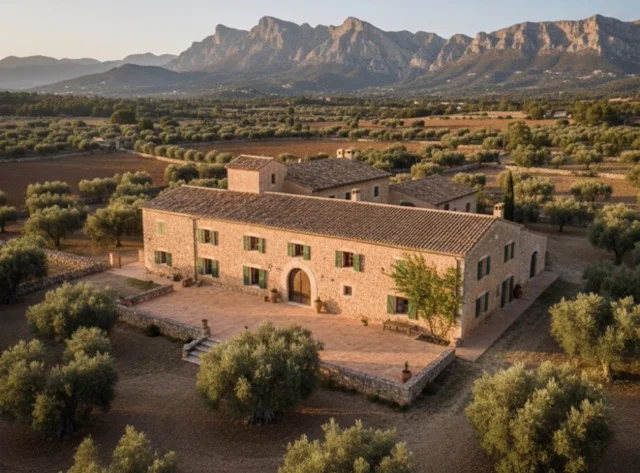
But there’s a different kind of privacy. The kind where your nearest neighbour is a kilometre away. Where 20 hectares of olive groves separate you from the road. Where the only surveillance is the circling eagles above the Tramuntana.
Mallorca’s finca market offers something the Costa del Sol simply cannot: genuine distance. Rural estates of 5 to 115 hectares, UNESCO-protected landscapes, and agricultural land that building regulations ensure will never be developed. For buyers who find gated communities vaguely suburban, Mallorca’s interior delivers an alternative that’s becoming increasingly rare in Mediterranean Europe.
On Spanish income to EUR 600K
Year of arrival + 5 following
Official sources cited
Dividends, gains, rentals abroad
Last updated: 10 June 2026
By: Alexander Thornbury
Contents
- What distinguishes finca privacy from gated community security?
- Where are Mallorca’s prime finca locations?
- What does a €3M+ finca actually include?
- How do building restrictions protect long-term privacy?
- What’s the investment case for rural Mallorca?
- Who buys fincas versus coastal villas?
What distinguishes finca privacy from gated community security?
Gated communities deliver controlled access. Your privacy depends on barriers, guards, and neighbours respecting boundaries. The model works, but you’re still living in proximity to 300+ other households.
Finca living delivers isolation by geography. A Tramuntana estate of 15-50 hectares means no visible neighbours. No shared entrance. No community rules about exterior paint colours or hedge heights. Your boundaries are stone walls that have stood for centuries, not electronic gates installed last decade.
The psychology differs too. Gated communities feel like defended territory. A finca feels like owned landscape. There’s a reason tech founders and family offices increasingly seek the latter.
| Privacy Model | Control Method | Neighbour Proximity | Community Obligations |
| Gated urbanisation | Security guards, CCTV, barriers | 50-200 metres | HOA fees, architectural guidelines |
| Golf resort | Controlled access, landscaping | 100-300 metres | Membership expectations, shared facilities |
| Finca estate | Distance, terrain, land ownership | 500m-2km+ | None (private ownership) |
Where are Mallorca’s prime finca locations?
Three zones dominate the luxury finca market:
Serra de Tramuntana commands the premium. UNESCO World Heritage status since 2011 means building restrictions that preserve exclusivity permanently. Stone fincas here sit among ancient olive terraces with mountain and sea views. Proximity to Deià, Sóller, and Valldemossa adds cultural credibility. Expect €5,000-8,000/m² for renovated properties, with large estates reaching €6-15M.
Central Plain (Es Pla) offers superior value. Towns like Alaró, Santa Maria, and Binissalem sit 20-30 minutes from Palma but feel genuinely rural. Wine country aesthetics, almond orchards, and Tramuntana views at €3,000-5,000/m². Recent appreciation hit 13.5% in some central areas as post-pandemic buyers sought space.
Southeast (Santanyí, Artà) balances countryside tranquility with beach access. Cas Concos and Felanitx deliver finca living within 15-20 minutes of Cala Mondragó and unspoilt coastline. Pricing sits between Tramuntana premiums and central bargains.
| Region | Price/m² (2024-25) | Drive to Palma | Plot Sizes Available | Character |
| Tramuntana | €5,000-8,000 | 25-40 min | 3-115 hectares | UNESCO heritage, mountain drama |
| Central (Es Pla) | €3,000-5,000 | 20-30 min | 2-50 hectares | Wine country, agricultural |
| Southeast | €3,200-5,500 | 35-45 min | 2-20 hectares | Beach proximity, gentle landscape |
What does a €3M+ finca actually include?
At the €3-5M level, expect 300-500m² of living space across main house and guest cottage, on 3-10 hectares of land. Pool, established gardens, and often productive olive or almond groves. Many properties include traditional features like working olive presses, wine cellars, and stone-built outbuildings.
At €5-10M, the offering expands considerably. Properties of 10-30 hectares with multiple guest houses, staff accommodation, equestrian facilities, and agricultural infrastructure capable of producing wine, olive oil, or citrus commercially. Some estates include tourist rental licences for guest cottages, creating income potential.
Above €10M, you’re looking at trophy estates. The 57-hectare Tramuntana property with tennis court, working olive oil factory, and two independent guest houses. The 115-hectare Selva estate with 700m² main house, 200m² guest cottage, private streams, and grazing sheep. Properties that function as private reserves.
Current listings show genuine depth at the €3-7M range, with 4-6 bedroom renovated fincas on 3-15 hectare plots appearing regularly.
How do building restrictions protect long-term privacy?
Mallorca’s rural land classifications create structural scarcity that buyers can rely upon.
Building permits on “rústica” land require minimum plot sizes of 15,000-50,000m² depending on municipality and land classification. In Pollença, some zones require 50,000m² (5 hectares) minimum for any new construction. This isn’t changing. If anything, restrictions are tightening.
The Tramuntana’s UNESCO designation adds another layer. Development is functionally impossible in protected zones. The landscape you buy today will remain unchanged in twenty years.
For privacy-focused buyers, these constraints are features, not bugs. Your sightlines are protected by regulation, not just distance.
What’s the investment case for rural Mallorca?
Tramuntana fincas appreciated 7-10% annually through 2024, outperforming many coastal segments. Central fincas saw even stronger growth, with some areas posting 13.5% gains as demand outstripped limited supply.
The fundamentals support continued appreciation: fixed land supply, tightening building restrictions, growing international demand, and a structural shortage of renovated fincas meeting modern standards.
Rental yields run lower than coastal properties, typically 2-3% gross for luxury fincas. Most buyers aren’t optimising for yield. They’re acquiring lifestyle assets with long-term capital appreciation and the optionality of agrotourism conversion.
| Property Type | 2024 Appreciation | Gross Yield | Total Return Potential |
| Tramuntana finca | 7-10% | 2-3% | 9-13% |
| Central finca | 10-13.5% | 3-4% | 13-17% |
| Son Vida villa | 8-10% | 2-3% | 10-13% |
| Palma apartment | 5-8% | 5-6% | 10-14% |
Who buys fincas versus coastal villas?
The coastal villa buyer wants convenience, beach access, marina proximity, and established social infrastructure. They’re happy with 1,500m² plots and neighbours 100 metres away. The priority is lifestyle amenity, not solitude.
The finca buyer has different priorities. Often second or third property owners who’ve done coastal living elsewhere. Tech entrepreneurs seeking digital detox retreats. Family offices acquiring heritage assets. Creative professionals (writers, artists, designers) who value inspiration over infrastructure.
Nationality patterns differ too. German and Scandinavian buyers dominate the finca market, drawn by landscape and authenticity over nightlife and marinas. British and Gulf buyers skew more coastal.
The common thread: finca buyers actively reject the gated community model. They want land, not compounds. Distance, not barriers. Ownership of landscape, not membership of developments.
Key Takeaways
Mallorca’s finca market serves buyers for whom privacy means genuine isolation rather than controlled access. The Tramuntana’s UNESCO protection and agricultural land regulations create structural scarcity that coastal developments cannot match. For buyers who’ve outgrown gated communities or never wanted them, rural Mallorca offers an increasingly rare Mediterranean proposition: substantial land, protected sightlines, and neighbours you’ll never see.
This is the privacy product Marbella cannot offer. If that’s what you’re seeking, the search starts here.
For exclusive access to Mallorca’s most exceptional luxury properties and comprehensive market insight, contact our specialized advisory team at mallorca@blackprive.com
Related Articles
- Mallorca Luxury Property Market: Complete Investment Guide 2026
- Palma vs Andratx vs Deià: Which Mallorca Location Matches Your Lifestyle?
- Living in Mallorca: Complete Lifestyle Guide for Luxury Property Owners
- Mallorca for Families with Young Children: Why the Quieter Island Wins Before Secondary School
About the Author
Alexander Thornbury analyses European luxury property markets for UHNWI buyers and family offices. With 15 years advising international clients at leading global property consultancies, he specialises in cross-border transactions and heritage property acquisition. He is the author of Quiet Capitals (2026) and contributes market intelligence to Black Privé’s research library.
His analysis is for informational purposes only and does not constitute investment, tax, or legal advice.