
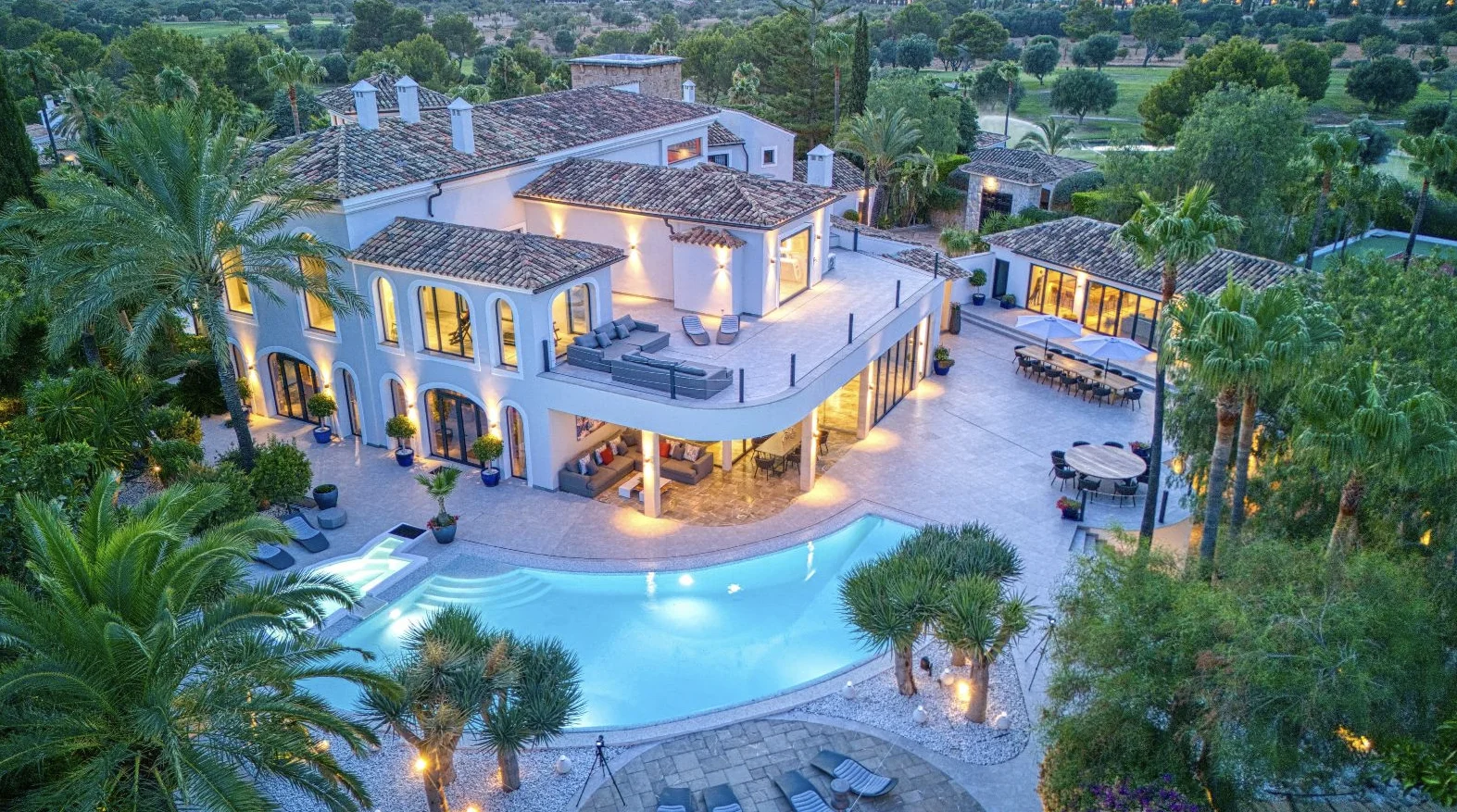
For buyers considering €3M+ property in Mallorca, timing decisions rest on accurate market intelligence rather than speculation. This forecast analyses verified data from the Steinbeis Transfer Institute, Spanish Land Registrars, and Aena airport statistics to project price trajectories through 2026.
The luxury segment delivered strong performance in 2024, crossing €10,900/sqm island-wide for the first time. Southwest coastal areas reached €13,400/sqm whilst Palma urban luxury hit €9,850/sqm. These figures come from the independent Porta Mallorquina/Steinbeis market study, not asking prices.
What follows examines supply constraints, buyer nationality trends, regulatory changes, and location-specific dynamics affecting luxury market performance. Critical developments include Spain’s Golden Visa closure (3 April 2025), the Balearic wealth tax exemption increase, and the tourism rental licence moratorium’s evolution.
On Spanish income to EUR 600K
Year of arrival + 5 following
Official sources cited
Dividends, gains, rentals abroad
Last updated: 10 June 2026
By: Alexander Thornbury
Contents
- What happened in Mallorca’s luxury market through 2024?
- Which factors will drive prices in 2025-2026?
- What price growth should buyers expect by location?
- How will supply constraints affect the luxury segment?
- Which buyer nationalities will dominate 2025-2026?
- What risks could derail the luxury market?
- How will tourism licensing changes affect investment returns?
- What’s the outlook for rental yields?
- Which property types offer the best 2-year prospects?
- Should buyers act now or wait for corrections?
What happened in Mallorca’s luxury market through 2024?
Mallorca’s luxury property segment delivered 11.2% price appreciation in 2024, significantly outpacing mainland Spain’s 6.9% growth according to data from the College of Notaries and property portal Idealista. The Balearic Islands recorded the highest price increases in Spain, with house prices rising 15.2% according to the Notaries data.
The luxury segment (properties €5M+) crossed €10,900/sqm island-wide average for the first time, per the Steinbeis Transfer Institute Centre for Real Estate Studies annual market study. Southwest coastal areas reached €13,400/sqm, and Palma urban luxury hit €9,850/sqm. These are actual transaction records, not aspirational asking prices.
Son Sant Joan airport handled 33.3 million passengers in 2024, a 7% increase from 2023’s 31.1 million, confirming tourism momentum that supports both short-term rental demand and lifestyle migration. International flights grew 7.8% to 24.2 million passengers, with domestic connections up 5% to over 9 million.
Key Regulatory Change:
The Balearic Government raised the regional wealth tax exemption from €700,000 to €3,000,000 per individual, effective for 2024 tax returns. This regional reform (not national) eliminated annual wealth tax liability for properties up to €6M when jointly owned by couples. The national Solidarity Tax on Large Fortunes still applies to assets exceeding €3M.
Foreign buyers accounted for 38% of all property transactions in the Balearic Islands according to Spanish Property Insight data. Germans continue as the leading foreign nationality, with British, Swiss, Scandinavian, and increasingly French buyers making up the balance.
2024 Market Summary
| Metric | 2024 Result | Source | Commentary |
| Luxury Price Appreciation | +11.2% | Idealista/Balearic Properties | Highest in Spain |
| Island-Wide Luxury Average | €10,900/sqm | Porta Mallorquina/Steinbeis | First time above €10k |
| Southwest Luxury | €13,400/sqm | Porta Mallorquina/Steinbeis | +4% year-on-year |
| Palma Urban Luxury | €9,850/sqm | Porta Mallorquina/Steinbeis | +10.5% year-on-year |
| Airport Passengers | 33.3M (+7%) | Aena | Record year |
| Balearic Price Growth | +15.2% | College of Notaries | Highest since 2007 |
| Foreign Buyer Share | 38% | Spanish Property Insight | Slightly up from 37% |
| Average Transaction Value | €411,454 | Spanish Property Insight | +10% year-on-year |
Which factors will drive prices in 2025-2026?
Five structural factors will dominate luxury market dynamics through 2026: supply constraints, demographic shifts, capital reallocation from alternative markets, infrastructure connectivity, and regulatory environment.
Supply constraints continue tightening.
Building regulations restrict development across prime locations. Calvià limits building coverage to 30% of plot area with minimum plot sizes of 1,500-2,000sqm for new villas. Palma’s Old Town faces physical limitations and heritage protection rules. The Serra de Tramuntana’s UNESCO World Heritage designation prevents meaningful new development in villages like Deià and Valldemossa.
The Steinbeis study notes that luxury properties now account for less than 4% of island-wide supply, down from approximately 17% in 2020. This supply-demand imbalance supports continued price appreciation.
Demographic shifts favour Mallorca’s positioning.
Northern European wealthy populations, the primary buyer base, continue aging with peak wealth accumulation in the 50-65 age bracket. Remote work adoption has proven durable, with significant demand from younger technology wealth (35-50) establishing Mallorca as operational base rather than pure holiday retreat.
Capital reallocation from alternative markets.
Swiss wealth faces regulatory pressures on non-domiciled residents. British non-dom regime changes drive wealth restructuring. French inheritance tax exposure motivates asset relocation. German buyers diversify from domestic property markets showing stagnation.
Improved connectivity.
New direct routes including United Airlines from Newark, with expanded connections from Miami and New York planned, open American buyer access. The airport’s 2024 record and continued route expansion signals sustained international demand.
Regulatory environment.
Despite political rhetoric about housing affordability, no restrictions affecting luxury property ownership have been implemented. The tourism licensing moratorium affects rental income potential but not property appreciation.
Price Driver Assessment 2025-2026
| Factor | Impact Direction | Magnitude Estimate | Confidence | Notes |
| Supply Constraints | Upward | Strong | High | Physical and regulatory limitations |
| Demographic Trends | Upward | Moderate | High | Structural, long-term |
| Capital Reallocation | Upward | Moderate | Medium | Depends on origin market policy |
| Remote Work Adoption | Upward | Moderate | Medium | Maturing but durable trend |
| Connectivity Expansion | Upward | Low | High | Airport investment continuing |
| Interest Rates | Mixed | Low | Medium | Cash buyers dominate luxury segment |
| Economic Uncertainty | Potential downward | Moderate | Low | Geopolitical dependent |
| Net Forecast | Upward | 5-8% annually | Medium-High | Conservative estimate |
What price growth should buyers expect by location?
Location-specific dynamics diverge significantly. Palma urban luxury demonstrates strength through functional versatility, whilst Southwest coastal areas maintain pricing power through scarcity.
Palma’s strength rests on serving multiple buyer segments. Properties function as primary residences for remote workers, investment rentals, or urban lifestyle bases. When one buyer segment weakens, others maintain demand. The 2025 data from Reiderstad Invest shows Palma apartments averaging €4,539/sqm and houses €5,277/sqm for the general market.
Santa Catalina and Portixol (waterfront urban neighbourhoods) attract younger wealth (35-50) seeking urban Mediterranean lifestyle. The renovation pipeline adds modest supply (estimated 10-20 units annually) insufficient to overwhelm demand.
Son Vidamaintains strong fundamentals supported by international school demand and limited villa inventory. This remains Mallorca’s most prestigious residential address for family buyers.
Port d’Andratx waterfrontmaintains pricing power through yacht ownership wealth. Current data shows Andratx municipality with apartments averaging €7,411/sqm and houses €8,923/sqm, making it Mallorca’s most expensive area per square metre in 2025.
Deià and Tramuntana villages show steady dynamics reflecting niche market positioning. InMallorcaMagazine reports Deià prices reaching €8,687/sqm at the high end. These locations appeal to culturally-focused buyers who’ve already achieved financial success and prioritise authenticity over amenities.
Pollença represents relative value opportunity. Currently trading at €2,000-€3,000/sqm for general properties, the area offers authentic Mallorcan charm with Tramuntana accessibility at significant discount to Deià.
Location Comparison 2025
| Location | Average Price/sqm | Price Category | Key Buyer Profile | Liquidity |
| Andratx Municipality | €7,411-€8,923 | Premium | Yacht owners, established wealth | Medium |
| Calvià | €6,523-€7,420 | Premium | International families, lifestyle | Good |
| Deià-Tramuntana | €6,000-€8,687+ | Premium | Cultural buyers, artists, privacy | Low |
| Palma (Central) | €4,539-€5,277 | Mid-Premium | Urban professionals, remote workers | Good |
| Sóller | €4,000-€5,500 | Mid-Premium | Tramuntana appeal, railway access | Medium |
| Pollença | €2,000-€3,000 | Mid-Market | Families, north coast appeal | Good |
| Central/Inland | €2,000-€2,500 | Accessible | Local market, budget conscious | Medium |
How will supply constraints affect the luxury segment?
Supply restrictions create structural support for pricing but risk liquidity challenges if demand weakens significantly.
Three constraint mechanisms operate simultaneously. First, municipal planning restrictions limit development to preserve island character. Legislative Decree 9/2020 reduced buildable area on rustic land from 3% to 1.5% of plot size, and maximum volume from 1,500m³ to 900m³.
Second, UNESCO World Heritage designation for the Serra de Tramuntana prevents meaningful new development across significant territory including Deià, Valldemossa, and surrounding villages.
Third, minimum plot sizes (14,000sqm to 50,000sqm depending on classification) for new rural builds limit supply of the finca-style properties most desired by luxury buyers.
The Steinbeis study documents the supply squeeze: luxury properties fell from 17% of listings in 2020 to under 4% in 2024. This reflects absorption by buyers rather than delisting.
Liquidity considerations matter. Properties typically sell within 6-8 months in Palma, 8-10 months in Andratx, and potentially 12+ months in niche markets like Deià. Constrained supply supports pricing when demand is strong but creates potential challenges during market weakness.
The December 2024 Decree 3/2024 introduced an extraordinary procedure for legalising certain constructions on rustic land, valid for three years. This may marginally increase supply but comes with conditions including prohibition on tourist rental use.
Which buyer nationalities will dominate 2025-2026?
German buyerslead the market. Data from the National Institute of Statistics of Spain confirms Germans as the largest foreign buyer group in Mallorca. Their share of foreign transactions has remained dominant for years. German buyer profile typically involves established business owners aged 48-65, cash purchasers with 12-16 week decision timelines.
British buyerscontinue recovering post-Brexit. Fine & Country data for all of Spain in 2024 shows British buyers leading foreign purchases nationally with 8,031 transactions (8.57% of foreign purchases), followed by Germans at 6,230 (6.67%). In Mallorca specifically, British purchasing has adapted to the 90-in-180 day Schengen limit.
Important regulatory change: Spain’s Golden Visa programme ended 3 April 2025. The property investment route (€500,000 minimum) is no longer available for new applications. This eliminates one path to Spanish residency for non-EU buyers. Alternative routes include the Non-Lucrative Visa (requiring €28,800 annual passive income), Digital Nomad Visa, or Standard Residence Permit.
French buyersrepresent a growing segment, driven by domestic inheritance tax exposure and regulatory uncertainty. Geographic proximity and EU mobility make Mallorca accessible.
American buyers benefit from USD strength and improved direct flight connectivity. United Airlines’ Newark route and planned expansion from Miami and New York support this growing segment.
Swiss and Scandinavian buyers remain consistent contributors to the luxury segment, with purchasing power and lifestyle alignment driving steady demand.
Buyer Nationality Overview
| Nationality | Position | Key Characteristics | 2025-2026 Outlook |
| German | Leading | Cash buyers, methodical, cultural affinity | Stable-strong |
| British | Strong #2 | Adapting post-Brexit, remote workers | Recovery continuing |
| Swiss | Significant | Wealth relocation, privacy focused | Stable |
| French | Growing | Tax efficiency, proximity | Increasing |
| American | Emerging | USD strength, new flights | Growing |
| Scandinavian | Consistent | Sun seekers, rental focused | Stable |
What risks could derail the luxury market?
Several risk categories warrant consideration, though probability and impact vary significantly.
Economic recession in Northern Europe represents the most significant risk. German economic weakness particularly matters given German buyer dominance. A recession reducing German GDP materially could cut German luxury property purchases substantially, dragging overall market demand.
Regulatory risks exist but implementation appears unlikely. Spain’s constitution protects property rights. Proposals for non-resident purchase restrictions face legal challenges and EU law conflicts. The proposed 100% tax on non-EU non-resident property purchases has been announced but details remain unconfirmed.
Tourism licensing enforcement has intensified. Fines for unlicensed tourist rentals range from €5,000 to €400,000. The moratorium on new tourist licences began in February 2022 (not 2018 as sometimes reported). While this moratorium has technically been lifted as of 2024, no new “plazas” (guest spaces) can be created. Only existing licensed properties can operate legally.
Climate events pose increasing concern. Forest fires in the Tramuntana mountains could materially impact specific localities. Coastal erosion affects some locations over longer timeframes.
Currency and interest rate movements affect purchasing power for non-Eurozone buyers, though cash purchases dominate the luxury segment, reducing financing sensitivity.
Risk Assessment Summary
| Risk Category | Probability | Impact if Occurs | Mitigation Available |
| Northern European Recession | 25-30% | High | Diversified buyer base provides buffer |
| Regulatory Changes | 10-20% | Medium | Monitor political developments |
| Tourism Licence Enforcement | Ongoing | Medium | Purchase licensed properties only |
| Climate Events | 5-10%/year | Location-specific | Insurance, location selection |
| Currency Movements | Variable | Moderate | Time purchases, hedge exposure |
How will tourism licensing changes affect investment returns?
Tourism licensing represents a binary factor for rental income potential. Licensed properties can legally operate short-term tourist rentals. Unlicensed properties are restricted to long-term letting (minimum one month contracts).
Current regulatory status:
The moratorium on new tourist licences began February 2022 and has since been lifted. However, the total number of tourist rental plazas is capped at approximately 160,000 across the Balearic Islands. No new plazas can be created; only existing ones can be exchanged or reactivated.
Three licence types exist:
- ETV (Estancias Turísticas en Viviendas): For standalone single-family homes, indefinite validity, €3,500 per guest space
- ETVPL: For apartments/multi-family buildings, renewable every 5 years, €875 per guest space, requires community approval
- ETV60: For principal residences with maximum 2 months tourist rental per year, €291.67 per guest space
Premium pricing for licensed properties: Market sources indicate licensed properties trade at approximately 20% premium versus equivalent unlicensed properties. This premium reflects the capitalised value of rental income differential.
Verification is critical. Buyers must confirm licensing status through the municipal registry, not seller representations. Licences specify maximum guest capacity and exact property identification. The Tourism Board’s official portal allows verification of licence status and details.
Properties legalised under the new Decree 3/2024 procedure for rustic land constructions cannot be used for tourist rentals.
Tourism Licence Impact Summary
| Licence Status | Rental Rights | Typical Yield Range | Premium Paid | Income Differential |
| Licensed (ETV) | Short-term tourist | 3-5% gross | +20% approx | Significant |
| Licensed (ETVPL) | Short-term tourist | 3-4% gross | +15% approx | Moderate |
| Unlicensed | Long-term only (1+ month) | 1-2% gross | Baseline | N/A |
What’s the outlook for rental yields?
Rental yields face compression as property prices appreciate faster than rental rates can increase. This mathematical reality affects gross yields even when absolute rental income remains stable or grows.
Yield compression mechanism:
If property appreciates 8% annually but rental rates increase only 3% annually, yield compresses. A property purchased at €3M generating €120,000 annually (4% yield) appreciates to €3.24M by year-end whilst rent grows to €123,600 – yield drops to 3.8%.
Yield compression doesn’t indicate poor investment performance. Total return (appreciation plus rental income) remains attractive: 8% appreciation + 3.8% yield = 11.8% total return. The compression simply reflects capital gains outpacing income returns.
Palma urban rentals benefit from remote worker demand. Properties suitable for 6-12 month professional rentals maintain stronger yield support than pure tourist lets dependent on seasonal patterns.
Operating cost inflation affects net yields more than gross figures suggest. Community fees, utilities, insurance premiums, and property management fees compound faster than rental income growth. Net yields (after operating costs) face greater compression than gross yields.
Long-term rental yields show relative resilience. Growing remote work adoption supports demand for quality furnished rentals in desirable locations. Supply of long-term luxury rentals remains limited as owners prefer short-term letting (where licensed) for flexibility.
Which property types offer the best 2-year prospects?
Licensed fincas with rural settings combine appreciation potential with rental income capability. Limited supply (licensing frozen, few suitable properties meeting both criteria) supports pricing power.
Palma Old Town penthouses in restored buildings benefit from scarcity in a market where supply comes only from renovation projects. Urban professional demand provides income support.
Son Vida family villas suit buyers prioritising international school access and established residential community. Capital appreciation drives returns rather than rental income for this owner-occupied segment.
Port d’Andratx waterfront with marina access maintains appeal for yacht ownership wealth. Demographic considerations (whether next-generation wealth sustains marina culture) warrant monitoring but current demand remains solid.
Pollença and North coast offers relative value for buyers seeking Tramuntana lifestyle at significant discount to Deià prices.
Property Type Comparison
| Property Type | Appreciation Potential | Income Potential | Best Suited For |
| Licensed Rural Finca | Moderate-Strong | Good (if licensed) | Income + appreciation investors |
| Palma Old Town Penthouse | Strong | Good | Urban lifestyle, remote workers |
| Son Vida Family Villa | Strong | Low (owner-occupied) | Primary residence, families |
| Port d’Andratx Waterfront | Moderate-Strong | Moderate | Yacht owners, lifestyle |
| Pollença/North | Moderate | Moderate | Value seekers, authenticity |
| Standard Inland Villa | Moderate | Low-Moderate | Basic appreciation, local use |
Should buyers act now or wait for corrections?
Market timing decisions require analysing correction probability, opportunity cost of waiting, and transaction costs.
Correction probability appears moderate. Supply constraints, diverse buyer base, and structural demand from remote work adoption provide downside protection. A material correction (10-15%) would likely require either European recession or significant regulatory changes.
Opportunity cost of waiting. Property appreciating at 5-8% annually whilst generating rental income means waiting costs money. Waiting 18 months “hoping” for a 10% correction costs similar or greater foregone returns.
Transaction costs favour longer holds. Spanish property transactions cost 11-14% in transfer taxes and fees. These costs amortise over holding period, favouring buyers with 5+ year horizons.
Strategic approach: Define clear purchase criteria (location, property type, price range, licensing status) and proceed when properties meeting criteria appear. Don’t chase appreciation by compromising on unsuitable properties. Don’t wait indefinitely for corrections that may not materialise.
Residency planning matters. With Spain’s Golden Visa programme closed (3 April 2025), non-EU buyers seeking Spanish residency must pursue alternative routes. The Non-Lucrative Visa requires demonstrating €28,800 annual passive income. The Digital Nomad Visa suits remote workers. These routes are independent of property purchase, unlike the former Golden Visa.
Market conditions favouring action:
- Specific property identified meeting requirements
- Property holds valid tourism licence (if rental income matters)
- Location demonstrates strong fundamentals
- Pricing aligns with recent comparable sales
- Personal timeline supports purchase
Market conditions suggesting patience:
- No specific property identified
- Pricing appears elevated versus comparables
- Major renovation required (construction costs rising)
- Personal circumstances uncertain
Frequently Asked Questions
What was the average price per square metre for luxury property in Mallorca in 2024?
The island-wide average for luxury properties reached €10,900/sqm in 2024 according to the Steinbeis Transfer Institute study, marking the first time the luxury segment exceeded €10,000/sqm. Southwest coastal areas reached €13,400/sqm whilst Palma urban luxury hit €9,850/sqm.
Can non-EU citizens still get residency by buying property in Spain?
No. Spain’s Golden Visa programme, which granted residency for €500,000+ property investments, ended on 3 April 2025. Non-EU buyers seeking Spanish residency must now pursue alternatives such as the Non-Lucrative Visa (requiring €28,800 annual passive income), Digital Nomad Visa, or standard residence permit routes.
What is the current status of tourist rental licences in Mallorca?
The moratorium on new tourist licences began February 2022 and has been lifted, but no new “plazas” (guest spaces) can be created. The total is capped at approximately 160,000 across the Balearic Islands. Only properties with existing licences can legally operate short-term tourist rentals. Fines for unlicensed rentals range from €5,000 to €400,000.
How much premium do licensed properties command?
Market sources indicate licensed properties trade at approximately 20% premium versus equivalent unlicensed properties, reflecting the capitalised value of rental income differential.
What changed with wealth tax in the Balearic Islands?
The Balearic Government raised the regional wealth tax exemption from €700,000 to €3,000,000 per individual, effective for 2024 tax returns. This is a regional (not national) reform. The national Solidarity Tax on Large Fortunes still applies to assets exceeding €3M.
Which nationality dominates foreign property purchases in Mallorca?
Germans lead foreign property purchases in Mallorca, with British, Swiss, French, Scandinavian, and increasingly American buyers making up significant portions of the remaining foreign demand.
What were the 2024 airport passenger numbers for Mallorca?
Son Sant Joan airport handled 33.3 million passengers in 2024, a 7% increase from 2023’s 31.1 million, according to Aena data. This was a record year, with international flights growing 7.8% to 24.2 million passengers.
Key Takeaways
Mallorca’s luxury property market enters 2025-2026 with strong fundamentals. The 11.2% appreciation in 2024 reflects genuine supply constraints and sustained international demand rather than speculative excess.
Critical regulatory changes affect buyer planning. The Golden Visa closure (3 April 2025) eliminates the property investment route to Spanish residency. The Balearic wealth tax exemption increase to €3M per individual (regional, not national) removes a friction point for many luxury buyers.
Supply constraints appear structural rather than temporary. Building regulations, UNESCO protections, and minimum plot sizes limit new luxury supply. The Steinbeis data showing luxury properties falling from 17% to under 4% of listings since 2020 indicates absorption rather than reduced interest.
Tourism licensing verification is non-negotiable for rental-focused buyers. Only properties with existing licences can legally operate short-term tourist rentals. Penalties for non-compliance are substantial.
Location selection drives outcome differentiation. Palma urban luxury offers liquidity and versatility. Southwest coastal commands premium pricing. Tramuntana villages provide authenticity with liquidity constraints. Pollença offers relative value with appreciation potential.
Conservative forecast: 5-8% annual appreciation for quality locations through 2026, with rental yields compressing as property values outpace rental growth.
Note: Forecasts based on 2024 market data, demographic trends, economic indicators, and regulatory environment as of December 2025. Individual circumstances vary. Property investment involves risk. Historical performance does not guarantee future results.
Readers should conduct independent analysis and obtain professional advice specific to their situation.
For exclusive access to Mallorca’s most exceptional luxury properties and comprehensive market insight, contact our specialized advisory team at mallorca@blackprive.com
Related Articles
- Mallorca Luxury Property Market: Complete Investment Guide 2026
- Palma vs Andratx vs Deià: Which Mallorca Location Matches Your Lifestyle?
- Mallorca Property Taxes for Non-Residents: Complete Guide 2025-2026
- Brexit Impact on British Buyers: Mallorca Property Guide
Author Bio
Alexander Thornbury specialises in Mediterranean luxury property markets and cross-border investment structuring for UHNWI clients. With 15 years advising on European real estate transactions exceeding €500 million in aggregate value, Alexander provides institutional-grade analysis of legal processes, due diligence requirements, and transaction risk mitigation strategies. His expertise in Spanish property law and Balearic market customs helps international buyers navigate complex legal frameworks protecting seven-figure investments. He is the author of Quiet Capitals (2026) and contributes market intelligence to Black Privé’s research library.
His analysis is for informational purposes only and does not constitute legal, tax, or investment advice.
References and Sources
- Market Data & Statistics: Luxury price data (€10,900/sqm island-wide, €13,400/sqm Southwest, €9,850/sqm Palma) verified through Mallorca Daily Bulletin. Airport data from Aena (33.3M passengers 2024, +7%). Price appreciation verified through Idealista, (11.2% YoY), and Spanish Property Insight. Foreign buyer share (38% of Balearic transactions) from Spanish Property Insight H1 2024 analysis.
- Regulatory & Tax Changes: Golden Visa closure (3 April 2025) verified through Global Citizen Solutions and Get Golden Visa. Balearic wealth tax reform (€700,000 to €3,000,000 exemption effective 2024) verified through Blevins Franks and Tax Foundation 2024 Spanish Regional Tax Competitiveness Index.
- Tourism Licensing: ETV licence moratorium (began February 2022, lifted but no new plazas) and fine ranges verified through Private Property Mallorca, and Check-in Scan. Plaza cap approximately 160,000 from Reiderstad Invest 2024/2025 status update.
- Location-Specific Pricing: Municipal pricing data from Yes! Mallorca Property, InMallorcaMagazine (Deià €8,687/sqm), Reiderstad Invest (Andratx €7,411-€8,923/sqm, Calvià €6,523-€7,420/sqm), and Sandberg Estates location analysis.
Methodology Note All statistics verified against primary sources where available. Conservative estimates used when ranges provided. Price data primarily from independent annual market study. Regulatory information from legal practitioners and government sources.