
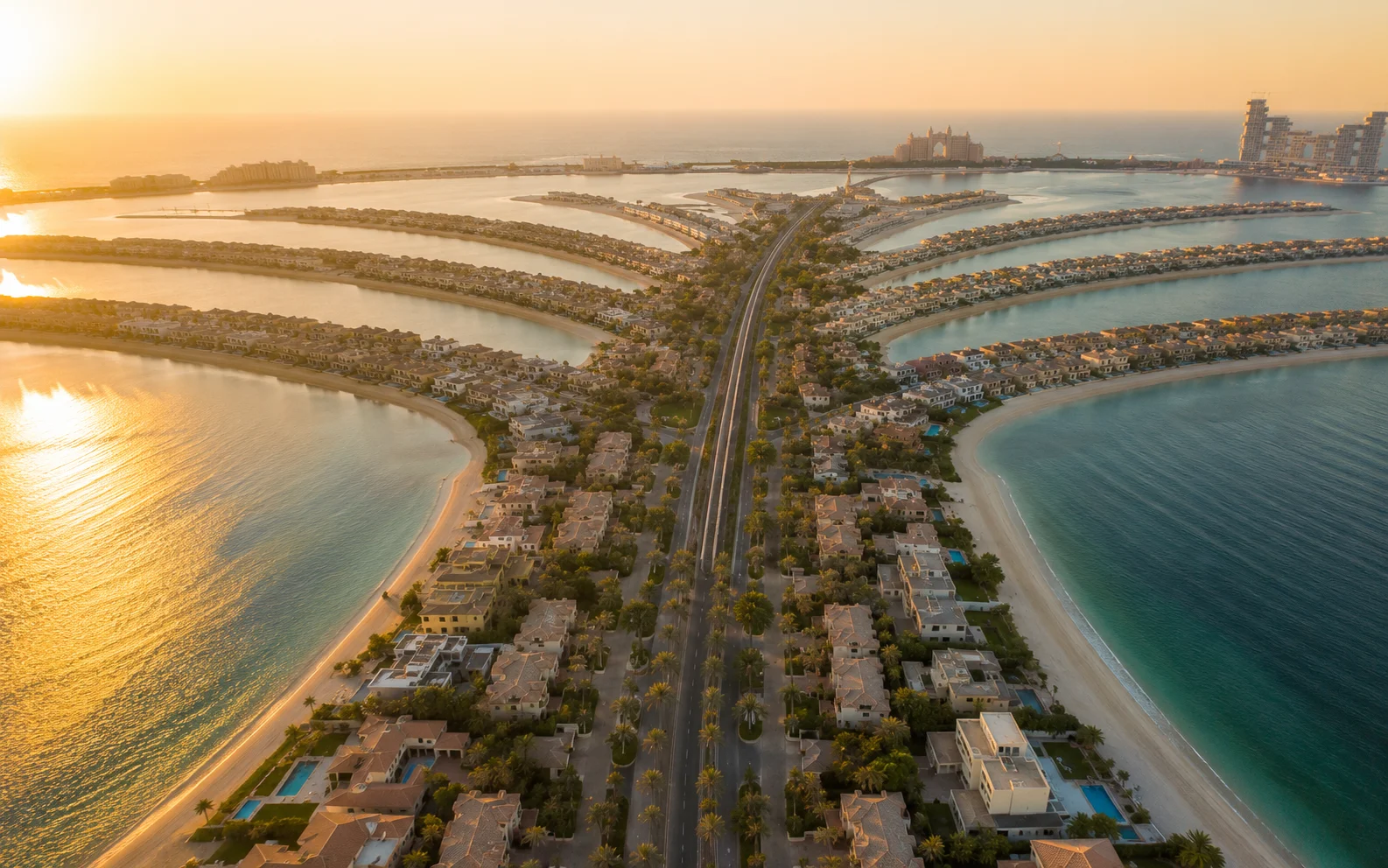
Palm Jumeirah is Dubai’s waterfront trophy address and one of the few prime communities named in the 2006 law that made foreign freehold possible, so its ownership footing is as solid as it gets. It is bought for recognition, water frontage and branded-residence living, not for yield. This guide sets out what the Palm is, why its freehold status is unusually secure, and the two ongoing costs a buyer there must weigh.
Named in the 2006 law
Trophy asset
Residence living
Material on the Palm
Last updated: July 2026
By: Alexander Thornbury
What is Palm Jumeirah?
Palm Jumeirah is the man-made palm-shaped island off Dubai’s coast, and it is the city’s best-known prime residential address. It is a waterfront trophy market: signature villas along the fronds, and branded residences on the trunk and crescent. Buyers come for the water frontage, the recognition and the resort-grade amenities, and it is the address most international buyers picture when they think of prime Dubai.
It is a distinct segment from the city’s business-district apartments or its gated golf enclaves. The Palm is about the sea and the name. For how it sits within the wider market, see our international buyer’s guide to Dubai property.
Why its freehold footing is secure
Palm Jumeirah is one of the prime communities named by name in Regulation No. 3 of 2006, the instrument that first allowed non-UAE nationals to own freehold in designated areas. That matters because many fashionable Dubai addresses were only designated freehold by later decrees, and their footing rests on the Land Department’s current map rather than the founding law. The Palm is in the founding text itself.
For a buyer who wants the most secure ownership basis, that is a genuine point in the Palm’s favour. It does not remove the standard due diligence, you still read the title deed, but it means the community’s freehold status is not a matter of interpreting a later designation. Our guide to Dubai’s freehold zones sets out which communities sit where on that spectrum.
| Palm Jumeirah | Detail |
|---|---|
| Freehold basis | Named in Regulation 3/2006 (the founding law) |
| Product | Frond villas; trunk and crescent branded residences |
| Bought for | Water frontage, recognition, resort amenities |
What you actually buy there
The Palm splits into two broad products. The fronds carry the signature villas, private beach-facing homes that are the trophy end of the market. The trunk and the crescent carry apartments and branded residences, including hotel-branded stock with serviced amenities. A buyer’s choice between them is really a choice between a private villa and a managed, amenity-led residence, and the two behave differently as assets and as homes.
Because the Palm is a mature, recognised market, liquidity at the top is reasonable by prime standards, but it is a market to buy into for the lifestyle and the address rather than for yield. Specific pricing moves and varies sharply by position and product, so treat any single per-square-foot figure as indicative and confirm current values for the specific home at purchase.
The two ongoing costs to weigh
Two recurring costs matter more on the Palm than almost anywhere. The first is the service charge. Branded and waterfront buildings on the Palm carry some of the higher service charges in the city, and because charges are set per building, the only reliable figure comes from the Dubai Land Department Service Charge Index for the specific tower or villa. On a large home this is a material annual cost, covered in our service charges guide.
The second is the municipality housing fee, 5% of the property’s assessed annual rental value, billed monthly through the utility account and payable by expatriate owners. Neither is a tax on the purchase, but together they make the true annual cost of holding a prime Palm home higher than the headline “no property tax” implies. Budget both from the outset.
| Ongoing cost on the Palm | What to know |
|---|---|
| Service charge | Among the higher in the city; check the DLD index per building |
| Municipality housing fee | 5% of assessed rental value, via the utility bill, expatriates |
Who the Palm suits
Palm Jumeirah suits the buyer who wants the recognised trophy address, water frontage and resort living, and who values the security of a freehold community named in the founding law. It is less suited to a buyer chasing yield or seeking a quiet, land-led estate, for whom a gated golf community elsewhere may fit better. The Palm is a lifestyle and status purchase first.
For an international UHNWI establishing a base in Dubai, the Palm remains the default prime address, and its combination of secure ownership footing and global recognition is why. Weigh the ongoing charges honestly against that, and the decision comes down to whether the water and the name are what you are buying.
Key takeaways
- Palm Jumeirah is Dubai’s waterfront trophy address, bought for water frontage, recognition and resort living.
- It is named in Regulation 3/2006, the founding freehold law, so its ownership footing is unusually secure.
- The product splits into frond villas and trunk/crescent branded residences, which behave differently as homes and assets.
- Service charges are among the city’s higher; check the DLD index for the specific building.
- Budget the 5% municipality housing fee too, so the true annual holding cost is clear.
Frequently asked questions
Can foreigners buy freehold on Palm Jumeirah?
Yes. Palm Jumeirah is named in Regulation No. 3 of 2006, the founding law allowing non-UAE nationals to own freehold in designated areas, so its ownership footing is among the most secure in Dubai.
What kind of property is on Palm Jumeirah?
Signature villas along the fronds, and apartments and branded residences on the trunk and crescent, including hotel-branded stock. The choice is broadly between a private villa and a managed, amenity-led residence.
Is Palm Jumeirah a good investment?
It is a lifestyle and status purchase first, bought for the water frontage and the address rather than yield. Liquidity at the top is reasonable by prime standards. Confirm current values for a specific home at purchase, as pricing varies sharply by position.
Are service charges high on Palm Jumeirah?
Branded and waterfront buildings carry some of the higher service charges in the city. Because charges are set per building, check the Dubai Land Department Service Charge Index for the specific tower or villa rather than relying on a range.
What annual costs come with a Palm Jumeirah home?
The building’s service charge and the 5% municipality housing fee on assessed rental value, billed through the utility account for expatriate owners, plus insurance. Together they make the true annual holding cost higher than the headline suggests.
Who is Palm Jumeirah best for?
A buyer who wants the recognised trophy address, water frontage and resort living, with the security of a freehold community named in the founding law. It suits status and lifestyle over yield or a quiet land-led estate.
Do I need a lawyer to buy on Palm Jumeirah?
There is no mandatory lawyer and no notary in a Dubai transaction, and the Form F is the binding sale contract, not a preliminary heads of terms. A European buyer’s assumption that a notary will catch problems does not apply here, so appointing your own independent counsel before signing is sensible even on a straightforward purchase.
How long does a Palm Jumeirah purchase take?
A cash resale typically completes in about 30 days, transferring at a Dubai Land Department trustee centre once the seller’s no-objection certificate is issued. An off-plan purchase instead follows the developer’s payment plan through to handover, so the timeline depends on the construction schedule rather than a fixed completion date.
Does a Palm Jumeirah home qualify me for a Golden Visa?
Yes, comfortably. A property worth AED 2 million or more qualifies its owner for a 10-year renewable Golden Visa, and Palm homes sit well above that threshold. It is important to be precise that this is residency, not citizenship; no property purchase leads to an Emirati passport.
Sources
- Dubai Legislation portal – Regulation No. 3 of 2006 (Palm Jumeirah named)
- Dubai Land Department – designated areas map, Service Charge Index
Figures current at July 2026. Freehold status, service charges and pricing for a specific property should be confirmed with the Dubai Land Department and a UAE-qualified lawyer before purchase.

About the author
Alexander Thornbury is a published author who writes on international property, tax and residency for high-net-worth buyers across Europe, the Gulf and North America. His work focuses on the practical mechanics of cross-border purchase: what a buyer actually pays, owes and signs. More at alexanderthornbury.com.