
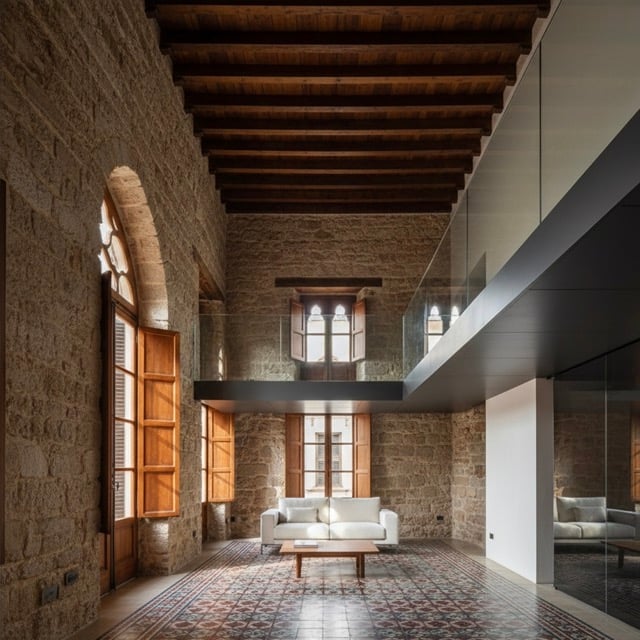
Barcelona’s designation as the 2026 UNESCO-UIA World Capital of Architecture has intensified global attention on the city’s extraordinary built heritage. From the sinuous facades of Eixample’s Modernista masterpieces to the medieval stone palaces of the Gothic Quarter, historic properties represent some of Europe’s most distinctive residential investments. For buyers seeking architectural significance alongside capital appreciation, Barcelona’s heritage market offers opportunities unavailable elsewhere on the continent.
This guide examines the practical realities of acquiring protected historic properties in Barcelona, from understanding the four-tier protection system to navigating renovation constraints and calculating realistic restoration budgets.
Contents
- What makes Barcelona’s architectural heritage unique?
- How do Modernista and Gothic properties compare?
- What are Barcelona’s heritage protection categories?
- What can you change in a protected building?
- How much does historic property restoration cost?
- Which areas offer the best heritage opportunities?
- How does 2026 World Capital of Architecture affect values?
- What should buyers know about heritage architects?
- What practical considerations affect heritage purchases?
- How should buyers approach heritage acquisition?
What makes Barcelona’s architectural heritage unique?
Barcelona possesses Europe’s largest concentration of Art Nouveau architecture, locally termed Modernisme, alongside one of the continent’s most intact medieval urban cores. The city’s heritage credentials include nine UNESCO World Heritage Sites, all works by Antoni Gaudí, and thousands of protected buildings spanning eight centuries.
The Eixample district alone contains over 150 notable Modernista buildings constructed between 1880 and 1930, designed by architects including Gaudí, Lluís Domènech i Montaner, and Josep Puig i Cadafalch. Meanwhile, the Ciutat Vella (Old Town) preserves Roman walls, medieval palaces, and Gothic ecclesiastical architecture within a remarkably coherent urban fabric.
Architectural periods and their characteristics
| Period | Era | Key Features | Typical Locations |
| Roman | 1st-4th century | Stone walls, foundations visible | Plaça del Rei, Gothic Quarter |
| Medieval Gothic | 13th-15th century | Stone arches, vaulted ceilings, narrow windows | Gothic Quarter, El Born |
| Renaissance/Baroque | 16th-18th century | Symmetrical facades, ornate plasterwork | Ciutat Vella, La Ribera |
| Modernisme | 1880-1930 | Organic forms, hydraulic tiles, ironwork | Eixample, Gràcia |
| Noucentisme | 1910-1930 | Classical restraint, Mediterranean influences | Sarrià, Pedralbes |
The rarity of these properties creates sustained demand. Unlike cities where historic buildings were demolished for post-war reconstruction, Barcelona’s Old Town survived largely intact, and the Eixample’s protected status prevents the wholesale alterations seen elsewhere.
How do Modernista and Gothic properties compare?
Buyers entering Barcelona’s heritage market typically choose between two distinct propositions: Eixample Modernista apartments with their celebrated decorative elements, or Gothic Quarter conversions offering medieval drama and central locations.
Modernista vs Gothic Quarter property comparison
| Factor | Eixample Modernista | Gothic Quarter |
| Price range (€/sqm) | €5,500-15,000+ | €5,000-8,500 |
| Typical property size | 150-400 sqm | 80-250 sqm |
| Ceiling height | 3.5-5.0 metres | 3.0-6.0+ metres (varies) |
| Natural light | Good (Cerdà grid design) | Variable (narrow streets) |
| Lift availability | Common in larger buildings | Rare in historic palaces |
| Parking | Limited street/nearby | Almost impossible |
| Noise levels | Moderate | Higher (tourist activity) |
| Rental restrictions | HUT phase-out applies | HUT phase-out applies |
| Buyer profile | Design collectors, families | Pied-à-terre, collectors |
Modernista properties: The Eixample proposition
Beyond the ultra-prime Quadrat d’Or, where prices reach €15,000/sqm or higher, the wider Eixample offers Modernista apartments at more accessible levels. Average prices in Eixample sit at approximately €5,737/sqm, with luxury rehabilitated units commanding €7,000-9,000/sqm.
Key features attracting buyers include original hydraulic floor tiles (often designed by architects as integral artworks), Catalan vaulted ceilings, ornate plasterwork, restored wooden joinery, and the distinctive wrought-iron balconies that define the district’s streetscape.
For detailed analysis of the Quadrat d’Or’s flagship Modernista addresses, see our Passeig de Gràcia and Quadrat d’Or guide.
Gothic Quarter properties: Medieval character
The Gothic Quarter offers a fundamentally different proposition: medieval and Renaissance palace conversions where exposed stone walls, original wooden beams, and centuries-old architectural bones create dramatic living spaces.
Prime Gothic Quarter addresses currently trade at €6,000-8,500/sqm for quality conversions, with unrenovated properties available from €4,500/sqm. The neighbourhood’s intensity suits buyers seeking characterful pied-à-terre rather than primary family residences, though exceptions exist in quieter pockets near Plaça Sant Felip Neri.
What are Barcelona’s heritage protection categories?
Understanding Barcelona’s protection framework is essential before any heritage purchase. Catalan Law 9/1993 on Cultural Heritage, combined with Barcelona’s Special Plans for Architectural Heritage Protection, establishes four protection levels with distinct implications for owners.
Heritage protection categories explained
| Level | Catalan Name | Designated By | Demolition | Key Restrictions |
| A (BCIN) | Bé Cultural d’Interès Nacional | Generalitat (Regional) | Prohibited | Full protection: facade, structure, interiors |
| B (BCIL) | Bé Cultural d’Interès Local | Ajuntament (Municipal) | Prohibited | Facade and structure protected; some interior flexibility |
| C | Bé d’Interès Urbanístic | Ajuntament (Municipal) | Prohibited | Urban interest protection; more renovation scope |
| D | Bé d’Interès Documental | Ajuntament (Municipal) | Permitted after study | Documentary recording required before alteration |
For properties at Levels A, B, and C, demolition is prohibited, and any significant works require heritage approval. Level D properties may be demolished, but only after completing an approved historical and architectural study documenting the building’s significance.
How protection affects your purchase
Over 60% of pre-1950 buildings in central Barcelona carry some form of protection designation. Before acquiring any historic property, buyers should verify protection status through the Barcelona City Council’s heritage catalogue and obtain written guidance on permissible interventions.
A building’s BCIL or BCIN status does not prevent interior modernisation, but it does require working within defined parameters. Facade alterations are typically prohibited, while interior works may proceed subject to heritage approval and the retention of specified original elements.
What can you change in a protected building?
The practical implications of heritage protection depend on both the protection level and the specific elements identified for preservation in the building’s catalogue entry.
Typical permissions and restrictions
| Element | BCIN (Level A) | BCIL (Level B) | Level C | Level D |
| Exterior facade | No changes | No changes | Limited changes | Changes with approval |
| Windows/balconies | Like-for-like only | Like-for-like only | Some flexibility | More flexibility |
| Roof profile | Protected | Protected | Often protected | Case-by-case |
| Interior walls | Case-by-case | More flexibility | Considerable flexibility | Full flexibility |
| Original features | Must retain | Should retain | Balance required | Document before change |
| Modern services | Hidden installation | Hidden installation | Standard installation | Standard installation |
| Energy upgrades | Limited options | More options | Good options | Full options |
What typically must be preserved
In BCIL and BCIN buildings, the following elements commonly require retention or like-for-like replacement: original hydraulic floor tiles, Catalan vaulted ceilings (volta catalana), ornate plasterwork and ceiling roses, wooden beam ceilings, original joinery profiles, decorative ironwork, and stained glass where present.
What can typically be modernised
Interior reconfiguration is often possible, subject to retaining structural walls and specified features. Modern kitchens and bathrooms can be installed, heating and air conditioning added (with concealed routing), electrical systems upgraded, and accessibility improvements made where they do not compromise protected elements.
How much does historic property restoration cost?
Historic property restoration in Barcelona involves substantially higher costs than standard residential renovation, reflecting specialist skills, heritage-compliant materials, and extended timelines.
Renovation cost estimates by scope
| Scope | Cost (€/sqm) | Timeline | Description |
| Light refresh | €800-1,200 | 3-6 months | Cosmetic updates, systems upgrade, no structural work |
| Moderate restoration | €1,500-2,200 | 6-12 months | Partial reconfiguration, some feature restoration |
| Comprehensive restoration | €2,200-3,000 | 12-24 months | Full systems, significant feature work, structural repairs |
| Museum-quality restoration | €3,000-5,000+ | 18-36 months | Complete restoration to original specifications |
Cost factors specific to heritage properties
Several factors inflate heritage renovation costs beyond standard works. Hydraulic tile restoration or reproduction runs €150-400/sqm. Plasterwork restoration requires specialist craftspeople at €80-150/hour. Original joinery repair or reproduction costs €500-2,000 per window or door. Heritage-compliant ironwork restoration adds €100-300/linear metre for balconies.
Worked example: 200sqm Gothic Quarter apartment
| Cost Element | Estimate |
| Purchase price (200sqm at €6,500/sqm) | €1,300,000 |
| Comprehensive restoration (€2,500/sqm) | €500,000 |
| Architect and heritage fees (12%) | €60,000 |
| Contingency (15%) | €75,000 |
| Total investment | €1,935,000 |
| Effective price per sqm | €9,675 |
This effective cost positions a restored Gothic Quarter property competitively against ready-to-occupy Eixample alternatives at similar per-square-metre pricing.
Which areas offer the best heritage opportunities?
Barcelona’s historic property market extends beyond the flagship Quadrat d’Or and Gothic Quarter core into several emerging areas offering value and authenticity.
Heritage area comparison
| Area | Price Range (€/sqm) | Property Types | Advantages | Considerations |
| Quadrat d’Or | €9,000-20,000+ | Principal floors, penthouses | Flagship Modernista | Ultra-prime pricing |
| Eixample Dreta | €5,500-9,000 | Apartments, duplexes | Good Modernista stock | Variable building quality |
| Eixample Esquerra | €4,800-7,500 | Apartments | Value Modernista | Less prestigious addresses |
| Gothic Quarter prime | €6,000-8,500 | Palace conversions | Medieval character | Tourist density, noise |
| El Born | €5,500-7,500 | Conversions, lofts | Emerging, vibrant | Gentrifying, competitive |
| La Ribera | €5,000-7,000 | Historic conversions | Authentic, less touristic | Infrastructure challenges |
| Gràcia | €4,500-6,500 | Townhouses, apartments | Village character | Smaller properties |
El Born: The emerging heritage market
El Born has undergone significant transformation since the 2013 opening of the Born Cultural Centre, which revealed extensive 18th-century archaeological remains beneath the old market. The neighbourhood now attracts buyers seeking historic character without Gothic Quarter tourist intensity.
Quality conversions in El Born trade at €5,500-7,500/sqm, with original features including stone walls, wooden beams, and period ironwork. The area benefits from proximity to Ciutadella Park and Barceloneta beach while maintaining walkable access to the city centre.
Compare El Born with contemporary waterfront alternatives in our Diagonal Mar and Poblenou guide.
How does 2026 World Capital of Architecture affect values?
Barcelona’s designation as the 2026 UNESCO-UIA World Capital of Architecture creates a once-in-a-generation marketing opportunity for the city’s built heritage. The year-long programme, running from February to December 2026, coincides with two additional architectural milestones.
2026 architectural events
The UIA World Congress of Architects in June-July 2026 will bring over 10,000 architecture professionals to Barcelona, the first city to host the Congress twice (previously 1996). This represents Barcelona’s largest professional gathering since the 1992 Olympics.
Simultaneously, the Sagrada Familia’s Tower of Jesus is expected to reach completion in 2026, coinciding with the centenary of Gaudí’s death. Upon completion, the basilica will become the world’s tallest church, generating renewed global media attention.
Market implications
The convergence of these events is expected to elevate international awareness of Barcelona’s architectural heritage and stimulate demand from design-conscious buyers. Properties with notable architectural pedigree, particularly those attributed to recognised architects or featuring exceptional original elements, may benefit from enhanced visibility and liquidity.
However, buyers should distinguish between genuine heritage value and marketing hyperbole. Not every old building warrants a premium, and 2026 momentum will favour properties with substantive architectural credentials over generic period stock.
What should buyers know about heritage architects?
Successful heritage restoration requires specialist expertise. Standard residential architects may lack experience navigating Barcelona’s heritage approval processes or the technical knowledge for historic building conservation.
Selecting a heritage architect
| Criterion | What to Look For |
| Heritage experience | Portfolio of BCIL/BCIN projects in Barcelona |
| Technical expertise | Understanding of traditional construction methods |
| Regulatory knowledge | Track record with heritage approval processes |
| Craftsperson network | Relationships with specialist conservators |
| Project management | Experience coordinating heritage timelines |
| Cost control | Realistic budgeting for heritage contingencies |
Architect fee structures
Heritage architects typically charge 10-15% of construction costs, reflecting the additional complexity of heritage projects. For comprehensive restorations, expect architect and heritage consultant fees to represent 12-15% of the total restoration budget.
Heritage premium by architect attribution
Properties with documented attribution to notable architects command significant premiums. Buildings by Gaudí’s contemporaries such as Josep Vilaseca, Enric Sagnier, or Joan Rubió i Bellver attract design-conscious buyers willing to pay for architectural provenance.
| Architect Attribution | Typical Premium |
| Antoni Gaudí | +50-100%+ (extremely rare residential) |
| Lluís Domènech i Montaner | +30-50% |
| Josep Puig i Cadafalch | +25-40% |
| Other notable Modernistes | +15-25% |
| Unknown/undocumented | Standard pricing |
What practical considerations affect heritage purchases?
Beyond architectural appreciation, heritage property acquisition involves practical complexities that standard residential purchases do not.
How long does heritage approval take?
Heritage approval timelines vary by protection level and intervention scope. Minor works in BCIL buildings may receive approval within 2-3 months. Substantial interventions in BCIN properties can require 6-12 months for full heritage committee review. Building realistic approval timelines into project planning is essential.
Can you install modern services in protected buildings?
Air conditioning installation is possible but restricted. External units visible from public space are typically prohibited on protected facades. Split systems with concealed external placement (courtyards, rooftops) are generally acceptable. Ducted systems requiring false ceilings may conflict with protected ceiling features.
What are the consequences of unauthorised works?
Unauthorised works on protected buildings trigger enforcement action including mandatory reinstatement of original features at owner expense, administrative fines, and potential criminal liability for serious heritage damage. The risk far outweighs any perceived savings from avoiding proper approvals.
How does insurance differ for heritage properties?
Specialist heritage building insurance typically costs 15-30% more than standard residential policies. Cover should include reinstatement to original specification using heritage materials and techniques, which significantly exceeds standard rebuilding costs.
Are restoration grants available?
Limited public funding exists for buildings of exceptional significance, but most private residential restorations receive no public subsidy. Tax incentives for heritage restoration in Spain are less generous than in countries like France or the UK.
Tourist rental restrictions apply equally to heritage properties. The 2028 HUT phase-out makes no distinction for architectural significance. For detailed rental regulation analysis, see our Barcelona rental regulations and investment strategy guide.
How should buyers approach heritage acquisition?
The decision between unrenovated and restored properties depends on risk tolerance, timeline, and local presence. Unrenovated properties offer potential value creation but require significant project management expertise. Ready-restored properties cost more but eliminate execution risk.
For buyers without Barcelona presence and heritage renovation experience, acquiring restored properties is generally advisable. The complexity of coordinating heritage approvals, specialist contractors, and extended timelines from abroad creates substantial execution risk.
Verifying protection status
Barcelona City Council maintains the Catàleg del Patrimoni Arquitectònic, accessible through the municipal website. Your lawyer should obtain formal written confirmation of protection status and specific restrictions before any purchase commitment. Never rely on seller representations alone.
Achieving modern energy efficiency
With careful design, heritage buildings can approach contemporary energy standards while respecting protected elements. Secondary glazing, underfloor heating compatible with original floors, roof insulation, and efficient mechanical systems can substantially improve performance without compromising heritage value.
Key Takeaways
Barcelona’s heritage property market offers exceptional architectural quality at prices below comparable historic districts in Paris, London, or Milan. The 2026 World Capital of Architecture designation will amplify global attention on the city’s Modernista and Gothic heritage.
However, heritage acquisition requires specialist knowledge. Understanding protection categories, renovation restrictions, and realistic restoration costs is essential before committing. Budget 15-25% contingency on all heritage projects, extend timelines by 50% beyond standard residential works, and engage architects with proven Barcelona heritage experience.
For buyers with patience and appropriate expectations, heritage properties deliver cultural significance alongside financial returns. For those seeking simpler acquisition, Barcelona’s contemporary luxury market offers alternatives without heritage complexity.
For exclusive access to Barcelona’s most exceptional luxury properties and comprehensive market insight, contact our specialized advisory team at barcelona@blackprive.com
Author Bio
Alexander Thornbury MRICS analyses European luxury property markets for UHNWI buyers and family offices. With 15 years advising clients at leading international property consultancies, he specialises in cross-border transactions and tax-efficient property structuring. Alexander holds MRICS accreditation and contributes market intelligence to Black Privé’s research library.
His analysis is for informational purposes only and does not constitute investment advice.
Related Articles
- Quadrat d’Or and Passeig de Gràcia: Barcelona’s Golden Square
- Diagonal Mar and Poblenou: Tech Wealth Meets Mediterranean
- Barcelona Property Taxes for International Buyers
- Pedralbes vs Sarrià vs Eixample: Neighbourhood Comparison