
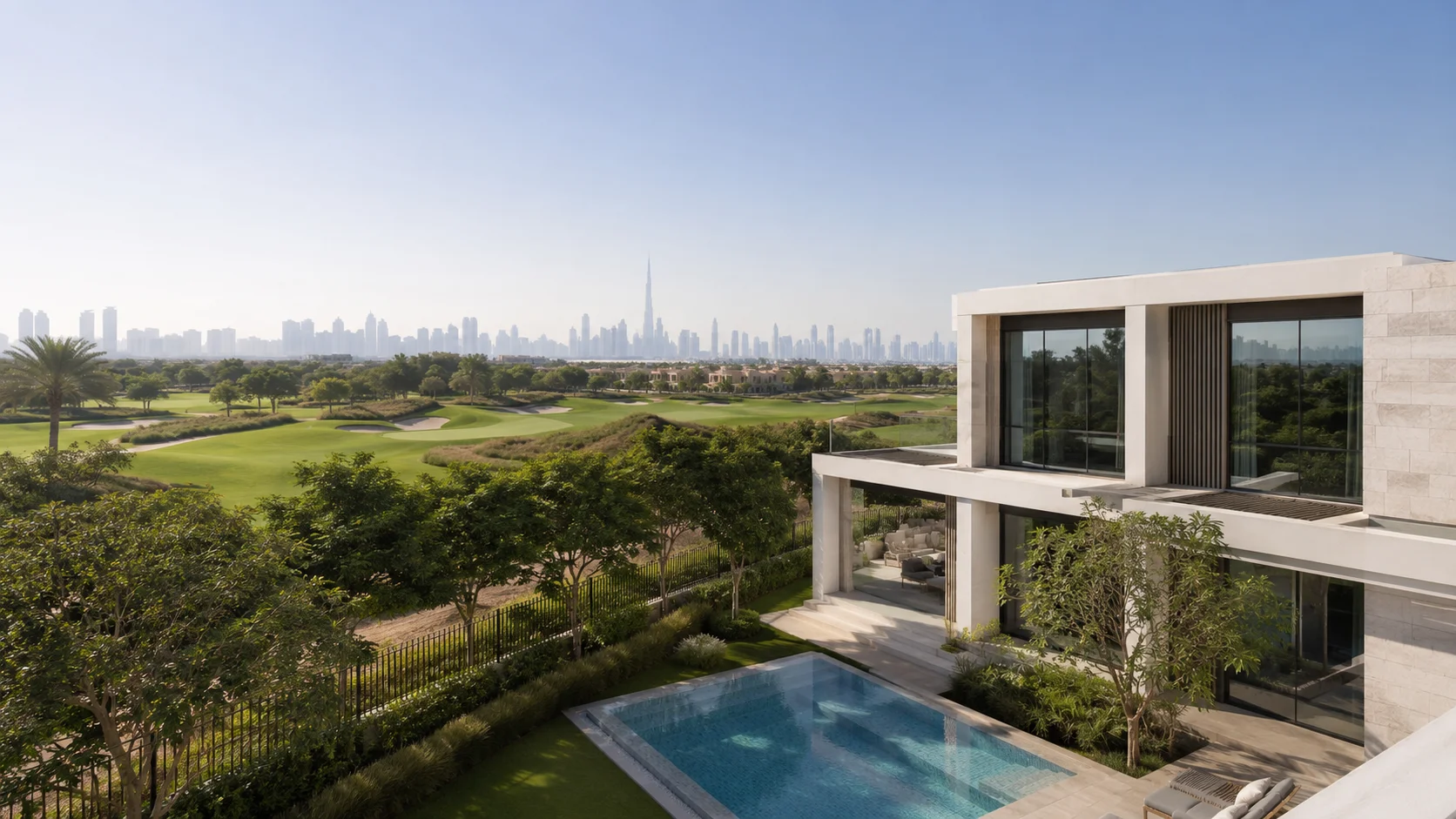
Dubai Hills Estate is the family-led golf-villa market, a master-planned green community that has become one of the city’s most in-demand prime addresses for buyers who want space and schools over towers or waterfront. Like Downtown, it is freehold under a later designation rather than the founding 2006 law, which is easily confirmed. This guide sets out what Dubai Hills is, how it differs from the older prime enclaves, and who it suits.
Green, master-planned
Schools and space
Check the DLD map
One of the newer prime cores
Last updated: July 2026
By: Alexander Thornbury
What is Dubai Hills Estate?
Dubai Hills Estate is a large master-planned community developed by Emaar around a championship golf course, built as a green, low-rise, family-oriented district. It offers villas and townhouses alongside some apartments, set among parks, schools and a central mall. It is one of the newer additions to Dubai’s prime map, and it has become highly sought after by families wanting space without leaving the city’s core.
Where Emirates Hills is the established old-money enclave and Downtown is the vertical urban core, Dubai Hills is the modern family-villa market: green, planned and amenity-rich. For how it sits within the wider market, see our international buyer’s guide to Dubai property.
The freehold point to check
Dubai Hills Estate is not named in Regulation No. 3 of 2006, the founding freehold law. It is transacted as freehold and foreign buyers own there freely, but its status rests on a later designation recorded on the Dubai Land Department’s current map, as with most of the city’s newer master-planned communities.
The verification rule is the same as everywhere: confirm the community on the DLD designated-areas map and read the title deed, rather than relying on the developer’s description alone. Our guide to Dubai’s freehold zones explains the difference between the founding law and the current map.
| Dubai Hills Estate | Detail |
|---|---|
| Freehold basis | Later designation on the DLD map (not the 2006 law) |
| Product | Villas and townhouses, some apartments; Emaar master plan |
| Bought for | Space, schools, green family living near the core |
Family-led: space and schools
The defining quality of Dubai Hills is that it is built for families. The community is planned around parks, schools, healthcare and a central retail hub, and the villa and townhouse stock offers the space and gardens that apartment districts cannot. For a relocating family who wants a house rather than a tower and good schooling within the community, it is a natural fit.
That family orientation is much of why demand has been strong, and it distinguishes Dubai Hills from the trophy and investment-led prime markets. A buyer here is typically buying a home to live in with children, not a pied-a-terre or a rental asset, though the villas hold their value and let well when needed.
What you actually buy there
Dubai Hills is a villa and townhouse market at its prime end, with value driven by plot size, position relative to the golf course and parks, and the specific sub-community and villa type within the master plan. Some apartment stock exists, but the prime interest is in the houses. It is a more uniform, developer-led product than the bespoke plots of Emirates Hills, which makes it more legible for a buyer new to the city.
Pricing varies by sub-community and villa type and moves with the market, so treat any single per-square-foot figure as indicative and value the specific home at purchase. Budget the community service charge, checked on the DLD Service Charge Index, and the 5% municipality housing fee, both covered in our service charges guide.
| Dubai Hills Estate | Emirates Hills | |
|---|---|---|
| Character | Modern family master plan | Established old-money enclave |
| Product | Developer villas and townhouses | Bespoke plot-led mansions |
| Freehold basis | Later DLD designation | Named in 2006 law |
Who Dubai Hills suits
Dubai Hills suits the relocating family who wants a villa or townhouse with space and gardens, good schools within the community, and green surroundings near the city core, in a legible developer-led master plan. It is less suited to a buyer chasing a trophy waterfront address or a bespoke estate on a large private plot, for whom the Palm or Emirates Hills fits better.
For an international family establishing a base in Dubai, Dubai Hills is one of the most straightforward prime choices: a house, a garden, schools and amenities in one planned community, with freehold ownership confirmed on the DLD map. Its strong demand reflects exactly that appeal.
Key takeaways
- Dubai Hills Estate is the family-led golf-villa market, a green Emaar master plan near the city core.
- It is freehold under a later DLD designation, not the 2006 law; confirm on the map and the deed.
- Its appeal is space, schools and green family living, which drives strong demand.
- It is a developer-led villa and townhouse market, more legible than the bespoke plots of Emirates Hills.
- Budget the community service charge and the 5% housing fee as ongoing costs.
Frequently asked questions
Can foreigners buy freehold in Dubai Hills Estate?
Yes. Foreign buyers own freehold in Dubai Hills, but it is not named in the 2006 freehold law; its status rests on a later designation on the Dubai Land Department’s map. Confirm the community on the map and read the title deed.
What kind of property is in Dubai Hills Estate?
Mainly villas and townhouses, with some apartments, in a master-planned community around a golf course, developed by Emaar. The prime interest is in the houses.
Is Dubai Hills good for families?
Yes, it is built for families, with parks, schools, healthcare and retail within the community and villa stock offering space and gardens. That family orientation is much of why demand has been strong.
How does Dubai Hills compare with Emirates Hills?
Dubai Hills is a modern, developer-led family master plan of villas and townhouses; Emirates Hills is the established old-money enclave of bespoke plot-led mansions. Dubai Hills is more uniform and legible; Emirates Hills is more exclusive and individual.
What annual costs come with a Dubai Hills home?
The community service charge, checked on the DLD Service Charge Index, plus the 5% municipality housing fee on assessed rental value for expatriate owners, and insurance.
Who is Dubai Hills best for?
A relocating family who wants a villa or townhouse with space, gardens and schools within a green master plan near the city core, in a straightforward developer-led community with confirmed freehold ownership.
Does a Dubai Hills villa qualify for a Golden Visa?
Yes, where the property is worth AED 2 million or more, which prime Dubai Hills villas comfortably are. Qualifying property grants a 10-year renewable Golden Visa, which lets the holder sponsor immediate family. It is residency, not citizenship.
What are the buying costs in Dubai Hills?
The main cost is the Dubai Land Department transfer fee of 4% of the price, plus agency and trustee-centre fees, so a cash purchase runs to roughly 5% to 6% all in, nearer 7% if financed. There is no VAT on the home itself, but 5% VAT applies to the agency, trustee and legal fees around the deal.
What annual costs come with a Dubai Hills home?
The community and service charges for the master plan, the 5% municipality housing fee on assessed rental value billed through the utility account for expatriate owners, and insurance. There is no annual property tax, but these together make the real holding cost higher than the headline implies.
Sources
- Dubai Land Department – designated areas map, Service Charge Index
- Dubai Legislation portal – Regulation No. 3 of 2006 (Dubai Hills not named; later designation applies)
Figures current at July 2026. Freehold status, service charges and pricing for a specific property should be confirmed with the Dubai Land Department and a UAE-qualified lawyer before purchase.

About the author
Alexander Thornbury is a published author who writes on international property, tax and residency for high-net-worth buyers across Europe, the Gulf and North America. His work focuses on the practical mechanics of cross-border purchase: what a buyer actually pays, owes and signs. More at alexanderthornbury.com.