
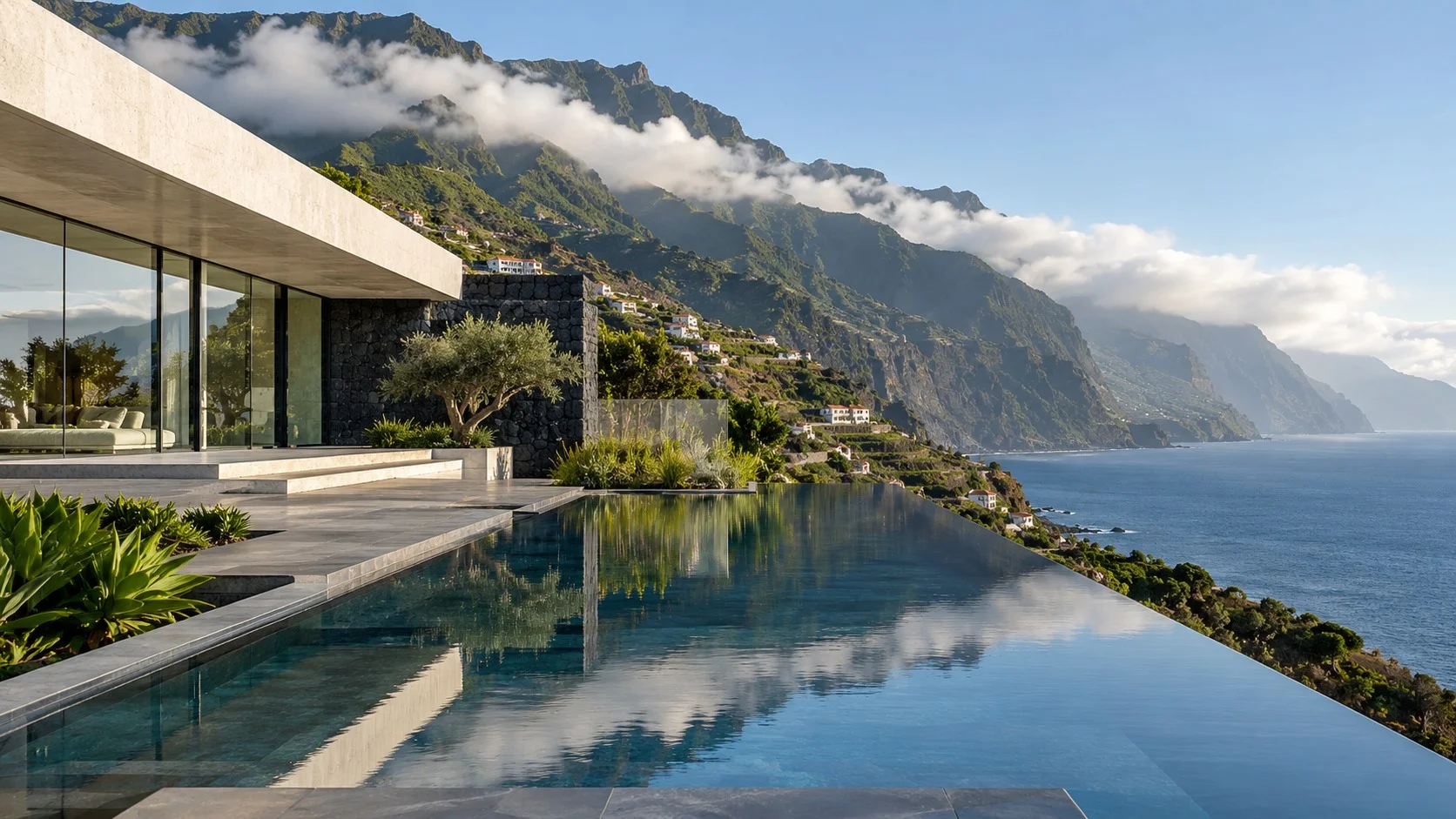
For a Swiss resident buying at the prime end, from EUR 2M, a Madeira home sits largely outside the Swiss tax base, and that shapes the whole decision. Switzerland leaves foreign property out of its income and wealth tax, counting it only to set your rate, and Portugal has no general wealth tax. Swiss citizens can live in Portugal under the free-movement agreement, and Portugal places no restrictions on foreign buyers. What a Swiss buyer does need to manage is the currency, the Portuguese transfer tax, and a will that settles which law governs the house.
Under the EU-Swiss agreement
Foreign property counted for rate only
Currency exposure to manage
Portuguese and Swiss rules
Last updated: October 2026
By: Alexander Thornbury
Can Swiss citizens buy and live in Madeira?
Yes, on both counts. Portugal places no restrictions on foreign buyers, so a Swiss buyer purchases on the same terms as a Portuguese citizen, with a Portuguese tax number, a lawyer, a promissory contract and a deed. And under the free-movement agreement between Switzerland and the EU, Swiss citizens can live in Portugal much as EU citizens do, registering their residence after three months. There is no visa and no 90-day limit to manage.
Owning the property is not what gives you that right, though; the agreement does. Since October 2023 property has not qualified for Portugal’s golden visa, so the purchase and the residence are separate questions for any buyer. Our Madeira residency guide sets out the residence side, and our international buyer’s guide to Madeira covers the market.
| For a Swiss-resident buyer | The position |
|---|---|
| Right to stay | Free movement under the EU-Swiss agreement |
| Transfer taxes (non-resident) | 7.5% IMT plus 0.8% stamp duty |
| Annual tax in Portugal | IMI at 0.3% of VPT; AIMI above EUR 600,000 of VPT |
| Swiss income and wealth tax | Foreign property excluded, but counted to set the rate |
| Currency | CHF to EUR exposure on purchase and sale |
What do you pay in Portugal?
About 8.3% of the price to buy as a non-resident, EUR 166,000 on a EUR 2M home: a flat 7.5% IMT and 0.8% stamp duty, both paid in euros before the deed, so they belong in the currency plan below. After that, IMI runs at 0.3% of the tax office’s valuation each year, and AIMI applies only above EUR 600,000 of it per person. Portugal taxes rent at a flat 25% for a non-resident and half of any gain at its progressive rates, which is the side of the bill Switzerland leaves alone. Our Madeira property tax guide covers each charge.
How does Switzerland treat a Madeira home?
Largely as outside its tax base. Swiss cantons and the federation exclude real estate located abroad from Swiss income and wealth tax, but count it when setting the rate on everything else, an approach known as exemption with progression. So a Madeira home does not itself attract Swiss wealth tax, and rental income from it is not taxed in Switzerland, but both can push up the rate you pay on your Swiss income and assets.
The double tax treaty between Switzerland and Portugal, dating from 1974 and since amended, sits behind that allocation: Portugal taxes the property and its income first, as the country where it is located. Combine that with Portugal’s lack of a general wealth tax, and the Madeira home sits largely outside wealth taxation altogether, with AIMI the only charge on its value, and only above EUR 600,000 of VPT. Confirm the cantonal treatment with your Swiss adviser, because the progression effect varies with your canton and your other assets.
How should a Swiss buyer handle the currency?
Deliberately, because it is the one real risk in the transaction. A Swiss franc buyer paying in euros carries exchange-rate exposure from the moment the price is agreed until the balance is paid, and again on any future sale. The binding moment is the promissory contract, when the deposit is paid and the price is fixed, so the currency decision belongs before it.
The usual options are fixing the rate for the purchase with your bank, holding euros in advance, or financing part of the price in euros. Which suits depends on the size of the purchase and how you will fund the running costs, which are in euros too. Our step-by-step buying guide shows when each payment falls due, so you can time the exchange to match.
| Item | Portugal | Switzerland |
|---|---|---|
| Tax on the property’s value | AIMI only above EUR 600,000 of VPT | Excluded from wealth tax; counted for rate |
| Rent | 25% flat for non-residents | Excluded from income tax; counted for rate |
| Death | 10% stamp duty; close family exempt | Cantonal; confirm for your canton |
| Treaty | Switzerland-Portugal, 1974, amended | Same treaty |
How is succession handled?
In two layers, tax and law. On tax, Portugal has no inheritance tax as such: its 10% stamp duty on inherited Portuguese assets exempts spouses, partners, children and parents. Swiss inheritance tax is set by each canton, and many exempt spouses and direct descendants, so confirm the position in yours. For comparison, Austria has no inheritance tax at all, while Germany taxes the worldwide estate of its residents; our guides for Austrian and German buyers cover both. For many Swiss families, a Madeira home passing to close relatives will carry little or no inheritance tax.
On law, Portugal has forced-heirship rules that reserve part of an estate for close family. A Swiss national can choose Swiss law to govern their succession in a will under the EU Succession Regulation, which Portugal applies to nationals of countries outside the EU. Without a choice, the law of your habitual residence at death applies, which matters if you later move to Madeira. Make the choice expressly, with a lawyer who knows both systems.
Getting there, and where to look
Zurich has direct services to Funchal with Edelweiss, taking about four hours. Madeira’s airport handled a record 5.4 million passengers in 2025. Check the current timetable for your airport, because schedules change with the season.
On the island, the choice follows how much of the year you will spend there. Funchal offers schools, restaurants and the deepest market. The sunny south-west and Porto Santo suit buyers who put quiet ahead of convenience, and golfers have three courses across the two islands. Funchal no longer registers new holiday lets in apartment buildings, which matters if rental income is part of your plan. Our guide to Madeira’s prime areas compares them. If you are weighing an Atlantic island against the Mediterranean, our comparison of Madeira, the Algarve and Mallorca sets out the differences.
Key takeaways
- Swiss citizens can buy and live in Madeira, under Portugal’s open buying rules and the EU-Swiss free-movement agreement.
- Transfer taxes are about 8.3% for a non-resident, and annual Portuguese tax is light.
- Switzerland excludes foreign property from income and wealth tax but counts it to set your rate.
- With no general Portuguese wealth tax, the home’s value is taxed only through AIMI, and only above EUR 600,000 of VPT.
- The currency is the real risk: decide how to handle CHF to EUR before signing the promissory contract.
- A will choosing Swiss law settles forced heirship; inheritance tax depends on your canton.
Frequently asked questions
Can Swiss citizens buy property in Madeira?
Yes. Portugal places no restrictions on foreign buyers, so Swiss citizens buy on the same terms as Portuguese citizens, with a tax number, a lawyer and the standard documents.
Can Swiss citizens live in Madeira?
Yes. Under the free-movement agreement between Switzerland and the EU, Swiss citizens can live in Portugal and register their residence after three months, without a visa.
What taxes does a Swiss buyer pay to buy in Madeira?
As a non-resident, about 8.3% of the price: a flat 7.5% IMT and 0.8% stamp duty, both on the higher of the price and the tax office’s valuation. Part of the IMT is refunded if you become Portuguese tax-resident within two years.
Is a Madeira property subject to Swiss wealth tax?
Not directly. Swiss cantons exclude real estate abroad from wealth tax but count it when setting the rate on your other assets, an approach called exemption with progression.
Is rent from a Madeira property taxed in Switzerland?
It is excluded from Swiss income tax but counted for the rate. Portugal charges a non-resident a flat 25% on residential rent, as the country where the property sits.
Is there a double tax treaty between Switzerland and Portugal?
Yes. The treaty dates from 1974 and has since been amended. It lets Portugal tax Portuguese property and its income first.
Does Portugal have a wealth tax?
No general wealth tax. AIMI is charged on the VPT of Portuguese residential property above EUR 600,000 per person, or EUR 1.2M for a couple taxed jointly.
How should I handle the Swiss franc when buying in Madeira?
Decide before you sign the promissory contract, when the price and deposit become binding. Common approaches are fixing the rate with your bank, holding euros in advance, or financing part of the price in euros.
Will my children pay inheritance tax on a Madeira home?
Not in Portugal if they are close family, because spouses, partners, children and parents are exempt from its 10% stamp duty. Swiss inheritance tax is cantonal, and many cantons exempt direct descendants; confirm yours.
Does Portuguese forced heirship apply to Swiss owners?
It can. A Swiss national can choose Swiss law for their succession in a will under the EU Succession Regulation. Without that choice, the law of your habitual residence at death applies.
Are there direct flights from Switzerland to Madeira?
Yes. Edelweiss flies direct from Zurich to Funchal, taking about four hours. Schedules vary with the season, so check the current timetable.
Sources
- Portal das Finanças – IMT Code, article 17, including the 7.5% non-resident rate added in 2026
- Diário da República – Decree-Law 97/2026 (IMT for non-residents)
- Portal das Finanças – IMI Code, article 112 (IMI rates)
- Portal das Finanças – IMI Code, article 135-F (AIMI rates)
- Portal das Finanças – IRS Code, article 16 (tax residence)
- EUR-Lex – EU Succession Regulation 650/2012
- Diário da República – Law 56/2023 (end of the property golden visa)
- ANA Aeroportos de Portugal – Madeira airport passes 5 million passengers in a year for the first time (2025)
- PwC Worldwide Tax Summaries – Switzerland: treatment of foreign real estate (exemption with progression)
- Swiss Federal Tax Administration – double tax treaty with Portugal
- State Secretariat for Migration – free movement of persons between Switzerland and the EU
Figures current at October 2026. Swiss tax depends on your canton; confirm your position with a Swiss tax adviser and a Portuguese lawyer before you buy.

About the author
Alexander Thornbury is a published author who writes on international property, tax and residency for high-net-worth buyers across Europe. His work focuses on the practical mechanics of cross-border purchase: what a buyer actually pays, owes and signs. More at alexanderthornbury.com.