
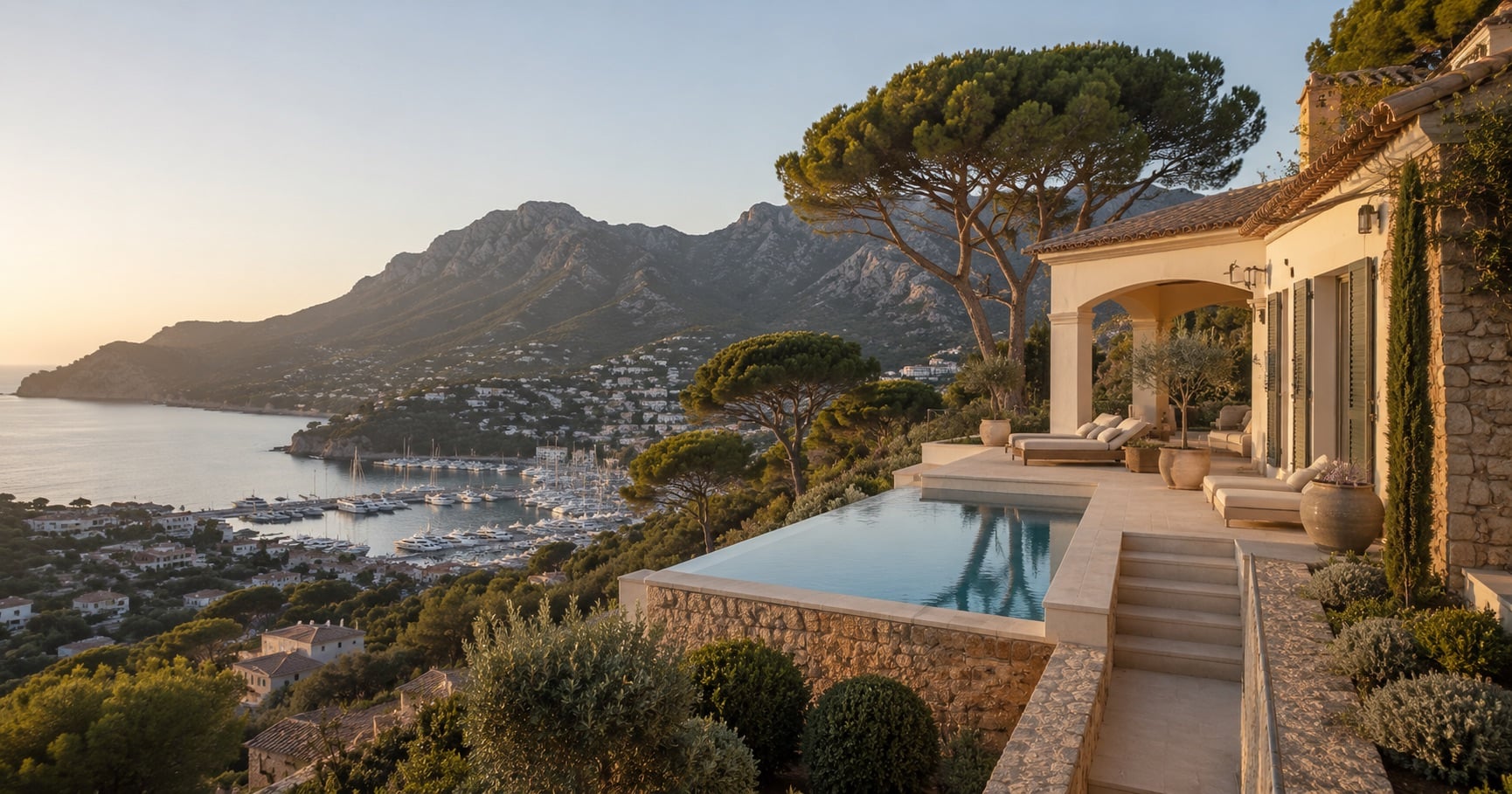
In 2024, Germans made up about 59% of Engel and Voelkers’ foreign sales in Mallorca; British buyers came a distant second at roughly 12%. The airport tells the same story: Palma handled 9.84 million German air passengers in 2025 against 5.92 million from the UK. A German buyer walking into a villa viewing in Port d’Andratx is not opening a frontier. They are buying into a German-led market where the estate agent, the neighbours and the builder next door are as likely to speak German as Spanish.
Last updated: July 2026 By: Alexander Thornbury This guide is for the German buyer at €3M and above. It skips the holiday-flat detail and stays on what shapes a purchase at that level: the advantages you carry into Spain as a euro-country EU citizen, the tax Spain charges, the tax the Finanzamt still expects you to declare at home, and why the Balearic transfer-tax bill runs higher than the mainland figure most price comparisons quote.
- What do German buyers get that non-EU buyers don’t?
- How much tax do you pay to buy in Mallorca?
- What do you owe every year, and when you sell?
- What does Germany tax on a Spanish property?
- Does German inheritance tax reach a villa in Mallorca?
- Can non-residents still buy freely in the Balearics?
- How does the buying process work?
- Where do German buyers buy in Mallorca?
- Key takeaways
- FAQ
What do German buyers get that non-EU buyers don’t?
Three things, and a German buyer tends to under-price all of them because they feel like nothing. Start with the euro. You already hold it, and Mallorca prices in it, so a €3M villa costs you exactly €3M. There is no Wechselkurs to track between the reservation and the notary, no forward contract to buy, no bank spread on the transfer. Compare that with the British buyers sitting across the table at the same viewing: every payment they make rides the pound against the euro, and a few points of movement on a €3M deal is a five-figure swing. For a German the number on the price sheet is the number that leaves your account. Then the passport. As a German citizen you are an EU citizen, so living in your Mallorca home needs no visa and no permit. You register at the local town hall, take a residence certificate and an NIE, and you are done. The 90-days-in-180 cap that catches non-EU buyers simply does not apply to you once you register. This is the freedom of movement Germans have used to make Mallorca a second home for two generations, and it did not change. Third, the rental band. Let the villa out and, as an EU resident, you are taxed on the net rent at 19%, with costs deductible. A non-EU owner pays 24% on the gross with nothing to deduct. On a well-let Mallorca property that spread is worth more each year than most buyers register when they sign.
How much tax do you pay to buy in Mallorca?
Between roughly 10% and 14% of the price, on top of the price. The transfer tax is the largest line, and the mechanics will feel familiar to any German buyer, with one sting in the tail. At home you know the Grunderwerbsteuer, the German transfer tax that runs a flat rate set by each Bundesland, up to 6.5% in the priciest states. Spain works the same way, tax set by the region, but the Balearic government made its version progressive rather than flat. On a Mallorca resale the ITP climbs in bands: 8% up to €400,000, 9% to €600,000, 10% to €1M, 12% to €2M, and 13% on the slice above €2M. So the more you spend, the harder the top band bites. On the Spanish mainland, Andalucia charges a flat 7% on any resale, closer to the flat German model you already know. For a €3M resale, the Balearic scale works out to about €340,000 in transfer tax. The same-priced villa in Marbella would carry about €210,000. Buying in Mallorca rather than on the Costa del Sol therefore costs roughly €130,000 more in tax alone, and roughly double the top German rate on the slice above €2M. A new-build is taxed on a different basis: 10% VAT (IVA) in place of ITP, plus Balearic stamp duty (AJD) at 1.5%. The VAT rate is national and the same across Spain; the Balearic stamp duty edges Andalucia’s 1.2%.
| Cost on a €3M resale | Mallorca (Balearics) | Marbella (Andalucia) |
|---|---|---|
| Transfer tax (ITP) | 8-13% progressive, ~€340,000 | 7% flat, ~€210,000 |
| Stamp duty (AJD, new-build/mortgage) | 1.5% | 1.2% |
| VAT on a new-build | 10% | 10% |
| Notary, registry, legal | ~1-2% | ~1-2% |
It almost never changes the decision. A German buyer set on Mallorca is buying the Tramuntana light and a two-hour flight from home, not shopping regions on tax. But the extra €130,000 should sit in the budget from the first conversation, not surface as a shock at the notary.
What do you owe every year, and when you sell?
As a non-resident who owns but does not let the property, you pay a small annual non-resident income tax on an imputed value, calculated as 1.1% of the cadastral value and taxed at 19% for EU residents. On top sits the local council tax (IBI), which in the Calvia municipality (Son Vida, Bendinat, Portals) runs around 0.5% of the cadastral value. Because cadastral values sit well below market price on prime villas, the annual bill stays modest next to the value of the home. Let the villa and, as an EU resident, you pay 19% Spanish tax on the net rent after expenses. On a sale, Spain charges a flat 19% capital gains tax on every non-resident, German or otherwise, so the EU rental advantage does not carry over to the exit; your passport buys you nothing on the gain. At completion the buyer of your property holds back 3% of the price and pays it straight to the Agencia Tributaria as an advance against your gain, and you settle up from there.
What does Germany tax on a Spanish property?
Less than most German buyers fear, because the Spain-Germany double tax treaty hands the property almost entirely to Spain. Under the treaty (signed 3 February 2011, in force since 18 October 2012), rental income from Spanish real estate is taxed only in Spain, under Article 6. Germany does not tax it again. It does, though, apply what German tax law calls the progression clause (Progressionsvorbehalt): the exempt Spanish rental income is added back in only to work out the rate on your other German income, which can nudge that rate up. You declare the Spanish rent in Germany, but you are not taxed twice on it. The bigger relief is on sale. Capital gains on Spanish property are taxed only in Spain under Article 13(1) of the treaty. Germany has no taxing right over the gain, even where the seller is a German tax resident. So the German 10-year speculation-tax rule, the Spekulationssteuer, which taxes a private property sale within 10 years of purchase and exempts it after, does not reach a Spanish home in the way it reaches a German one. The Spanish 19% capital gains tax applies; the German speculation tax does not layer on top. Individual circumstances vary, so confirm your own position with a cross-border adviser. The practical read: for a German buyer, Spanish tax is effectively the tax on the Mallorca property’s income and its eventual sale. Germany takes rental income into account only for the rate on other income, and takes nothing at all on the gain. Here is how the two sides line up on each event in the life of the property.
| Tax event | Spain | Germany |
|---|---|---|
| Rental income | 19% on net rent, expenses deductible (EU resident) | Exempt, but added back to set the rate on other German income (progression clause) |
| Capital gain on sale | 19% flat, plus 3% withheld at completion as an advance | No taxing right; treaty gives the gain to Spain (Article 13(1)) |
| Inheritance | Spanish inheritance tax on the Spanish property | Worldwide assets in scope where deceased or beneficiary is German-resident; Spanish tax credited under Section 21 |
Does German inheritance tax reach a villa in Mallorca?
Yes, and this is the part German buyers most often miss. Germany taxes worldwide assets for inheritance and gift tax (Erbschaftsteuer) where either the deceased or the beneficiary is a German tax resident. A Spanish villa is a foreign asset, so it falls inside the German inheritance tax net and must be declared. Spain also charges its own inheritance and gift tax on Spanish-situated property, and there is no separate Germany-Spain inheritance tax treaty to carve up the two claims. That raises the prospect of tax in both countries. German law softens it: under Section 21 of the German inheritance tax act, Germany credits the Spanish inheritance tax paid against the German bill on the Spanish portion, so you are not taxed twice in full. Note also the extended German rule: a German citizen who has not lived outside Germany for a continuous five years can stay inside unlimited German inheritance tax liability even after leaving. None of this is a reason not to buy. It is a reason to plan the succession side properly, with advice on both sides, before the villa is bought rather than after. Take specialist cross-border advice on wills and structure.
Can non-residents still buy freely in the Balearics?
Yes. A proposal to limit non-resident purchases in the Balearics was debated in the regional parliament and rejected on 24 February 2026. It never became law. Foreign buyers, German or otherwise, remain free to buy. Headlines about a Balearic “ban” overstate what happened; the restriction was proposed and voted down, not enacted.
How does the buying process work?
One habit German buyers should drop at the border: the notary here is not your adviser. In Germany the Notar is a neutral state officer who effectively runs the conveyance for both sides. The Spanish notario is neutral too, but far more hands-off, and does not check the things a German notary would. So you engage your own abogado, a lawyer working only for you, with no link to the seller or the agent, to do the due diligence the notary will not. You also need an NIE, the foreigner’s tax number, before you can sign. Reckon on about six to ten weeks from accepted offer to signing on a resale.
- Instruct your own lawyer and apply for the NIE; the lawyer can act under power of attorney, so you need not fly over just for paperwork. If you plan to live in Spain, register for the EU residence certificate as a separate step.
- Pay a reservation fee to pull the villa off the market, usually about 1%.
- Sign the arras contract, the private purchase deposit, normally 10%. Walk away and you forfeit it; if the seller walks, they owe you double back.
- Sign the escritura before the notary and pay the balance.
- Lodge the deed at the Land Registry, which then takes a further two to six weeks.
Before that 10% deposit leaves your hands, your lawyer runs the checks: clean title, no debts secured on the property, planning in order, community charges paid, and where the tourist-rental licence stands. Signing the arras before those checks land is the one mistake to avoid. The same process governs a purchase on the mainland, whether you are buying in Spain from the UK, from Ireland, or from the UAE.
Where do German buyers buy in Mallorca?
The ultra-prime core is the south-west “Golden Triangle”: Port d’Andratx, Bendinat and Santa Ponsa, plus old-money Son Vida above Palma, the artists’ village of Deia on the Tramuntana coast, and Portals Nous. Palma’s old town has drawn buyers wanting a walkable base rather than a hillside villa. Getting there is the easiest part. Palma is Spain’s third-busiest airport, handling 33.8 million passengers in 2025, and its route map is overwhelmingly German. Flights from the main German hubs run around two hours ten minutes, and the frequency in season is closer to a shuttle than a holiday route. That density is a large part of why the German community here is the deepest of any foreign group: INE recorded 21,723 German residents in the Balearics at the start of 2025, ahead of 18,374 Britons, and local academic estimates put the real, partly de-registered, German presence far higher. Prime prices have held firm. Per-square-metre figures vary by source and by street, so treat any single number as indicative and dated, but Andratx houses have been quoted around €8,900 per square metre and ultra-prime sea-view stock above €10,000. For the wider picture across the island, see the Mallorca luxury property guide, and for how the island sits against other Spanish markets, the international buyer’s guide to Spain.
Key takeaways
- Germans are Mallorca’s dominant foreign buyers – about 59% of one leading agency’s foreign sales in 2024.
- You carry the euro and an EU passport into the deal – no FX risk, no visa, just registration and an NIE.
- Budget 10-14% on top of the price – Balearic transfer tax runs to 13% above €2M, roughly €130,000 more than Marbella on a €3M home.
- The treaty gives Spain the rental income and the sale gain – Germany taxes neither directly.
- German inheritance tax still reaches the villa – plan the succession, and the tourist-rental licence, before you buy.
For exclusive access to Marbella’s most exceptional luxury properties and comprehensive market insight, contact our specialized advisory team at marbella@blackprive.com
Frequently asked questions
Can German nationals buy property in Mallorca freely?
Yes. Ownership is open to any nationality. The 2026 proposal to limit non-resident purchases in the Balearics was rejected and never became law.
Do I need a visa to live in my Mallorca home?
No. Your German passport is an EU passport, so you register at the town hall for a residence certificate and take an NIE. Once registered, the 90-days-in-180 cap that limits non-EU owners no longer applies to you.
Is there any currency risk for a German buyer?
None. You pay in the euro you already hold for a villa priced in euros, so nothing moves between reservation, deposit and completion, and there is no bank spread or forward contract to arrange. It is a real edge over the pound-holding buyers beside you.
How much are the total costs on top of the price?
Plan for roughly 10% to 14% all-in: transfer tax or VAT, plus notary, registry and legal fees. Transfer tax is the swing factor, and the Balearic progressive scale puts it above the mainland flat rate.
Why is the purchase tax higher in Mallorca than in Marbella?
Transfer tax is set regionally. The Balearics use a progressive scale reaching 13% above €2M; Andalucia charges a flat 7%. On a €3M resale that is about €130,000 more in Mallorca.
What tax do I pay on rental income from a Mallorca let?
As an EU resident, 19% on the net rent after expenses. Germany does not tax the rent again, though it counts it when setting the rate on your other German income.
What will I pay when I sell?
A flat 19% Spanish capital gains tax, the same rate every non-resident pays. Your buyer holds back 3% of the price as an advance on it. The treaty gives the gain to Spain, so Germany does not tax it again.
Does the German speculation tax (Spekulationssteuer) apply to a Spanish sale?
The treaty gives Spain exclusive taxing rights on the gain, so the Spanish 19% applies rather than the German speculation tax. Confirm your own position with a cross-border adviser.
Does German inheritance tax apply to my Mallorca villa?
Yes, where the deceased or beneficiary is a German tax resident. Spain also taxes it, but Germany credits the Spanish tax under Section 21 of its inheritance tax act. Plan the succession before you buy.
Do I still file anything in Germany for the Spanish property?
Yes. You declare Spanish rental income in Germany for the progression calculation, even though it is taxed only in Spain. Take advice on your filing duties.
Is Spain wealth-tax-free for a €3M estate?
No. A national Solidarity Tax on Large Fortunes applies above €3M of net wealth, at 1.7% to 3.5%, regardless of any regional wealth-tax position.
How long does a purchase take?
Count on six to ten weeks from an accepted offer to signing the escritura on a resale, then a further two to six weeks for the deed to register.
Can I let the property to cover costs?
Sometimes, but Balearic tourist-rental licences are restricted and new ones limited. Confirm the licence position for the specific property before relying on rental income.
Do I need a Spanish will?
It is commonly advised for Spanish assets, and doubly worth advice given the German inheritance tax overlap. Succession planning is case-specific; take cross-border legal advice.
How big is the German community in Mallorca?
INE recorded 21,723 German residents in the Balearics at the start of 2025, the largest foreign group. Academic estimates of the real presence, including part-time and de-registered owners, run considerably higher.
Sources
- Govern de les Illes Balears / ATIB – Balearic ITP and AJD rates
- Agencia Tributaria – non-resident income tax, capital gains, Solidarity Tax, residency
- BOE – Ley Organica 1/2025, Golden Visa abolition
- Aena – Palma airport passenger traffic
- INE – Balearic foreign-resident figures, 1 January 2025
- Spain-Germany Double Taxation Agreement 2011 – Articles 6, 13, 22
- German Einkommensteuergesetz – progression clause, Spekulationssteuer
- German Erbschaftsteuergesetz – Sections 2 and 21
Figures current at July 2026; tax rates and thresholds should be confirmed at the point of purchase.

About the author
Alexander Thornbury writes on international property, tax and residency for high-net-worth buyers across Europe. His work focuses on the practical mechanics of cross-border purchase: what a buyer actually pays, owes and signs. More at alexanderthornbury.com.