
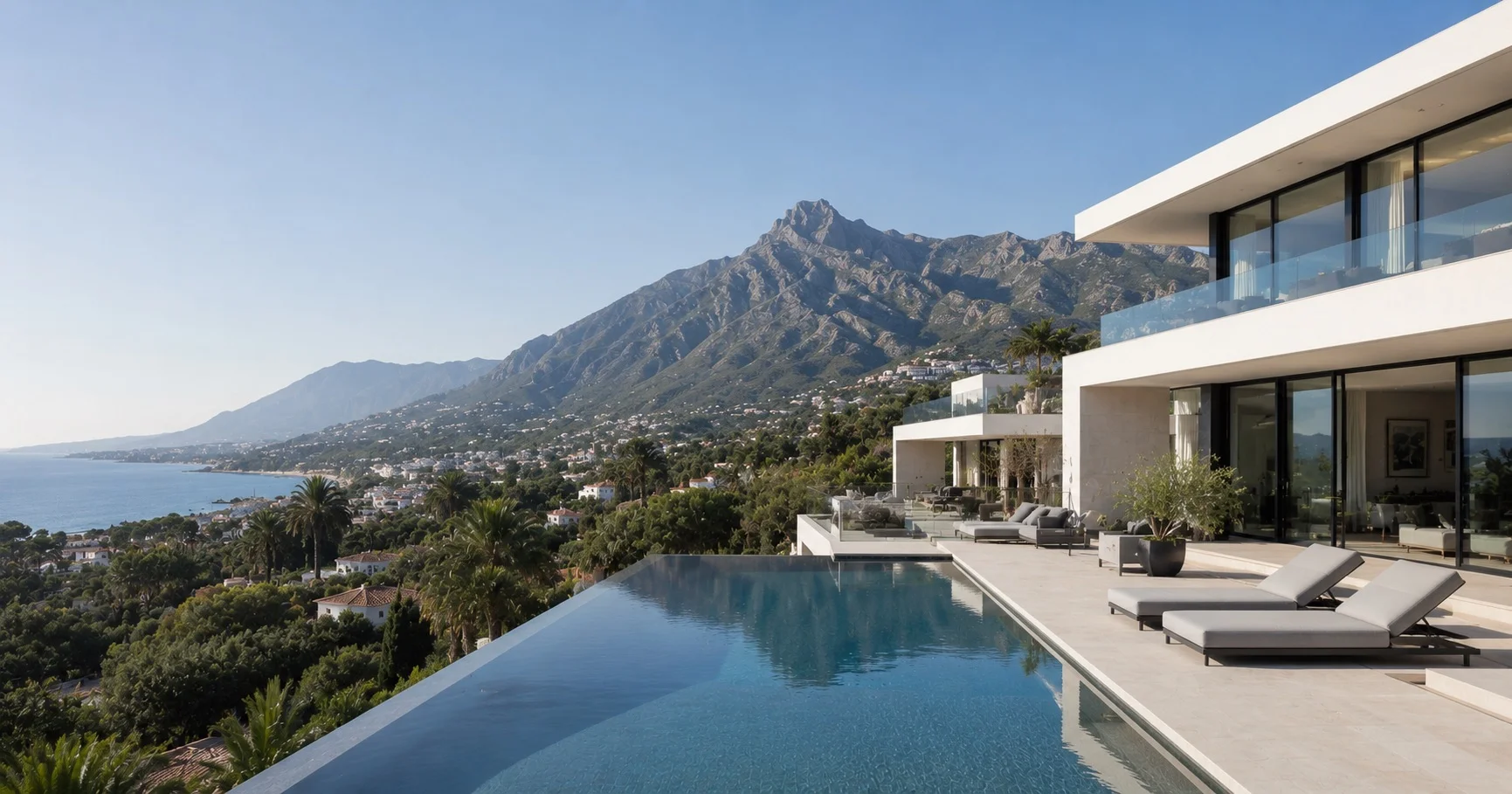
A Swiss buyer in Marbella is treated like an EU national at the town hall and a non-EU one at the tax office. Free movement puts you on the same residency footing as a German or French buyer, no visa required. Yet Switzerland sits outside both the EU and the EEA, so the higher 24% non-resident tax band lands on you, not the 19% a French owner pays. Free movement without EU tax status is the Swiss condition, and it is the thing most Swiss buyers price wrong.
Last updated: July 2026 By: Alexander Thornbury
- Can a Swiss citizen live in Spain, and does buying help?
- Why does Switzerland’s non-EU status cost you on Spanish tax?
- How much do you pay to buy in Marbella, and how does Mallorca compare?
- How does Switzerland tax a Spanish home in your wealth return?
- What does the Spain-Switzerland treaty actually do?
- Does the Swiss franc create a risk a euro buyer avoids?
- Where do international buyers buy on the Costa del Sol?
- Key takeaways
- FAQ
This guide is for the Swiss buyer moving EUR 3M and up out of francs and into the Costa del Sol, with Mallorca held up where the two diverge. It works through that split position, what completion actually costs, how a Spanish villa lands in your Swiss wealth return alongside the cantonal tax you already file, and the franc-against-euro question a buyer paying in euros from home never has to hold in mind.
Can a Swiss citizen live in Spain, and does buying a home help?
Yes to the first, no to the second. The Agreement on the Free Movement of Persons between Switzerland and the EU puts a Swiss citizen on the same residency footing as a French or German one. No visa, no income test, no queue. Stay past 90 days and you register with the local authorities for a residence certificate and take an NIE, the foreigner’s tax number. That is the whole of it. The deed adds nothing to that right. Spain closed its Golden Visa on 3 April 2025, which took the buy-to-reside route off the table for everyone. Swiss buyers never used it, because free movement already handed them what the Golden Visa sold to Gulf and Asian buyers who had no other way in. So your standing in Spain rests on the Swiss passport and the free-movement agreement, not on the villa. This is the one place the Swiss position reads unambiguously like an EU buyer’s. The next section is where it stops.
Why does being Swiss cost you on Spanish tax?
Because Spain splits its non-resident rates by whether you’re inside the EU/EEA or outside it, and Switzerland is outside both. It sits in neither the EU nor the European Economic Area. The free-movement agreement gives Swiss citizens residency and property-purchase rights, but it does not put Switzerland inside the EEA for tax. So on Spanish non-resident income tax, Swiss owners fall into the 24% band that applies to everyone outside the EU/EEA, not the 19% band that Germans, French and even Norwegians and Icelanders get. This is the single most misread point for Swiss buyers. Free movement makes you feel like an EU buyer at the town hall. The tax office treats you like a non-EU one. Two facts to hold together:
- Residency: EU-equivalent. Register, get the certificate, no visa.
- Non-resident tax: non-EU. The 24% band, and no expense deductions on rental income.
The table below sets the split out plainly. Residency access reads like an EU buyer’s; the tax status reads like a non-EU buyer’s; and the gain on sale sits outside the split entirely.
| Swiss buyer status | What applies | How it compares |
|---|---|---|
| Residency access | EU-equivalent free movement: register, residence certificate and NIE, no visa | Same as a German or French buyer |
| Non-resident income tax | Non-EU: 24% band on rental and imputed income, no rental deductions | Higher than the 19% EU/EEA band |
| Capital gains on sale | 19% flat, with 3% buyer withholding | Same as every non-resident, EU or not |
The gap only bites in two places, and it’s worth being precise about where. First, rental income. If you let the property, an EU or EEA owner pays 19% on the net rent after deducting costs. A Swiss owner pays 24% on the gross, with no deductions. On a villa let commercially, that difference is real money every year. A 2025 Spanish court ruling has challenged the no-deductions rule for non-EU owners, but it is not yet settled law and the tax office has not changed its published position, so budget on the current rule and treat any relief as a possible later reclaim, not a given. Second, imputed income. If you own but don’t let the home, Spain charges a small non-resident income tax on a notional value based on the cadastral value. The rate is again 24% for a Swiss owner against 19% for an EU one. Because cadastral values sit well below market on prime villas, the annual bill is modest, but the rate difference is there.
The split closes the moment you sell. Capital gains tax runs at a flat 19% for every non-resident, and being Swiss neither helps nor hurts here: a German seller pays the same rate you do. At completion the buyer holds back 3% of the price and pays it straight to the tax office as an advance against your gain, which you then settle up.
How much do you pay to buy in Marbella, and how does Mallorca compare?
Add roughly 10% to 14% to the agreed price, with the split set by region and by whether the villa is new or resale. Coming from a market where purchase costs are lighter, a Swiss buyer should read this as a real line, not a rounding error. The heaviest part is the transfer tax, and that is the number that separates the Costa del Sol from Mallorca. Marbella sits in Andalucia, and an Andalucian resale carries a flat 7% transfer tax (ITP). Mallorca sits in the Balearics, where a progressive scale climbs to 13% on the portion above EUR 2M. A new-build anywhere in Spain goes a different way: 10% VAT plus regional stamp duty, 1.2% in Andalucia against 1.5% in the Balearics. Set the two side by side on a EUR 3M resale:
| Cost on a EUR 3M resale | Marbella (Andalucia) | Mallorca (Balearics) |
|---|---|---|
| Transfer tax (ITP) | 7% flat, ~EUR 210,000 | 8-13% progressive, ~EUR 340,000 |
| Stamp duty (AJD, new-build/mortgage) | 1.2% | 1.5% |
| VAT on a new-build | 10% | 10% |
| Notary, registry, legal | ~1-2% | ~1-2% |
So the identical EUR 3M house costs about EUR 130,000 more in transfer tax on Mallorca than on the Costa del Sol. It seldom decides where a Swiss buyer settles, since the feel of the place and the crowd usually do that, but it belongs in the francs you set aside before the first viewing, not after.
How does Switzerland tax a Spanish home in your wealth return?
Switzerland taxes its residents on worldwide net wealth, so a Spanish villa does have to go in your Swiss tax return. But it is not taxed twice in the way people fear. Switzerland exempts foreign real estate from actual Swiss tax and uses its value only to set the rate on your Swiss assets, the method known as exemption with progression. In plain terms: the Spanish property’s value is added in to work out which wealth-tax rate you pay, then the property itself is taken back out before the tax is charged. So the villa pushes the rate on your Swiss wealth up a little, but Switzerland does not levy wealth tax on the Spanish home directly. The same logic runs on the income side. Rental income from the Spanish property, and the imputed rental value if you use it yourself, are rate-determining in Switzerland but not directly taxed there. One forward-looking note. Switzerland passed a 2025 reform that is set to abolish the imputed rental value on self-used property, including foreign homes, once it takes effect later this decade. The timing and final shape are not yet fixed, so treat it as a change to watch rather than a rule to plan around.
The wealth charge that catches Swiss buyers out sits on the Spanish side, and it is worth reading through Swiss eyes. A Swiss UHNWI already pays an annual wealth tax at home. Every canton levies one on worldwide net assets, and anyone on a lump-sum forfait arrangement is used to a yearly bill pitched off wealth rather than income. So an annual charge on net worth is not the foreign idea to a Swiss buyer that it is to a British or Gulf one. The trap is different: it is believing Marbella removes it. Below EUR 3M, Andalucia genuinely costs you nothing. Above it, at exactly the level this guide is written for, the Solidarity Tax applies whatever the region has waived. A Swiss buyer swapping a known cantonal rate for a “wealth-tax-free” headline is swapping one wealth tax for another, not escaping the class.
What does the Spain-Switzerland tax treaty actually do?
It stops the same income being fully taxed twice, and it settles which country taxes what. The convention was signed in 1966 and amended by a protocol signed in 2011 that came into force in 2013. It covers taxes on income and on capital. For a property, the rule is the one common to almost all such treaties: income from immovable property is taxed in the country where the property sits. So Spain has the first claim on rent and imputed income from your Marbella home. Switzerland then relieves the double charge through the exemption-with-progression method described above, exempting the Spanish property income and using it only to set your Swiss rate. The practical result is that you deal with the Spanish tax on the Spanish home, and Switzerland does not pile a second full charge on top. Treaties are detailed and personal circumstances vary. Take Swiss and Spanish advice on your own position before you complete; this is the shape of it, not a substitute for a cross-border tax opinion.
Does the Swiss franc create a risk a euro buyer avoids?
Yes. This is the one exposure a German or French buyer never faces and a Swiss buyer always does. You hold francs; the property, the taxes and the running costs are all in euros. Every time you convert, from the reservation deposit through completion to the annual bills, the CHF-EUR rate decides how many francs the euro figure actually costs you. Move the rate a few points and a EUR 3M purchase can cost meaningfully more, or less, in francs than the day you agreed the price. The standard tool is a forward contract, which lets you fix today’s rate for a future settlement so you know the franc cost of your euro completion in advance. Banks and specialist FX firms offer them. The point is not to predict the rate but to remove the guesswork from a large, dated payment. Factor the currency line into the budget from the start; it is as real as the transfer tax, and unlike the tax it can move against you between offer and completion.
Where do international buyers buy on the Costa del Sol?
Marbella’s money gathers in a short list of names: the Golden Mile, Sierra Blanca on the hillside, the gated La Zagaleta estate over in neighbouring Benahavis, the Golf Valley in Nueva Andalucia, and Puerto Banus on the marina. Malaga airport sits 40 to 60 minutes away by road and ranks among Europe’s best-connected, with a direct link from Zurich of roughly two and a half hours; check the current season’s schedule before you count on it. For a buyer used to a Geneva-to-Nice hop or the drive up to a Verbier chalet, a Thursday-to-Sunday on the coast is no further and costs less to hold. Weigh Mallorca alongside it and the ultra-prime heart is the south-west “Golden Triangle” of Port d’Andratx, Bendinat and Santa Ponsa, with old-money Son Vida above Palma and the protected village of Deia. Palma is Spain’s third-busiest airport, under two hours from Zurich, and its buyer base tilts heavily German, closer to a single-nation enclave than the Costa del Sol ever is. For a Swiss buyer choosing between them, the decision usually comes down to the transfer-tax gap above and whether you want a properly international address or a German-speaking one. The Costa del Sol has carried a broad international community for decades, British, Scandinavian, Gulf and Dutch owners side by side, and Swiss residents sit within that weave rather than forming a bloc of their own. Prime values have held their line: Knight Frank logged prime Marbella up 8.1% across 2025. Per-square-metre figures shift and disagree by source, so read any single number as indicative and dated, not a quote.
Key takeaways
- Residency EU-equivalent, tax non-EU. Free movement gives Swiss buyers EU-equivalent residency, but Spanish tax still treats Switzerland as non-EU: the 24% rate on rental and imputed income, not 19%.
- Only annual rates split. Capital gains tax on sale is 19% for everyone; only the annual rental and imputed rates split by status.
- The Spanish home lifts your Swiss rate, not your Swiss bill. Switzerland taxes worldwide wealth but exempts the Spanish home itself, using its value only to set your rate.
- “No wealth tax in Marbella” is conditional. True below EUR 3M; above that the national Solidarity Tax applies at 1.7% to 3.5%.
- Currency risk is yours alone. The Swiss franc adds an exposure a euro buyer never carries; a forward contract can fix the rate on completion.
- Mallorca costs more to buy. Roughly EUR 130,000 more in transfer tax than Marbella on a EUR 3M resale.
For exclusive access to Marbella’s most exceptional luxury properties and comprehensive market insight, contact our specialized advisory team at marbella@blackprive.com
Frequently asked questions
Can Swiss citizens buy property in Spain?
Yes. Ownership is open to any nationality, resident or not, and Swiss buyers face no purchase restriction in either Marbella or Mallorca.
Can I live in Spain as a Swiss citizen?
Yes. The free-movement agreement between Switzerland and the EU lets Swiss citizens live in Spain without a visa. For stays over 90 days you register locally and get a residence certificate and an NIE.
Does buying a home give me residency?
No. Residency comes from your Swiss passport and the free-movement agreement, not from a property. The Golden Visa, which sold residency to buyers, ended on 3 April 2025.
Do Swiss buyers pay the 19% or the 24% non-resident tax rate?
The 24% rate. Switzerland is not in the EU or the EEA, so Swiss owners fall into the non-EU band for Spanish non-resident income tax, despite having EU-equivalent residency rights.
What tax do I pay on rental income from a Spanish property?
As a Swiss owner, 24% on the gross rent with no expense deductions. EU and EEA owners pay 19% on the net after costs. A 2025 court ruling may narrow the gap for non-EU owners but is not yet settled law.
What will I pay in capital gains tax when I sell?
A flat 19% on the gain, identical for every non-resident whatever the passport, so being Swiss makes no difference here. The buyer retains 3% of the sale price and pays it over as an advance against the bill.
How much are the total buying costs on top of the price?
Around 10% to 14% all-in: transfer tax or VAT, plus notary, registry and legal fees. Transfer tax is the largest line and turns on the region and on whether the villa is new or resale.
Why is the tax higher in Mallorca than Marbella?
Regions set their own transfer tax. Andalucia takes a flat 7% on resales; the Balearics run a progressive scale reaching 13% above EUR 2M, about EUR 130,000 more on a EUR 3M home.
Does Switzerland tax my Spanish property?
Not directly. Switzerland exempts foreign real estate and uses its value only to set the rate on your Swiss wealth and income, the exemption-with-progression method. The Spanish home lifts your Swiss rate but is not itself taxed in Switzerland.
Is Spain wealth-tax-free above EUR 3M in Marbella?
No. Andalucia’s regional wealth tax is bonified to zero, but the national Solidarity Tax on Large Fortunes still applies above EUR 3M of net wealth, at 1.7% to 3.5%.
What does the Spain-Switzerland tax treaty do for me?
Signed in 1966 and updated by a 2011 protocol in force from 2013, it assigns first taxing rights on property income to Spain and relieves the double charge on the Swiss side, so you are not fully taxed twice on the same income.
Do I face a currency risk that a euro buyer doesn’t?
Yes. You pay in euros from francs, so the CHF-EUR rate affects the true franc cost of the deposit, completion and running costs. A forward contract can fix the rate for a dated payment.
How long does a purchase take?
Reckon on six to ten weeks for a resale, from accepted offer to signing before a notary, with a further few weeks for the Land Registry entry to land.
Do I need an NIE and a lawyer?
Both, yes. The NIE has to be in hand before you can sign anything, and you want an independent lawyer with no link to the seller or agent, running the title and debt checks before a single franc of deposit moves.
Can I let the property to cover costs?
Sometimes, though tourist-rental licensing is restricted and the Balearics cap new licences tightly. Confirm the position for the specific property before you lean on rental income, and factor in the 24% gross rate that lands on any rent you earn as a non-EU owner.
Read next: Buying luxury property in Spain: the international buyer’s guide – Buying in Marbella from the UK – from the UAE – from Ireland – the Marbella luxury property guide.
Sources
- Agencia Tributaria – non-resident income tax rates (19% EU/EEA, 24% other), capital gains and Solidarity Tax
- Fedlex – Spain-Switzerland Convention of 26 April 1966
- Spanish Ministry of Finance – 2011 amending protocol (in force 2013)
- Swiss State Secretariat for Migration – Free Movement of Persons, Switzerland-EU/EFTA
- EUR-Lex – Agreement on the Free Movement of Persons (residence and right to acquire property)
- Taxolution Advisory – taxation of properties abroad (exemption with progression)
- UBS Switzerland – hedging currency risks
Figures current at July 2026. Tax rates and thresholds should be confirmed at the point of purchase. Regional transfer tax and stamp duty per Junta de Andalucia and Govern de les Illes Balears; Golden Visa abolition per Ley Organica 1/2025 (BOE); prime price growth per Knight Frank Wealth Report 2026; airport data per Aena.