
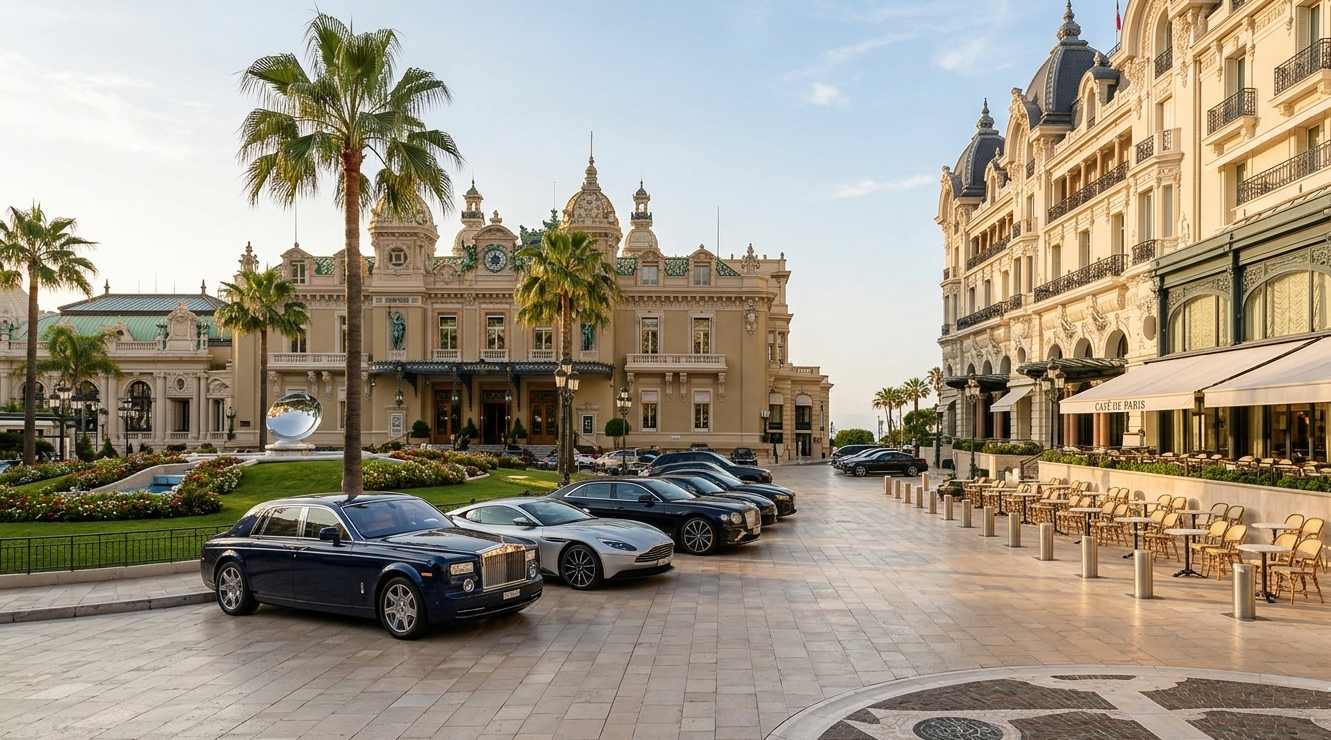
Monaco is 2.02 square kilometres of Mediterranean coastline where a coffee costs EUR 6, a school place costs EUR 25,000, and a parking space can sell for EUR 300,000. Everything in the principality operates at a premium. That’s the trade-off for zero income tax, world-class safety, and a lifestyle that genuinely delivers on its promises. But “premium” doesn’t mean “unliveable” – it means you need to know exactly what you’re getting into before committing. This guide covers the practical reality, not the brochure version.
Annual cost of living (UHNWI family)
Sunshine per year
Police officers to residents
Official sources cited
Last updated: February 2026
By: Alexander Thornbury MRICS
- What does it actually cost to live in Monaco?
- How much is rent and property maintenance?
- What school options exist for families?
- How does Monaco’s healthcare system work?
- Why is Monaco considered the safest place in Europe?
- How do you get around and travel from Monaco?
- What’s the social and cultural scene like?
- What are the genuine downsides of living here?
- Key takeaways
- FAQ
What does it actually cost to live in Monaco?
Let’s break it down for a family of four living at UHNWI standard. Not extravagantly, not austerely – the level at which most high-net-worth families in Monaco actually live.
| Category | Annual cost (EUR, approx) | Notes |
|---|---|---|
| Rent (3-bed prime) | 180,000-300,000 | EUR 142.30/sqm/month for 3-bed (Savills). 100-175 sqm range |
| School fees (2 children) | 30,000-50,000 | International School of Monaco or equivalent. Higher for boarding |
| Healthcare (CCSS + private) | 5,000-15,000 | CCSS contributions + supplementary private insurance |
| Dining and entertainment | 30,000-60,000 | Restaurant meals EUR 100-300 pp at quality establishments |
| Vehicle and transport | 15,000-30,000 | Parking EUR 3,000-6,000/year. Fuel, insurance, maintenance. Helicopter transfers optional |
| Groceries and household | 20,000-35,000 | Supermarkets (Casino, Carrefour) exist but prices are 20-40% above French mainland |
| Club memberships | 10,000-50,000 | Monte Carlo Country Club, yacht club, sports clubs. Varies widely |
| Total (excluding property purchase) | 290,000-540,000 | Range reflects lifestyle choices. Median UHNWI family: ~EUR 350,000-400,000 |
That’s a lot. But the context matters. A UHNWI family earning EUR 2 million+ who saves EUR 900,000 per year in taxes by living in Monaco (zero income tax, zero CGT) is still substantially net positive, even with the elevated cost of living. The tax saving exceeds the entire cost of living for most Monaco resident families.
How much is rent and property maintenance?
If you own, the ongoing costs are lower than most European cities because there’s no annual property tax. Your main expenses: building charges (charges de copropriete, typically EUR 5,000-15,000+ per year for a prime building), insurance, and any maintenance or renovation.
If you rent, the Savills Spotlight Monaco 2025 data gives you the benchmarks. Pricing varies significantly by district: EUR 114.50/sqm/month on average for prime, EUR 142.30 for three-bedroom stock. A 150 sqm three-bedroom in Monte Carlo or Larvotto: EUR 200,000-260,000 per year in rent. Fontvieille is somewhat cheaper.
Parking deserves special mention. In a territory of 2.02 sq km with dense development and narrow roads, parking is genuinely scarce. Allocated parking spaces in residential buildings can sell for EUR 150,000-300,000 or more. Annual parking (if renting a space) costs EUR 3,000-6,000+. This isn’t a footnote expense – it’s a real line item.
What school options exist for families?
Monaco’s school provision is smaller than its reputation might suggest. The options:
- International School of Monaco (ISM): English-language, IB curriculum through to Diploma level. Good reputation. Annual fees approximately EUR 15,000-25,000 depending on age
- Ecole des Revoires / Lycee Albert Premier: French-system public schools. Free for Monaco residents. Instruction in French. High academic standard but follows the French national curriculum
- Francois d’Assise – Nicolas Barre: Private Catholic school, French curriculum. Well-regarded locally
For British curriculum, IB, or American-system secondary education with a wider range of subjects and extracurriculars, many families look to the French Riviera:
- Mougins School (British): ~30 minutes from Monaco. British curriculum, GCSE/A-levels
- International School of Nice: ~30 minutes. IB curriculum
- CIV (Centre International de Valbonne): ~40 minutes. International section within the French system
| School | Curriculum | Language | Annual fees (approx.) | Distance from Monaco |
|---|---|---|---|---|
| International School of Monaco | IB (through to Diploma) | English | EUR 15,000-25,000 | In Monaco |
| Ecole des Revoires / Lycee Albert Premier | French national | French | Free (residents) | In Monaco |
| Mougins School | British (GCSE / A-levels) | English | EUR 10,000-20,000 | ~30 minutes |
| International School of Nice | IB | English | EUR 15,000-25,000 | ~30 minutes |
| CIV Valbonne | International section (French system) | French / English | EUR 3,000-8,000 | ~40 minutes |
Fees are indicative and vary by year group. Verify directly with each school.
For older children, Swiss boarding schools (Le Rosey, Aiglon, College du Leman) are a common choice among Monaco-based UHNWI families, as is the UK boarding circuit. The Monaco vs Andorra vs Switzerland comparison covers the schooling options in more detail.
How does Monaco’s healthcare system work?
Monaco’s healthcare is excellent. The system operates through the CCSS (Caisses Sociales de Monaco), which provides statutory healthcare coverage for all residents.
Princess Grace Hospital Centre (CHPG): Monaco’s main hospital. Modern, well-equipped, with specialist departments. It handles most medical and surgical needs. For highly specialised procedures, patients are referred to major centres in Nice (CHU Nice) or Marseille.
How coverage works: Employed residents contribute through payroll (employer and employee split). Self-employed and non-working residents make contributions based on their category. The CCSS reimburses a percentage of medical costs (typically 70-80%), and most residents top up with a complementary private insurance policy (mutuelle) to cover the remainder.
Quality: High. Monaco attracts medical professionals with competitive salaries, and the small population means access to specialists is usually faster than in larger countries. Private clinics on the Cote d’Azur provide additional options.
For UHNWI families accustomed to Harley Street or Cleveland Clinic standards, Monaco’s healthcare won’t disappoint for routine and most specialist care. For extremely rare or cutting-edge treatments, Nice, Paris, or London may be necessary – all within a short flight or drive.
Why is Monaco considered the safest place in Europe?
This isn’t marketing. The numbers back it up.
Monaco has approximately one police officer for every 70 residents. For context, London has roughly one for every 200, and most European cities have ratios of 1:300 or worse. The entire principality is monitored by a network of CCTV cameras, and the police force operates 24 hours a day with a response time measured in minutes, not tens of minutes.
Street crime is virtually non-existent. Violent crime is exceptionally rare. Car theft, burglary, and mugging rates are a fraction of those in any comparable European city. The combination of wealth concentration, intense policing, extensive surveillance, and a very small territory makes Monaco one of the safest populated places on earth.
For UHNWI families with personal security concerns (kidnapping risk, stalking, corporate espionage), Monaco offers a level of ambient security that’s hard to replicate anywhere else outside a private compound. You can walk the streets at any hour. Your children can walk to school. That matters.
How do you get around and travel from Monaco?
Within Monaco: You can walk across the entire principality in about 40 minutes. Most residents walk or use the free public bus service (6 routes, clean, frequent). Lifts and escalators connect different elevation levels. Cars are useful for trips outside Monaco but not essential for daily life within it.
To Nice Cote d’Azur Airport (NCE): 30 minutes by car (traffic dependent – can be longer during events or rush hour). Or 7 minutes by helicopter from Monaco Heliport (Monacair operates regular transfers, approximately EUR 150-200 one way). NCE has direct flights to most European capitals and many long-haul destinations.
To the French Riviera: Nice, Cannes, Saint-Tropez, Eze, Cap-Ferrat, and Menton are all within an hour’s drive. The coastal road (Basse Corniche) is scenic but slow. The A8 motorway is faster but involves tolls.
Rail: Monaco-Monte Carlo station is on the main coastal rail line. Direct trains to Nice (20 min), Cannes (1 hour), Ventimiglia, Italy (15 min), and connections to Paris (TGV, ~5.5 hours with one change in Nice).
Private aviation: Nice airport has a dedicated private aviation terminal (Signature Flight Support). Several helicopter and charter operators serve Monaco directly. For families with private aircraft, connectivity is excellent.
What’s the social and cultural scene like?
Monaco’s social calendar is genuinely world-class for a territory of 40,000 people. The annual highlights:
- Monaco Grand Prix (May): The most prestigious Formula 1 race, run through Monaco’s streets. The principality transforms for two weeks. It’s also the peak rental season
- Monte Carlo Rally (January): Historic motorsport event that starts and finishes in Monaco
- Monaco Yacht Show (September): The world’s premier superyacht exhibition, held in Port Hercule
- Rolex Monte Carlo Masters (April): ATP tennis tournament at the Monte Carlo Country Club. One of the most picturesque sporting venues globally
- Opera de Monte-Carlo: World-class opera and ballet season in the Salle Garnier (the opera house attached to the Casino de Monte-Carlo, designed by Charles Garnier of Paris Opera fame)
- Oceanographic Museum: Founded by Prince Albert I. Aquarium and marine science museum on the Rock of Monaco
Day-to-day social life revolves around restaurants (Hotel de Paris, Blue Bay, Elsa – the Riviera’s first Michelin-starred organic restaurant), beach clubs (Larvotto Beach, Monte Carlo Beach), and private clubs. The Monte Carlo Country Club, Yacht Club de Monaco (designed by Norman Foster), and various members’ clubs provide networking and social infrastructure.
The honest picture: Monaco’s social scene is intense, concentrated, and status-conscious. If you thrive on proximity to other wealthy, ambitious people, you’ll love it. If you value anonymity, space, and low-key living, you might find it exhausting. It’s a village – a very wealthy village, but a village nonetheless. Everyone knows everyone. Privacy exists within your apartment, not on the streets.
What are the genuine downsides of living here?
No guide worth reading skips the negatives. Here they are.
Space. 2.02 sq km. Your apartment will be smaller than what you’d get for the same money in any other market. Gardens are rare. Outdoor space means a balcony or terrace, not a lawn. If you’re coming from a country house in Surrey or a villa in Tuscany, the adjustment is real.
Noise and density. Construction is constant (Monaco is always building or renovating something). Traffic during events (Grand Prix, yacht show) can gridlock the principality. Helicopter transfers add noise. It’s a city compressed into a very small area.
Limited dining diversity. The restaurant scene is excellent but narrow. French and Italian cuisine dominate. Good Japanese, Chinese, or Indian food requires a trip to Nice. The Michelin-star count is impressive; the variety of everyday dining options is less so compared to London, Paris, or New York.
Goldfish bowl effect. In a community this small and wealthy, you will be observed. Your car, your clothes, your dinner companions, your children’s school – all noted. Some people relish this visibility. Others find it suffocating. Know which camp you fall into before signing a lease.
Limited green space. The Jardin Exotique, Princess Grace Rose Garden, and a few small parks exist, but Monaco is fundamentally built-up. There’s no equivalent of Hyde Park or Central Park. The beach (Larvotto) is pleasant but compact. If nature and open space are important to you daily, Andorra or Mallorca will suit you better.
Summer heat and crowds. July and August bring 30C+ temperatures and a significant influx of tourists. The Cote d’Azur is one of Europe’s most popular summer destinations, and Monaco’s beaches, restaurants, and roads fill up. Many long-term residents escape to cooler locations in peak summer.
The view from the other side of the ledger: for tax-free investment returns, unmatched safety, Mediterranean climate for 10 months of the year, and access to the Riviera lifestyle – most residents consider these trade-offs entirely acceptable. But go in with open eyes.
Key takeaways
- Annual cost of living: EUR 290,000-540,000 for a UHNWI family of four – excluding property purchase. The tax savings from 0% income tax typically exceed this for high-income families.
- Schools are good but limited – ISM offers English-language IB. French-system schools are free and high quality. For broader options, the Riviera and Swiss boarding schools supplement.
- Healthcare is excellent via CCSS – Princess Grace Hospital handles most needs. Nice and Paris for highly specialised care. Private insurance supplements standard coverage.
- Safety is unmatched – 1 police officer per 70 residents, 24/7 CCTV, near-zero street crime. The safest populated territory in Europe.
- Connectivity is strong – Nice airport 30 min (7 min by helicopter). Direct rail to Nice, Cannes, Italy. Private aviation well-served.
- The downsides are real – limited space, density, noise, goldfish bowl social dynamics, restricted dining diversity, and summer crowds. Not for everyone.
Frequently asked questions
How much does it cost to live in Monaco per year?
For a UHNWI family of four, approximately EUR 290,000-540,000 per year excluding property purchase costs. The largest expense is housing (rent or building charges), followed by school fees, dining, and transport. This figure varies enormously based on lifestyle choices.
Is Monaco safe for families?
Exceptionally safe. Monaco has one police officer per approximately 70 residents, extensive CCTV coverage, and near-zero rates of violent crime, street crime, and burglary. Children can walk safely anywhere in the principality at any hour.
What language do they speak in Monaco?
French is the official language. English is widely spoken in business, hospitality, and international social circles. Italian is common given the proximity to the Italian border. You can live comfortably in Monaco speaking only English, though basic French improves daily life.
What schools are available in Monaco?
The International School of Monaco (English, IB curriculum), French-system public schools (free for residents), and private French schools. For broader English-language options, Mougins School and International School of Nice are within 30 minutes. Swiss boarding schools are a common supplement for secondary education.
How does healthcare work in Monaco?
Through the CCSS (Caisses Sociales de Monaco) social security system. Residents contribute based on employment status. CCSS reimburses 70-80% of costs; most residents add private complementary insurance. Princess Grace Hospital is the main facility. Quality is high.
Can you drive in Monaco?
Yes, but it’s not strictly necessary for daily life within the principality. Most locations are walkable. Free public buses serve 6 routes. Cars are useful for trips to the Riviera, airport, and shopping in France. Parking is scarce and expensive (EUR 3,000-6,000+/year or EUR 150,000-300,000 to buy a space).
How far is Monaco from Nice airport?
30 minutes by car (traffic dependent). 7 minutes by helicopter from Monaco Heliport via Monacair. Regular helicopter transfers cost approximately EUR 150-200 one way.
Is Monaco boring?
It depends entirely on what you consider exciting. The social calendar includes the Grand Prix, yacht show, tennis masters, opera, and a year-round restaurant and nightlife scene. The Riviera is on the doorstep. But it’s 2.02 sq km. If you need geographic variety, wide open spaces, or a large city’s cultural diversity in daily life, Monaco may feel limiting after the initial novelty.
Do I need to speak French to live in Monaco?
Not strictly, but it helps significantly. Government offices conduct business in French. School communications (even at ISM) often include French. Neighbours, building management, and local services operate in French. Many English-speaking residents take French lessons after arriving.
Are groceries expensive in Monaco?
Yes, 20-40% more than French mainland prices for comparable items. The Casino supermarket on Boulevard d’Italie is the main option within Monaco. Most residents shop across the border in Beausoleil or Cap-d’Ail (France) for routine groceries. This is completely normal and widespread.
What’s the weather like in Monaco?
Mediterranean. 300+ sunny days per year. Mild winters (average 8-12C, rarely below 5C). Warm summers (25-30C, occasionally higher). Rain is concentrated in autumn and early spring. The climate is one of Monaco’s strongest selling points – genuinely pleasant for approximately 10 months of the year.
Sources
- Savills – Spotlight Monaco 2025 – Rental data: EUR 114.50/sqm/month, 3-bed EUR 142.30, rent growth figures
- Monaco Government Service Portal – CCSS healthcare, residency, government services
- Monaco Government – Official information on living in Monaco, education, transport
- Knight Frank – Monaco – Property costs, market context
- IMSEE – Population and economic statistics
For exclusive access to Monaco’s finest luxury properties and expert market insight, contact our concierge team at monaco@blackprive.com
Browse our full Monaco property collection at www.blackprive.com/monaco