
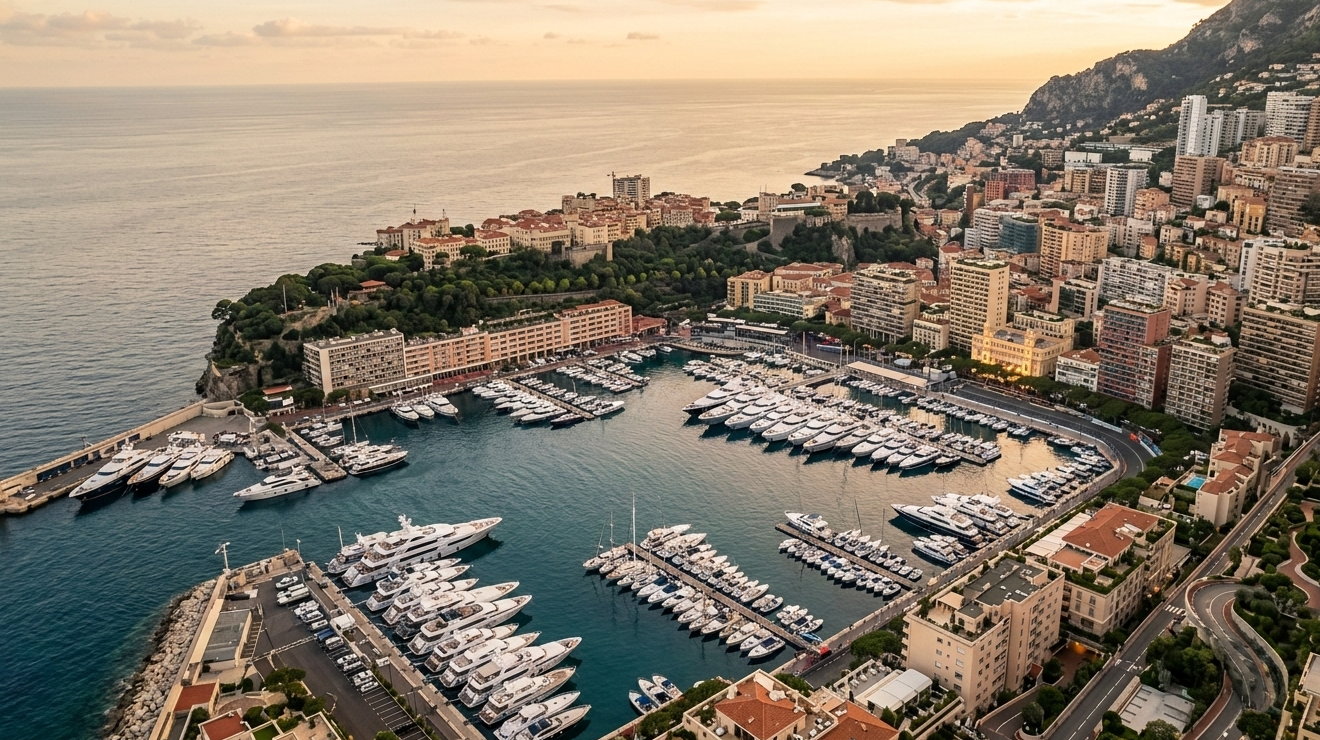
Monaco’s resale property market hit an average of EUR 51,967 per square metre in 2024 – a 44.3% increase over the past decade, according to IMSEE data. That figure already made it the world’s most expensive residential market per square metre. Then, in early 2025, Monaco’s revised price index methodology pushed the headline number to EUR 57,569 per square metre, with Larvotto – the principality’s seafront district – breaking through the EUR 71,000 barrier. For buyers operating at the EUR 3 million threshold and above, Monaco isn’t just expensive. It’s structurally different from every other European property market.
Typical Monaco entry point
Data-driven market analysis
Official sources cited
Full principality coverage
Last updated: February 2026
By: Alexander Thornbury MRICS
- What makes Monaco’s property market unique?
- How do prices differ across Monaco’s seven districts?
- What’s happening in the new build market?
- How strong is Monaco’s rental market?
- Why does Monaco’s zero-tax regime matter for buyers?
- What does the buying process actually involve?
- How does Monaco compare to other ultra-prime markets?
- Who’s buying in Monaco right now?
- Key takeaways
- FAQ
What makes Monaco’s property market unique?
Two square kilometres. That’s the entire principality. Roughly 39,000 residents occupy a footprint smaller than most London parks, and there’s physically nowhere left to build – bar one exception we’ll get to shortly. This permanent land scarcity is the single biggest factor driving Monaco’s pricing.
But scarcity alone doesn’t explain a 44.3% price increase over a decade. Monaco’s market sits at the intersection of three forces that don’t exist together anywhere else in Europe: zero personal taxation (no income tax, no capital gains tax, no wealth tax for residents), extreme physical constraint, and a regulatory environment that actively limits supply through controlled development approvals.
The result? A market that behaves less like residential property and more like a finite asset class. Resale prices averaged EUR 51,967 per square metre in 2024 according to IMSEE (Monaco’s national statistics institute) data. Year-on-year growth was a modest +1.1%, but that steadiness is the point. Monaco doesn’t spike and crash. It grinds upward.
One thing catches experienced property investors off guard. In Monaco, you’re not really buying square metres. You’re buying access to the jurisdiction. The property itself is the mechanism for residency, for tax positioning, for proximity to a specific lifestyle infrastructure. That distinction shapes everything from negotiation tactics to hold periods.
How do prices differ across Monaco’s seven districts?
Monaco packs extraordinary price variation into two square kilometres. The gap between the most expensive district (Larvotto at EUR 71,167 per square metre) and the mid-tier cluster (EUR 51,000-54,000) represents a 35-39% premium – and that’s within walking distance.
Here’s what the 2025 revised index data tells us.
| District | Price per sqm (2025) | YoY change | Character |
|---|---|---|---|
| Larvotto | EUR 71,167 | First above 70k | Seafront, beach, Mareterra delivery zone |
| Monte Carlo | EUR 54,009 | +4.8% | Casino, luxury retail, Hotel de Paris, prestige address |
| Fontvieille | EUR 52,518 | +4.5% | Reclaimed land, commercial hub, wider layouts |
| La Rousse / Saint-Roman | EUR 51,000-54,000* | Mid-tier band | Residential, high-rise, eastern principality |
| La Condamine | EUR 51,000-54,000* | Mid-tier band | Port Hercule, market hall, commercial core |
| Jardin Exotique | EUR 51,000-54,000* | Mid-tier band | Hillside, panoramic views, slightly quieter |
| Moneghetti | EUR 51,000-54,000* | Mid-tier band | Residential, garden settings, access to Jardin Exotique |
Sources: Monaco Tribune and Riviera Radio reporting on IMSEE’s 2025 revised price index. *Mid-tier cluster: Monaco Tribune reported four neighbourhoods in the EUR 51,000-54,000 band; individual breakdowns for these districts aren’t yet published under the revised methodology.
The takeaway for buyers is straightforward. Larvotto commands a structural premium because of seafront scarcity and the Mareterra development (Monaco’s only significant new land in a generation). Monte Carlo carries its own premium – it’s the prestige address, the Casino quarter, the place people picture when they think “Monaco.” But for buyers focused on square metres rather than postcode cachet, the mid-tier cluster offers materially more space for the money. And in a principality this small, “mid-tier” is still a ten-minute walk from everything.
For a deeper district-by-district analysis with development pipeline data and buyer suitability mapping, see our Monte Carlo vs Larvotto vs Fontvieille comparison guide.
What’s happening in the new build market?
The new build market in Monaco operates on a different plane from resales. Half of all new build transactions in 2024 exceeded EUR 22 million, and the mean new build sale price hit EUR 36.4 million according to IMSEE’s infographic data. That’s not a typo. The average new build transaction was EUR 36.4 million.
Why so high? Because new developments in Monaco are rare by design. The government controls approvals tightly, and there’s almost no land left to develop. The exception is Mareterra (formerly known as Le Portier) – a EUR 2 billion land extension project that’s literally creating new ground in the sea off Larvotto. It will deliver roughly 110 luxury apartments across 10 buildings, plus public amenities and a hectare of parkland.
Mareterra matters because it’s the last significant supply injection Monaco is likely to see for decades. The pricing will almost certainly set new benchmarks for the principality. Other recent completions include One Monte Carlo (mixed-use, delivered) and Bay House (Larvotto, ultra-premium).
For investors, the new build vs resale split creates a bifurcated market. Resale pricing grew steadily at +1.1% year-on-year in 2024, reflecting the steady, low-volatility character of Monaco. New builds, by contrast, trade at substantial premiums and tend to attract the very top end of the wealth spectrum – buyers for whom the price per square metre is secondary to exclusivity and specification.
How strong is Monaco’s rental market?
Prime rents in Monaco averaged EUR 114.50 per square metre per month in 2024, with overall rent growth of 6% for the year, according to Savills’ Spotlight Monaco 2025 report. Three-bedroom apartments – the benchmark for family-sized units – commanded EUR 142.30 per square metre per month, a 56% increase.
That 56% figure on three-bedroom rents deserves attention. It reflects extreme demand compression in the family segment. Monaco has limited stock of larger apartments, and families relocating for schooling and residency purposes compete fiercely for the few three-bedroom-plus units available. Supply simply can’t respond.
| Rental metric | Value (2024) | Source |
|---|---|---|
| Average prime rent per sqm/month | EUR 114.50 | Savills Spotlight Monaco 2025 |
| Overall rent growth | +6% | Savills Spotlight Monaco 2025 |
| 3-bed rent per sqm/month | EUR 142.30 | Savills Spotlight Monaco 2025 |
| 3-bed rent change | +56% | Savills Spotlight Monaco 2025 |
For context, a 100 square metre apartment in Monaco would rent for approximately EUR 11,450 per month at the average prime rate. A 150 square metre three-bedroom would be closer to EUR 21,345 per month. These are among the highest residential rents anywhere in the world, but they’re supported by a tenant pool that can afford them – Monaco’s rental market effectively has a built-in wealth filter.
The investment implications are mixed. Gross yields are compressed by extreme purchase prices – typically in the 2-3% range for prime Monaco property. But rental demand is structurally supported by the residency system (many new residents rent before buying), and void periods are essentially non-existent in the prime segment. Our Monaco property investment analysis covers yield calculations in detail.
Why does Monaco’s zero-tax regime matter for buyers?
Monaco’s tax position is the single biggest draw for UHNWI buyers, and it’s worth being precise about what “zero tax” actually means.
For residents of Monaco (excluding French nationals, who have their own arrangement under a 1963 bilateral treaty), there is no income tax, no capital gains tax, no wealth tax, and no property tax. Inheritance tax between spouses and direct-line heirs is 0%. For siblings it’s 8%, for aunts and uncles 10%, and higher rates apply to non-relatives. These rates are set by Monaco’s government service portal.
But “zero tax” doesn’t mean zero cost. The transaction costs of buying are real. For individuals and Monaco civil company structures (SCIs), transfer and notary-style costs run to approximately 6% of the purchase price. For other corporate structures, that figure rises to roughly 9%. On a EUR 10 million purchase, that’s EUR 600,000-900,000 in upfront friction.
The comparison with other European markets tells the story clearly. A buyer relocating from the UK with GBP 500,000 in annual income and a GBP 5 million property would face income tax of up to 45%, capital gains tax of up to 24%, and annual council tax and stamp duty. In Monaco, the same buyer pays none of those ongoing taxes. The savings compound dramatically over a 10-year hold period.
That said, there’s a critical exception. French nationals who become Monaco residents remain subject to French taxation under the 1963 convention between France and Monaco – a point that catches some buyers by surprise. And company tax does apply in Monaco for businesses generating more than 25% of their revenue outside the principality, at a rate of 25%.
For a full breakdown of Monaco’s tax framework compared to Andorra and Switzerland, see our Monaco vs Andorra vs Switzerland tax comparison. For detailed residency and tax guidance specific to Monaco, our Monaco property taxes and residency guide covers the specifics.
What does the buying process actually involve?
Buying in Monaco follows French-influenced civil law procedures, but the process is simpler than most buyers expect. There are no restrictions on foreign ownership – anyone, of any nationality, can purchase property in the principality.
The process works like this. Buyer and seller agree terms, then sign a preliminary agreement (compromis de vente) with a 10% deposit held by the notaire. There’s a standard 10-day cooling-off period for the buyer. The notaire then conducts due diligence on the title and any encumbrances, and the final deed of sale (acte de vente) is signed, typically within two to three months of the preliminary agreement.
Cost breakdown for a typical purchase:
| Cost element | Typical rate | On EUR 10m property |
|---|---|---|
| Transfer and notary costs (individual/SCI) | ~6% | ~EUR 600,000 |
| Transfer and notary costs (other structures) | ~9% | ~EUR 900,000 |
| Agency commission (if applicable) | 3-5% | EUR 300,000-500,000 |
| Annual property tax | None | EUR 0 |
| Annual wealth tax | None | EUR 0 |
Source: Monaco government and notarial guidance. Rates are indicative – always verify with a Monaco-qualified notaire.
A few practical points that agents won’t always mention upfront. First, Monaco’s notaires are appointed by the Prince and act for both parties – they’re neutral, not adversarial. Second, many transactions use SCI structures (Societe Civile Immobiliere) for succession planning and flexibility. Third, mortgage financing is available from Monaco-based banks, though most UHNWI buyers purchase outright.
For buyers considering residency alongside a purchase, the two processes can run in parallel but are technically separate. You don’t need to own property to become a resident (renting qualifies too), and owning property doesn’t automatically grant residency. Our Monaco residency application guide walks through the process step by step.
How does Monaco compare to other ultra-prime markets?
Comparing Monaco to other luxury markets isn’t quite apples to apples. No other city operates within the same constraints – two square kilometres, zero income tax, controlled development. But the comparison is useful for benchmarking what you get for the money and understanding where Monaco sits in a global portfolio.
| Market | Prime price per sqm | Income tax rate | Annual property tax | Capital gains tax |
|---|---|---|---|---|
| Monaco | EUR 51,967 (resale avg 2024) | 0% | None | 0% |
| London (prime central) | EUR 25,000-35,000 | Up to 45% | Council tax + ATED | Up to 24% |
| Paris 16th | EUR 12,000-18,000 | Up to 45% | Taxe fonciere | Up to 36.2% |
| Hong Kong (The Peak) | EUR 35,000-55,000 | 15% (salaries) | Rates + government rent | 0% |
| New York (Manhattan prime) | EUR 18,000-30,000 | Up to 37% federal + state | ~1.1% of assessed value | Up to 20% federal |
| Singapore (Sentosa Cove) | EUR 15,000-25,000 | Up to 22% | Property tax 10-20% | 0% (after 3 years) |
Monaco data: IMSEE (2024). Other markets: indicative prime ranges from Knight Frank, Savills, and local sources. Tax rates are headline rates for non-domiciled/foreign buyers – effective rates vary by structure and individual circumstances.
What jumps out isn’t just that Monaco is the most expensive per square metre. It’s the total cost of ownership over time. In London, a EUR 10 million property faces ongoing council tax, potential ATED charges, income tax on any rental income, and capital gains tax on disposal. In Monaco, after the initial ~6% transaction cost, the ongoing tax burden is effectively zero. Over a 10-year hold period, the total cost of ownership calculation often favours Monaco despite the higher entry price.
For a Mediterranean-specific comparison – where many UHNWI buyers are weighing Monaco against Spanish coastal markets – our Monaco vs Marbella vs Mallorca comparison provides a head-to-head analysis. The Marbella vs Monaco vs Ibiza comparison covers the same ground from the Spanish perspective.
Who’s buying in Monaco right now?
Monaco’s buyer pool is global, but certain patterns emerge consistently. The market positions itself squarely toward globally mobile UHNWIs – individuals and families whose wealth, lifestyle, and tax planning needs align with what the principality offers.
The typical Monaco buyer profile looks something like this. Net worth of EUR 30 million or above. Age 45-65 for the primary segment, with a growing cohort of 35-45 year old tech entrepreneurs and family office principals. Multiple properties globally – Monaco would typically be the second, third, or fourth home. The primary motivation is a combination of tax efficiency, personal security, lifestyle, and access to the broader French Riviera.
British buyers represent one of the largest nationality groups in Monaco’s international property market. Post-Brexit changes to freedom of movement haven’t dampened demand; if anything, the tax differential between the UK and Monaco has become a stronger pull factor as UK tax burdens have increased. Our British buyers in Monaco guide covers the post-Brexit specifics.
German, Scandinavian, and Middle Eastern buyers make up the other prominent nationality groups. Each nationality brings different priorities. German buyers tend to favour larger apartments with parking and storage. Scandinavian buyers often prioritise proximity to schools and outdoor amenities. Middle Eastern buyers typically focus on the highest specification new builds.
Family offices are an increasingly visible buyer segment. With 5-15% of assets under management typically allocated to real estate, a family office managing EUR 500 million might target EUR 25-75 million in property exposure. Monaco’s stability, liquidity (relative to other ultra-prime markets), and zero ongoing taxation make it attractive for institutional-grade capital preservation.
For buyers weighing Monaco against other low-tax European jurisdictions, our Monaco vs Andorra vs Switzerland comparison breaks down how these three markets compete for the same buyer pool.
Key takeaways
- Resale prices averaged EUR 51,967 per sqm in 2024 – a 44.3% increase over the past decade, with the 2025 revised index pushing the headline to EUR 57,569 per sqm (IMSEE, Monaco Tribune).
- Larvotto is the most expensive district at EUR 71,167 per sqm – driven by seafront scarcity and Mareterra delivery. Monte Carlo sits at EUR 54,009 and Fontvieille at EUR 52,518 (2025 revised index).
- New builds trade at extraordinary levels – half of 2024 new build sales exceeded EUR 22 million, with a mean transaction price of EUR 36.4 million (IMSEE).
- Prime rents averaged EUR 114.50 per sqm per month – with three-bedroom rents at EUR 142.30 per sqm per month, up 56% year-on-year (Savills Spotlight Monaco 2025).
- Zero ongoing personal taxation for residents – no income tax, no capital gains, no wealth tax, no property tax. Purchase costs of ~6% for individuals/SCIs, ~9% for other structures (Monaco government).
- Permanent land scarcity defines the market – two square kilometres, controlled development, and Mareterra as the last significant supply injection for decades. Monaco property behaves more like a finite asset class than residential real estate.
Frequently asked questions
What is the average property price per square metre in Monaco?
The average resale price was EUR 51,967 per square metre in 2024, according to IMSEE data. Under the revised 2025 index methodology, the average is EUR 57,569 per square metre. The difference reflects improved measurement accuracy, not a sudden price jump.
How much have Monaco property prices risen over the past decade?
Resale prices increased by 44.3% over the 10-year period to 2024, according to IMSEE data. Year-on-year growth in 2024 was +1.1%, reflecting the market’s characteristic low-volatility trajectory.
Which is the most expensive district in Monaco?
Larvotto, at EUR 71,167 per square metre under the 2025 revised index. It’s the first district to break through the EUR 70,000 barrier, driven by seafront scarcity and the Mareterra development. Monte Carlo is the next most expensive at EUR 54,009 per square metre.
What are typical purchase costs when buying property in Monaco?
Transfer and notary costs run to approximately 6% of the purchase price for individuals and SCI structures, or approximately 9% for other corporate structures. New builds may be subject to VAT instead. Source: Monaco government and notarial guidance.
Is there property tax in Monaco?
No. Monaco does not levy an annual property tax on residential real estate. There is also no income tax, no capital gains tax, and no wealth tax for residents (excluding French nationals under the 1963 convention). Source: Monaco government service portal.
Can foreigners buy property in Monaco?
Yes. There are no restrictions on foreign ownership. Any individual of any nationality can purchase residential property in Monaco. The buying process follows French-influenced civil law procedures, with a notaire acting for both parties.
What is Mareterra and why does it matter?
Mareterra (formerly Le Portier) is a EUR 2 billion land extension project creating new ground off the Larvotto coastline. It will deliver approximately 110 luxury apartments across 10 buildings, plus public amenities and parkland. It’s significant because it’s the last major land reclamation project Monaco is likely to undertake, making it the final substantial addition to the principality’s housing stock.
What are rental yields like in Monaco?
Gross yields in prime Monaco typically fall in the 2-3% range, compressed by extreme purchase prices. Average prime rents are EUR 114.50 per square metre per month, with 6% growth in 2024. Three-bedroom rents are higher at EUR 142.30 per square metre per month. Source: Savills Spotlight Monaco 2025.
How does Monaco compare to London for property investment?
Monaco is significantly more expensive per square metre (EUR 51,967 vs EUR 25,000-35,000 for prime central London), but the total cost of ownership over time can favour Monaco due to zero ongoing taxation. London property faces income tax on rental income (up to 45%), capital gains tax (up to 24%), council tax, and potential ATED charges for corporate-held property.
What is the Monaco residency bank deposit requirement?
Residency applicants must demonstrate financial self-sufficiency, typically evidenced by a deposit of EUR 500,000 or more in a Monaco-based bank account. This requirement is administered by the Direction de la Surete Publique. Property ownership alone does not grant residency.
How did the 2025 price index methodology change affect reported prices?
Monaco’s government introduced a revised price index in 2025 that better accounts for location and asset characteristics. This pushed the reported average from EUR 51,967 (2024 resale average under the old methodology) to EUR 57,569 under the new model. The change improves data quality but means year-on-year comparisons should specify which methodology is used. Source: Monaco Tribune, Riviera Radio.
What does EUR 5 million buy in Monaco?
At the 2024 resale average of EUR 51,967 per square metre, EUR 5 million buys approximately 96 square metres – roughly a well-specified two-bedroom apartment. In the mid-tier districts, you might stretch to 100 square metres. In Larvotto, at EUR 71,167 per square metre, the same budget buys approximately 70 square metres. Monaco is not a market where EUR 5 million buys grandeur – it buys access to the jurisdiction.
Are there inheritance tax advantages to owning Monaco property?
Yes. Inheritance tax between spouses and direct-line heirs (children, parents) is 0% in Monaco. Between siblings the rate is 8%, between aunts/uncles and nieces/nephews it’s 10%, and higher rates apply to unrelated parties. Source: Monaco government service portal (monservicepublic.gouv.mc).
What share of new build sales exceed EUR 22 million?
Half of all new build sales in 2024 exceeded EUR 22 million, and the mean new build sale price was EUR 36.4 million. This reflects Monaco’s position as an ultra-prime market where new developments target the very top of the wealth spectrum. Source: Monaco Tribune reporting IMSEE data.
Is Monaco a good long-term property investment?
Monaco’s track record suggests strong capital preservation with steady, low-volatility growth – 44.3% over 10 years equates to roughly 3.7% compounded annually before rental income. Gross rental yields of 2-3% add to total returns. The structural arguments (permanent scarcity, zero taxation, stable governance) support long-term holdings, but entry costs are high and liquidity is lower than mainstream markets. For a detailed investment analysis, see our Monaco property investment returns guide.
Sources
- IMSEE – Institut Monegasque de la Statistique et des Etudes Economiques (Monaco’s national statistics institute – property price data, market reports, infographics)
- Knight Frank – Monaco Property Market Insight (resale pricing, 10-year trends, market analysis citing IMSEE data)
- Knight Frank – Monaco Buying Guide (purchase costs, transaction process, tax framework)
- Savills – Spotlight Monaco 2025 (prime rental data, rent growth, three-bedroom benchmarks)
- Monaco Government Service Portal (inheritance tax rates, residency requirements, official tax guidance)
- Monaco Tribune (2025 revised price index reporting, district-level pricing, new build data)
For exclusive access to Monaco’s finest luxury properties and expert market insight, contact our concierge team at monaco@blackprive.com
Browse our full Monaco property collection at www.blackprive.com/monaco