
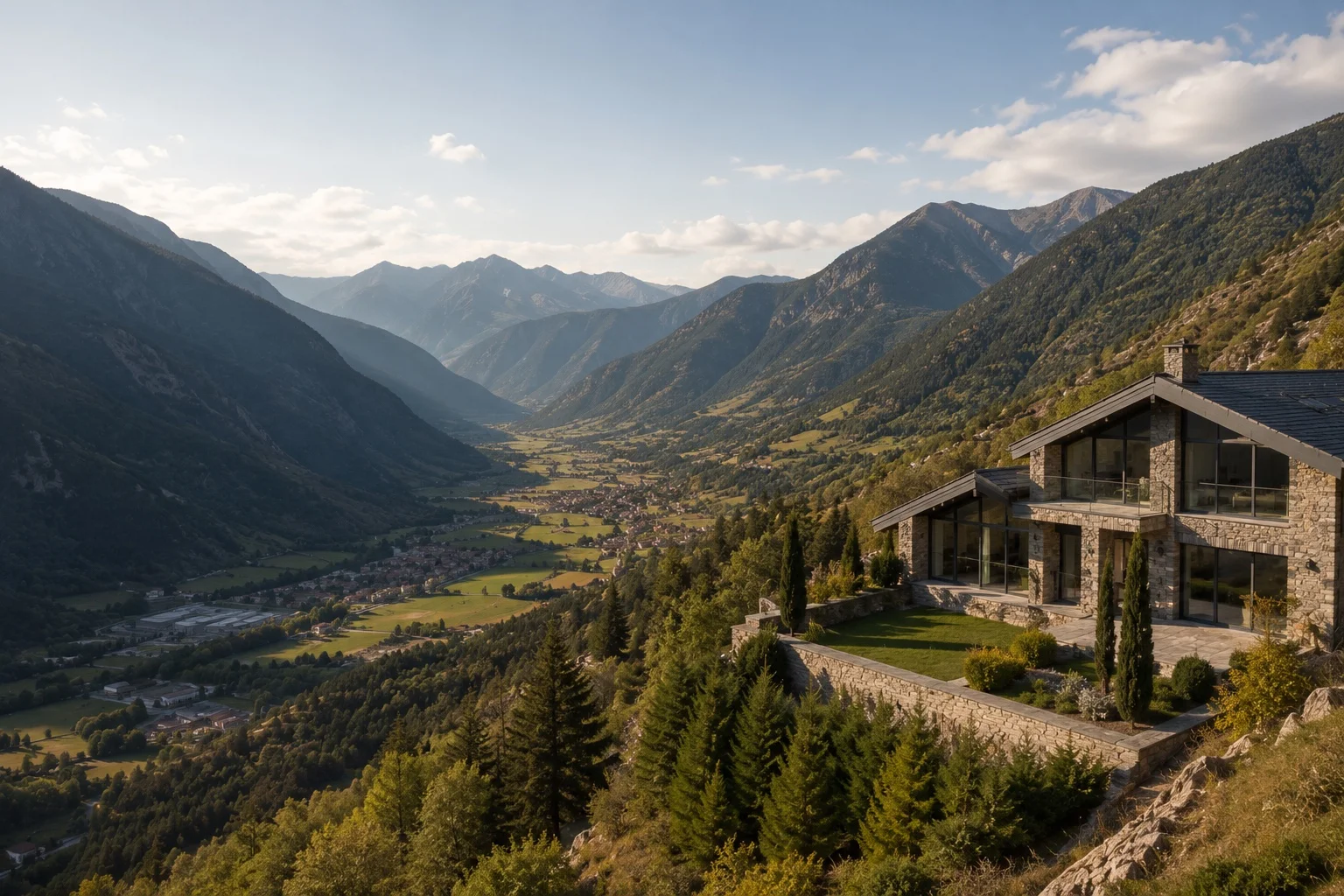
Spain borders Andorra to the south, has a tax treaty with it since 2016, and is the corridor most travelled by relocating buyers heading into the principality. For a Spanish resident, Andorra offers a far lower tax bill a couple of hours from Barcelona, and a permanent alternative to Spain’s time-limited inbound regimes. This guide covers what you leave, what you land in, and how the two systems connect.
Barcelona in ~3 hours
Spain-Andorra tax treaty
Not a time-limited regime
On the Spanish exit
Last updated: 22 July 2026
By: Alexander Thornbury
Why Spanish buyers choose Andorra
Spain is the busiest corridor into Andorra, and for good reason. The two share a border, so a move is a short drive rather than an emigration, and Spain sends a steady flow of entrepreneurs, business owners and online professionals north for a lower tax base. Andorra’s draw against Spain is a top income tax rate of 10%, no wealth tax, and no inheritance or gift tax, set against Spain’s higher income tax, its regional wealth and solidarity taxes, and its succession taxes.
As always with Andorra, the benefit is a residency benefit, not an ownership one. It rewards a genuine move and genuine tax residency. For the full framing, see our international buyer’s guide to Andorra property.
Andorra versus Spain’s Beckham regime
A Spanish resident weighing options often compares Andorra with staying in Spain under the Beckham Law, Spain’s inbound impatriate regime. The key difference is duration and permanence. The Beckham regime is a time-limited arrangement tied to Spanish employment, and it does not switch off Spanish wealth tax on Spanish assets. Andorra, by contrast, is a permanent low-tax base for someone who actually relocates.
So the two are not the same product. Beckham keeps you in Spain on favourable terms for a defined window; Andorra takes you out of the Spanish system entirely, permanently, if you move properly. For a buyer whose horizon is long and who is willing to relocate, Andorra is the more durable answer; for someone tied to Spanish employment for a fixed period, Beckham may suit better.
What you land in
The Andorran regime is the prize. Income tax tops out at 10%, with nothing on the first EUR 24,000. There is no wealth tax, no inheritance tax and no gift tax, and IGI is 4.5%. Buying a home carries the Foreign Investment Tax, but at 6% on a single home, it is a real cost to budget for.
Residency unlocks it. Passive residency requires EUR 1,000,000 in Andorran assets, or EUR 400,000 via the Housing Fund, plus a non-refundable deposit and 90 days a year of presence. See our residency guide and tax guide for the detail.
| For a relocating buyer | Spain (as resident) | Andorra (as resident) |
|---|---|---|
| Top income tax | High, progressive | 10% |
| Wealth tax | Regional wealth tax + Solidarity Tax above EUR 3M | None |
| Inheritance tax | Applies (regional) | None |
The treaty and breaking Spanish residence
Spain and Andorra have had a double-tax treaty in force since 2016, which makes this corridor cleaner than moving from a country with no Andorran treaty. It allocates taxing rights between the two countries and gives a framework for the transition. It does not, though, remove the need to break Spanish tax residence properly.
Spain taxes worldwide income for its residents and applies an exit tax on unrealised gains for those leaving with substantial shareholdings; the thresholds turn on your position, so take Spanish tax advice before moving. Spanish tax residence is based on more than 183 days in Spain or your centre of economic interest there, and Andorran tax residence on the same kind of test in Andorra. Meeting the Andorran permit’s 90-day floor is not the same as becoming Andorran tax-resident. Coordinate both sides with advisers.
Getting there
Andorra has no airport, but from Spain it is a straightforward drive: roughly two and three-quarter to three hours from Barcelona-El Prat, or 30 to 40 minutes from the small La Seu d’Urgell airport just over the border, which handles limited domestic Spanish flights. For a Spanish buyer, that is close enough that relocation keeps Barcelona, and its international connections, within easy reach.
The proximity is a large part of why Spain is the dominant Andorra corridor. A Spanish business owner can base themselves in Andorra for tax residency while staying connected to Barcelona and the wider region. It is a genuine move, but a short one, which suits buyers who want the tax outcome without uprooting entirely.
| Passive residency at a glance | Detail |
|---|---|
| Investment | EUR 1,000,000 in Andorran assets, or EUR 400,000 via the Housing Fund |
| Government deposit | EUR 50,000 + EUR 12,000 per dependant, non-refundable |
| Physical presence | 90 days a year minimum |
Key takeaways
- Spain borders Andorra and has a tax treaty with it since 2016, making this the busiest corridor.
- Andorra offers a 10% top income tax and no wealth, inheritance or gift tax, against Spain’s higher income tax and its wealth and solidarity taxes.
- Andorra is a permanent base, unlike Spain’s time-limited Beckham regime, which does not switch off Spanish wealth tax.
- Breaking Spanish residence needs planning, including Spain’s exit tax on substantial holdings. Take Spanish advice.
- It is a short drive from Barcelona, or minutes from La Seu d’Urgell.
Frequently asked questions
Why do people move from Spain to Andorra?
For a much lower tax base close to home: a 10% top income tax, no wealth tax, and no inheritance or gift tax, against Spain’s higher income tax, its regional and solidarity wealth taxes, and its succession taxes. Andorra borders Spain, so the move stays regional.
Is Andorra better than Spain’s Beckham Law?
They differ. The Beckham regime is a time-limited arrangement tied to Spanish employment and does not remove Spanish wealth tax on Spanish assets. Andorra is a permanent low-tax base for someone who genuinely relocates. Which suits depends on your horizon.
Is there a tax treaty between Spain and Andorra?
Yes, in force since 2016. It allocates taxing rights between the two countries and gives a framework for a clean transition, an advantage over moving from a country with no Andorran treaty.
Does Spain have an exit tax?
Spain applies an exit tax on unrealised gains for those leaving with substantial shareholdings, and taxes worldwide income for its residents. The thresholds depend on your position, so take Spanish tax advice before moving.
How long does it take to get from Spain to Andorra?
Roughly two and three-quarter to three hours by road from Barcelona-El Prat, or 30 to 40 minutes from the small La Seu d’Urgell airport across the border. Andorra has no airport of its own.
How much do I need to invest for Andorra residency?
Passive residency requires EUR 1,000,000 in Andorran assets, or EUR 400,000 via the Housing Fund, plus a non-refundable deposit of EUR 50,000 plus EUR 12,000 per dependant, and 90 days a year of presence.
Sources
- Govern d’Andorra – Andorran tax, residency and the Spain-Andorra double-tax convention (2016)
- Agencia Tributaria (Spain) – Spanish residence, wealth and solidarity taxes, exit tax
Figures current at July 2026. The Spanish exit and the Andorran arrival should both be planned with qualified advisers before you move.

About the author
Alexander Thornbury is a published author who writes on international property, tax and residency for high-net-worth buyers across Europe. His work focuses on the practical mechanics of cross-border purchase: what a buyer actually pays, owes and signs. More at alexanderthornbury.com.