
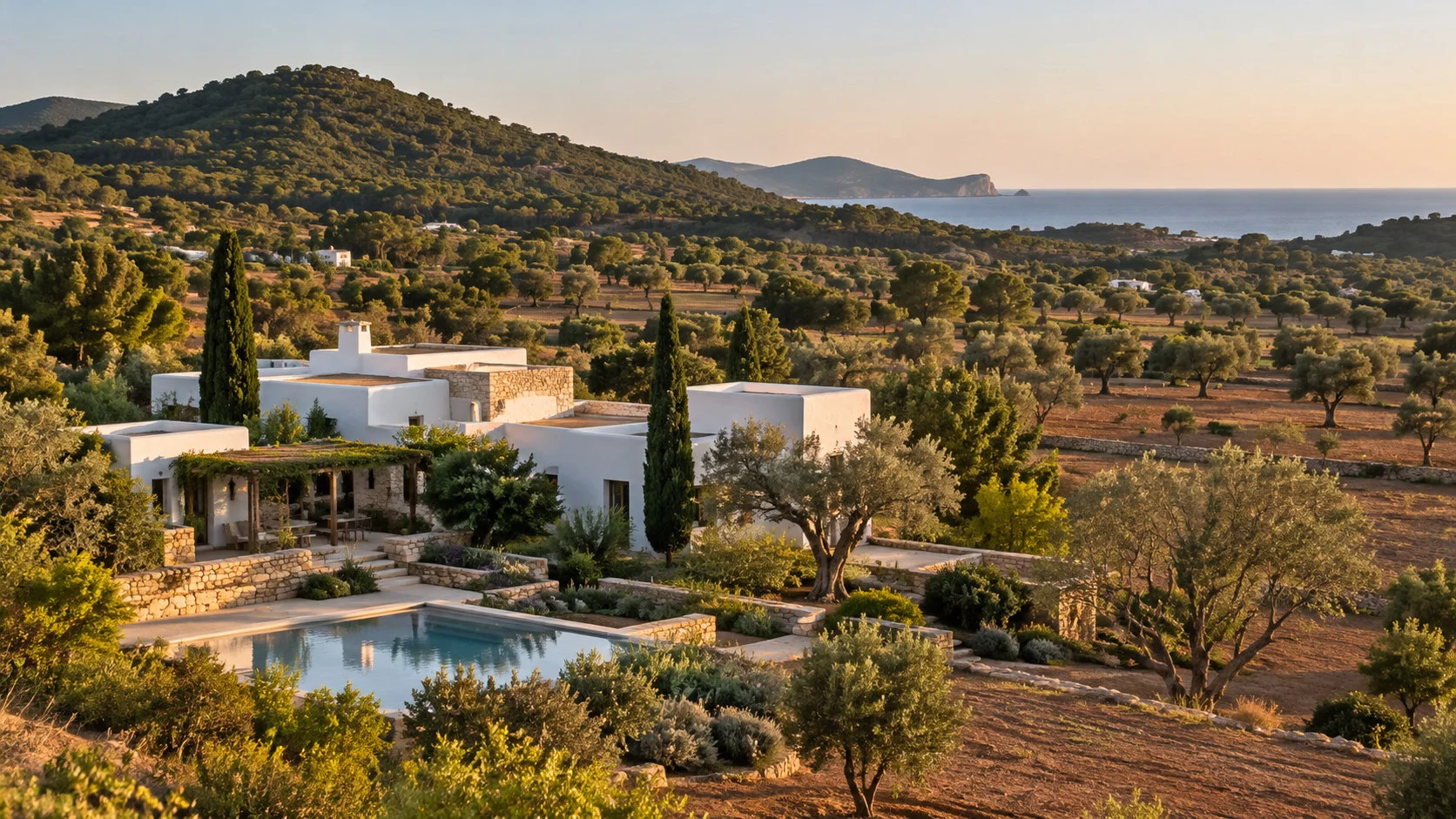
Ibiza’s prime market isn’t one strip of coast. It runs across all five of the island’s municipalities, and each offers a different life. Santa Eulària des Riu, on the east coast, has had the highest appraised home values of any large Spanish town every quarter since mid-2022. Eivissa has the old walled town and the marinas. Sant Josep has the south-west coves, Sant Antoni the sunsets and Sant Joan the quiet north. This guide takes international buyers through each, with what the 2025 letting rules mean for a villa in each kind of setting.
Five different markets
Per m2, Santa Eulària, Q2 2026
Dalt Vila, since 1999
Letting limits by setting
Last updated: October 2026
By: Alexander Thornbury
How is the island divided?
Into five municipalities, and each one is its own market. Eivissa is the capital and port in the south-east. Santa Eulària des Riu covers the east coast and the green interior behind it. Sant Josep de sa Talaia runs along the south and west, Sant Antoni de Portmany holds the west coast, and Sant Joan de Labritja the north. Each town hall sets its own local property tax, and the island council’s 2025 letting rules apply differently to town homes and to country villas.
Only two of the five appear in the Ministry of Housing’s appraisal figures for towns of more than 25,000 people, and both sit near the top of the national table. Santa Eulària des Riu led it in the second quarter of 2026 at EUR 6,844 per square metre, and Eivissa came third at EUR 5,473. These are averages across all homes, so a prime villa trades far above them. Our main Ibiza guide covers the market as a whole.
| Municipality | Where | What buyers look for | Appraised value, Q2 2026 |
|---|---|---|---|
| Santa Eulària des Riu | East coast and interior | Country estates around Santa Gertrudis and Jesús, the golf at Roca Llisa, coastal villas | EUR 6,844 per m2 (1st in Spain) |
| Eivissa | South-east, the capital | Dalt Vila, the marina at Botafoch, town living | EUR 5,473 per m2 (3rd in Spain) |
| Sant Josep de sa Talaia | South and west | Cliff-top villas around Es Cubells and Cala Jondal, views to Es Vedrà | Not in the series |
| Sant Antoni de Portmany | West coast | Sunset-facing villas, the valleys around Santa Agnès de Corona | Not in the series |
| Sant Joan de Labritja | North | Quiet country houses around Sant Miquel and Sant Llorenç | Not in the series |
Source: Ministry of Housing, average appraised value of free-market homes, municipalities over 25,000 people. Sant Josep, Sant Antoni and Sant Joan are not covered.
Why is Santa Eulària des Riu the most valuable?
Because it offers the widest choice of prime settings in one municipality. It takes in the small resort town of Santa Eulària itself, the coast to the north and south, and a green interior of farmland and low hills where the villages of Santa Gertrudis and Jesús sit. The island’s only golf course is at Roca Llisa, and Eivissa and the airport are within easy reach. Buyers who want a country estate, a golf-side villa or a house by the sea can find all three here.
The numbers show the demand. Its average appraised value rose 13.3% in the year to the second quarter of 2026, and from EUR 4,219 to EUR 6,844 per square metre in the four years since it first topped the national table. Much of the best stock is in the countryside, though, and that brings the letting and licence questions in section 6 into play.
What does Eivissa offer?
Town life, which no other part of the island can match. Eivissa is the capital and port, and its old walled town, Dalt Vila, is part of the UNESCO World Heritage site Ibiza, Biodiversity and Culture, listed in 1999. Below it are the harbour, the marina at Botafoch and the restaurants and shops that keep running through the winter. Buyers here are usually after an apartment or townhouse they can lock and leave, with everything within walking distance.
Two points shape a purchase. Most homes are in apartment buildings, and since April 2025 no new tourist places can be created in apartment buildings anywhere in the Balearics, so treat an Eivissa flat as a home, not a holiday let. And town homes avoid the rustic-land licence questions that come with a country villa. Our buying guide sets out the checks for each.
Sant Josep, Sant Antoni or Sant Joan?
Choose by the light and the pace. Sant Josep de sa Talaia, in the south and west, has many of the island’s best-known coves, from Cala Jondal to Es Cubells, the views across to the rock of Es Vedrà, and the airport, which sits within the municipality. Its southern tip runs into the salt flats and beaches protected as the Ses Salines natural park. It suits buyers who want dramatic sea views and quick access to flights.
Sant Antoni de Portmany faces west, so its villas look straight into the sunset, and inland the valleys around Santa Agnès de Corona are some of the quietest countryside on the island. Sant Joan de Labritja, in the north, is the greenest and least developed part of Ibiza, with old farmhouses around Sant Miquel de Balansat and Sant Llorenç. It suits buyers who want privacy above all and don’t mind the drive south. In all three, much of the prime stock is on rustic land, so the 2025 letting rule applies.
Is Formentera worth considering?
For buyers who want something quieter still, yes. Formentera is the small island south of Ibiza, reached only by sea from Ibiza’s port, as it has no airport. The waters between the two islands, with their Posidonia seagrass meadows, are part of the same UNESCO World Heritage site as Dalt Vila. It is a separate, much smaller market, and the same Balearic taxes apply.
The trade-off is access. Every trip starts with a flight to Ibiza and a boat across, which suits a summer house better than a year-round home. If you’re weighing the islands against each other or against the mainland, our comparison of Ibiza, Mallorca and Marbella sets the bigger choices side by side.
What should decide where you buy?
How you’ll use the house, more than the postcode. If you plan to let it to holidaymakers, the rules narrow the choice sharply: since August 2025, no home on rustic land built after 1956 can be let to tourists on Ibiza, and since April 2025 no new tourist places can be created in apartment buildings. A villa that already holds a valid registration, for the number of places you need, is worth more to a letting buyer than the same house without one.
If you’ll live in it yourself, the questions are practical: how far you want to be from town, the airport and the beach, how you feel about the drive in winter, and whether every part of the house is properly licensed. Our Ibiza tax guide covers the running costs wherever you buy, and our residency guide covers what changes if you move to the island.
| If you want | Look at | Watch for |
|---|---|---|
| A country estate near town | Santa Gertrudis, Jesús (Santa Eulària) | Licences on rustic land; no new tourist lets after 1956 |
| Walk-everywhere town living | Dalt Vila, Botafoch (Eivissa) | No new tourist places in apartment buildings |
| Sea views and quick flights | Es Cubells, Cala Jondal (Sant Josep) | Steep plots, water supply, pool licence |
| Sunsets and quiet valleys | Santa Agnès de Corona (Sant Antoni) | Rustic-land licences |
| Privacy above all | Sant Miquel, Sant Llorenç (Sant Joan) | Distance to town and airport |
| Golf on the doorstep | Roca Llisa (Santa Eulària) | Community rules on letting |
Key takeaways
- Santa Eulària des Riu is Spain’s most valuable large town on the official figures: EUR 6,844 per m2 in Q2 2026, first every quarter since mid-2022.
- Eivissa offers town living around Dalt Vila and the marinas, mostly in apartment buildings.
- Sant Josep has the south-west coves and the airport; Sant Antoni the sunsets; Sant Joan the quiet north.
- Formentera is the quieter alternative, reached only by sea.
- Letting rules depend on the setting: no new places in apartment buildings, and none on rustic land for homes built after 1956.
- Choose by how you’ll use the house, then check its licences and registration.
Frequently asked questions
What is the most expensive area of Ibiza?
Santa Eulària des Riu, on the Ministry of Housing’s figures. It had the highest average appraised home value of any Spanish town over 25,000 people in the second quarter of 2026, at EUR 6,844 per square metre.
Where do the wealthiest buyers live on Ibiza?
Across the island rather than in one enclave: country estates around Santa Gertrudis and Jesús, cliff-top villas in Sant Josep around Es Cubells and Cala Jondal, and the quiet north around Sant Miquel and Sant Llorenç.
Is it better to buy in Ibiza town or the countryside?
It depends on use. Eivissa suits a lock-up-and-leave home within walking distance of everything. The countryside offers space and privacy, but brings licence checks and stricter letting rules for homes built after 1956.
Where is the quietest part of Ibiza?
Sant Joan de Labritja in the north, the greenest and least developed part of the island, and the valleys around Santa Agnès de Corona in Sant Antoni.
Which part of Ibiza is closest to the airport?
Sant Josep de sa Talaia, where the airport sits. Eivissa and the southern part of Santa Eulària are also within easy reach.
Is there a golf course on Ibiza?
One, at Roca Llisa in Santa Eulària des Riu, and the villas around it form one of the island’s established residential areas.
Can I let a villa in the Ibiza countryside to tourists?
Only if it already holds a valid tourist registration. Since August 2025, no home on rustic land built after 1956 can be let to tourists on Ibiza.
Can I let an apartment in Ibiza town to tourists?
Not with a new registration. Since April 2025 no new tourist places can be created in apartment buildings anywhere in the Balearics.
What is Dalt Vila?
The old walled town of Eivissa, part of the UNESCO World Heritage site Ibiza, Biodiversity and Culture since 1999, and one of the island’s most sought-after places to own a townhouse.
Is Formentera a good alternative to Ibiza?
For buyers who want more quiet and can accept the boat trip, yes. It has no airport, is reached by sea from Ibiza and shares the same Balearic taxes.
Do property taxes differ between Ibiza’s municipalities?
The Balearic taxes on buying, wealth and inheritance are the same across the island. Each town hall sets its own local property tax, IBI, on the cadastral value.
Sources
- Ministry of Housing – Average appraised value of free-market homes, municipalities over 25,000 people (table 4)
- Ajuntament d’Eivissa – Ibiza, Biodiversity and Culture, UNESCO World Heritage since 1999
- Govern de les Illes Balears – Decree-Law 4/2025 on tourism containment
- Consell d’Eivissa – Modification no. 2 of the Ibiza territorial plan (1 August 2025)
- Aena – Ibiza airport, 2025
- Golf Ibiza – Roca Llisa, the island’s only golf course
Figures current at October 2026.

About the author
Alexander Thornbury is a published author who writes on international property, tax and residency for high-net-worth buyers across Europe. His work focuses on the practical mechanics of cross-border purchase: what a buyer actually pays, owes and signs. More at alexanderthornbury.com.