
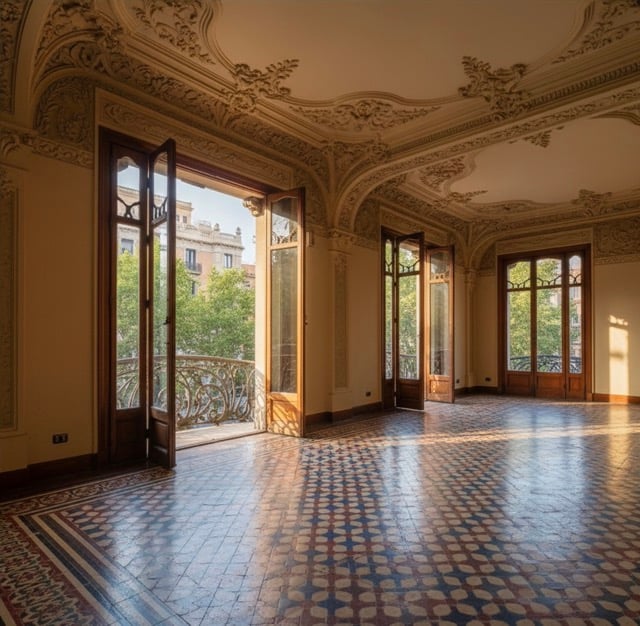
The Quadrat d’Or represents Barcelona’s most concentrated collection of architectural masterpieces. This 100-block zone within the Eixample district contains Europe’s finest Modernista heritage, with residential units available in buildings designed by Gaudí, Domènech i Montaner, and Puig i Cadafalch.
Living here means occupying irreplaceable architecture that museums worldwide celebrate. The €45 million Mandarin Oriental penthouse sale achieved approximately €69,231 per square metre, establishing Barcelona’s ultra-prime ceiling. For buyers seeking design significance alongside residential function, no European address competes.
Contents
- How much do properties cost on Passeig de Gràcia?
- What makes the Quadrat d’Or architecturally significant?
- Which buildings contain residential units?
- How do floor premiums work in Modernista buildings?
- What are the renovation constraints for protected buildings?
- Who buys in the Quadrat d’Or?
- How does the Quadrat d’Or compare to other Eixample zones?
- What is the 2026 World Capital of Architecture designation?
How Much Do Properties Cost on Passeig de Gràcia?
Passeig de Gràcia and the surrounding Quadrat d’Or command Barcelona’s highest per-square-metre prices, with refurbished units regularly exceeding €10,000 per square metre and exceptional properties approaching €20,000.
The avenue’s pricing reflects irreplaceable location, architectural heritage, and scarcity. Unlike new developments where supply can theoretically expand, Modernista building stock is finite. Each transaction reshuffles ownership rather than adding inventory.
Passeig de Gràcia Price Positioning
| Property Category | €/sqm Range | Typical Size | Total Price |
| Principal floor, original features | €12,000-18,000 | 200-400 sqm | €2.4-7.2M |
| Upper floor apartment | €9,000-14,000 | 150-300 sqm | €1.35-4.2M |
| Penthouse (added later) | €15,000-25,000 | 150-350 sqm | €2.25-8.75M |
| Renovation project | €7,000-10,000 | 150-350 sqm | €1.05-3.5M |
| Ground floor/commercial conversion | €6,000-9,000 | 200-500 sqm | €1.2-4.5M |
Ultra-Prime Transactions (Anonymised)
| Property Type | Size | Price | €/sqm | Building |
| Penthouse, landmark building | 650 sqm | €45M | €69,231 | Modernista icon |
| Principal floor, original features | 380 sqm | €5.8M | €15,263 | Domènech i Montaner |
| Duplex, rooftop terrace | 420 sqm | €7.2M | €17,143 | Early Eixample |
| Restored apartment, Gaudí building | 280 sqm | €4.9M | €17,500 | Casa Milà vicinity |
| Corner apartment, triple aspect | 310 sqm | €4.2M | €13,548 | Puig i Cadafalch |
What Makes the Quadrat d’Or Architecturally Significant?
The Quadrat d’Or (Golden Square) encompasses roughly 100 blocks radiating from Passeig de Gràcia, containing the world’s densest concentration of Catalan Modernisme architecture. This late 19th and early 20th-century movement paralleled Art Nouveau elsewhere in Europe but developed distinctive Catalan characteristics.
The Manzana de la Discòrdia
Passeig de Gràcia’s most celebrated block contains three masterpieces competing for attention:
Casa Batlló (Gaudí, 1904-1906) features the famous dragon-spine roof and skull-like balconies. No residential units are publicly available; the building operates as a museum and event venue.
Casa Amatller (Puig i Cadafalch, 1898-1900) blends Gothic and Dutch influences with a distinctive stepped gable. The building contains limited residential and commercial space.
Casa Lleó Morera (Domènech i Montaner, 1902-1906) showcases the architect’s decorative exuberance. Some residential units occasionally trade.
Signature Architectural Features
| Feature | Description | Residential Impact |
| Catalan vaults | Thin-tile vaulted ceilings | Distinctive, irreplaceable |
| Hydraulic floor tiles | Geometric patterned flooring | Restoration priority |
| Ornate ironwork | Balconies, gates, railings | Protected element |
| Stained glass | Windows, skylights | Light quality unique |
| Carved woodwork | Doors, panelling, mouldings | Often museum-quality |
| Ceramic decoration | Facades, interior detailing | Building character |
Architects of Note
| Architect | Active Period | Notable Buildings | Style |
| Antoni Gaudí | 1878-1926 | Casa Batlló, La Pedrera | Organic naturalism |
| Lluís Domènech i Montaner | 1878-1923 | Casa Lleó Morera, Palau de la Música | Decorative richness |
| Josep Puig i Cadafalch | 1896-1936 | Casa Amatller, Casa de les Punxes | Gothic-influenced |
| Enric Sagnier | 1882-1931 | Multiple Eixample buildings | French-influenced |
| Josep Vilaseca | 1878-1910 | Casa Bruno Cuadros | Eclectic |
Which Buildings Contain Residential Units?
While the most famous Modernista buildings operate as museums or commercial premises, numerous architect-attributed buildings throughout the Quadrat d’Or contain purchasable residential units.
Buildings with Known Residential Availability
| Building | Architect | Year | Residential Status |
| Casa Milà (La Pedrera) | Gaudí | 1906-1912 | Limited upper floors |
| Casa Sayrach | Manuel Sayrach | 1915-1918 | Multiple units |
| Casa Comalat | Salvador Valeri | 1909-1911 | Upper floors |
| Casa Lamadrid | Lluís Domènech | 1902 | Various floors |
| Casa Thomas | Domènech i Montaner | 1895-1898 | Upper floors |
| Casa Fuster | Domènech i Montaner | 1908-1911 | Hotel (formerly residential) |
| Numerous unlisted buildings | Various | 1880-1930 | Regular availability |
Typical Apartment Configurations
| Floor | Layout | Size | Features |
| Principal | 4-6 bedrooms | 300-500 sqm | Highest ceilings, best light |
| Entresuelo | 3-4 bedrooms | 200-350 sqm | Often commercial origin |
| Floors 2-4 | 3-5 bedrooms | 180-350 sqm | Standard residential |
| Top floor | 2-4 bedrooms | 150-280 sqm | Lower ceilings, terrace potential |
| Penthouse (added) | 2-4 bedrooms | 150-400 sqm | Modern addition, views |
How Do Floor Premiums Work in Modernista Buildings?
Unlike modern buildings where penthouses command top prices, Modernista buildings follow historical valuation patterns where the principal floor (first floor above ground) carries the greatest prestige.
Floor Premium Analysis
| Floor | Premium vs Average | Characteristics | Buyer Profile |
| Principal (1st) | +25-40% | Highest ceilings (4m+), best ironwork | Design collectors |
| Entresuelo | -10-20% | Lower ceilings, street noise | Value seekers |
| 2nd-3rd floor | Baseline | Standard residential | General luxury |
| 4th-5th floor | -5-15% | Reduced ceiling height | Budget-conscious |
| Top floor | Variable | Depends on terrace, views | Lifestyle buyers |
| Penthouse (added) | +30-60% | Modern intervention, terraces | Contemporary taste |
Historical Context
The principal floor tradition dates to pre-elevator Barcelona when the first floor above street level offered optimal conditions: sufficient elevation to avoid street noise and odours, but accessible without climbing. Building owners typically occupied principal floors while renting upper levels.
This hierarchy persists in pricing despite elevator availability because the architectural investment concentrated on principal floors: the finest ironwork, most elaborate mouldings, and tallest ceilings.
Principal Floor vs Penthouse Premium
| Factor | Principal Floor | Penthouse |
| Ceiling height | 4.0-4.5m | 2.8-3.2m (typically) |
| Original features | Complete | Minimal/none |
| Balcony ironwork | Architect-designed | Standard |
| Natural light | Good (tall windows) | Excellent (multiple aspects) |
| Outdoor space | Balcony only | Terrace 50-200+ sqm |
| Views | Limited | City/sea/mountain |
| Renovation flexibility | Constrained | More freedom |
| Typical €/sqm | €15,000-20,000 | €18,000-25,000 |
What Are the Renovation Constraints for Protected Buildings?
Purchasing in the Quadrat d’Or requires understanding Catalonia’s heritage protection framework and its implications for renovation scope.
Protection Categories
| Category | Abbreviation | Scope | Renovation Impact |
| Bien de Interés Cultural | BIC | Highest national protection | Severe constraints |
| Bien Cultural de Interés Nacional | BCIN | Catalan national heritage | Major constraints |
| Bien Cultural de Interés Local | BCIL | Municipal protection | Moderate constraints |
| Unlisted (Eixample character) | – | Urban planning only | Planning consent required |
What Can and Cannot Be Changed
| Element | Typically Permitted | Typically Prohibited |
| Kitchen | Full modernisation | N/A |
| Bathrooms | Full modernisation | N/A |
| Mechanical systems | Complete upgrade | N/A |
| Internal walls | Reconfiguration possible | Original layouts (some) |
| Flooring | Restoration/replacement | Removal of original hydraulic tiles |
| Ceiling mouldings | Restoration required | Removal |
| Windows | Like-for-like replacement | Profile changes |
| Facade | Restoration only | Any modification |
| Balconies | Maintenance/restoration | Any modification |
| Staircase | Restoration only | Any modification |
Renovation Cost Estimates
| Scope | €/sqm | 300 sqm Apartment | Timeline |
| Cosmetic refresh | €800-1,200 | €240,000-360,000 | 3-6 months |
| Full renovation (standard) | €1,500-2,500 | €450,000-750,000 | 8-12 months |
| High-end restoration | €2,500-4,000 | €750,000-1,200,000 | 12-18 months |
| Museum-quality restoration | €4,000-6,000 | €1,200,000-1,800,000 | 18-36 months |
Heritage-grade restoration of original features adds substantial cost but maintains or enhances value. Budget renovations that compromise original elements risk diminishing future saleability to discerning buyers.
Who Buys in the Quadrat d’Or?
The Quadrat d’Or attracts a distinct buyer profile: those who value architectural significance and cultural positioning alongside residential function.
Buyer Profile Analysis
| Segment | Percentage | Motivation | Typical Purchase |
| Design collectors | 25% | Architectural significance | Principal floor, original |
| Fashion/creative industry | 20% | Brand alignment | Renovated contemporary |
| Latin American UHNWI | 18% | Cultural affinity | Various |
| European art collectors | 15% | Gallery proximity | Various |
| Second-home buyers | 12% | Barcelona base | Penthouse/turnkey |
| Local Catalan wealth | 10% | Heritage investment | Various |
Nationality Distribution
| Nationality | Market Share | Primary Zone |
| Spanish (including Catalan) | 35% | Throughout |
| American | 15% | Passeig de Gràcia |
| French | 12% | Rambla Catalunya |
| Latin American | 15% | Passeig de Gràcia |
| British | 8% | Various |
| German | 7% | Various |
| Italian | 5% | Throughout |
| Asian | 3% | Passeig de Gràcia |
What Distinguishes Quadrat d’Or Buyers
Unlike Pedralbes buyers seeking privacy and space, Quadrat d’Or purchasers typically prioritise urban density, walkable amenities, and proximity to Barcelona’s cultural infrastructure. Many maintain properties here alongside holdings in other cities, using Barcelona apartments for extended stays rather than permanent residence.
How Does the Quadrat d’Or Compare to Other Eixample Zones?
The broader Eixample district contains distinct micro-markets with varying character and pricing.
Eixample Zone Comparison
| Zone | €/sqm Range | Character | Protection Level |
| Quadrat d’Or (Passeig de Gràcia) | €9,000-20,000+ | Ultra-prime Modernista | Highest |
| Eixample Dreta (wider) | €6,800-9,000 | Quality Modernista | High |
| Rambla Catalunya | €8,000-12,000 | Premium boulevard | High |
| Eixample Esquerra | €5,500-7,500 | Residential Modernista | Moderate |
| Sant Antoni | €4,500-6,500 | Gentrifying | Moderate |
| Sagrada Família | €4,800-6,500 | Tourist-adjacent | Lower |
Investment Characteristics
| Factor | Quadrat d’Or | Wider Eixample |
| Capital appreciation 5yr | +45% | +35% |
| Rental yield (long-term) | 2.5-3.5% | 3.5-4.5% |
| Liquidity | Moderate (niche buyers) | Good |
| Volatility | Lower | Higher |
| Entry price minimum | €1.5M | €600K |
| Renovation complexity | High | Moderate |
For broader neighbourhood comparison, see our Pedralbes vs Sarrià vs Eixample analysis.
What Is the 2026 World Capital of Architecture Designation?
Barcelona will hold the UNESCO World Capital of Architecture title in 2026, recognising the city’s architectural heritage and ongoing contribution to the built environment.
Expected Market Impact
| Factor | Projected Effect |
| International profile | Increased |
| Quadrat d’Or demand | Strengthened |
| Renovation activity | Accelerated |
| Tourism pressure | Intensified |
| Heritage enforcement | Heightened |
| Price trajectory | Supportive |
The designation builds on Barcelona’s existing reputation and may particularly support demand for architect-attributed properties in the Quadrat d’Or. Expect intensified buyer interest from architecture and design communities worldwide.
Programming and Events
While specific 2026 programming remains under development, expect exhibitions, symposia, and public events celebrating Barcelona’s built environment. Properties in architecturally significant buildings may benefit from association with these activities.
Key Takeaways
The Quadrat d’Or offers Barcelona’s most architecturally significant residential addresses. Prices of €9,000-20,000+ per square metre reflect irreplaceable heritage, scarcity, and global demand from design-focused buyers. Principal floor apartments with original features command particular premiums, while later penthouse additions offer contemporary living atop historic structures.
Buyers must navigate heritage protection constraints that limit renovation scope but preserve long-term value. The 2026 World Capital of Architecture designation may further enhance the zone’s international profile. Those seeking museum-quality residential architecture find no equivalent elsewhere.
For exclusive access to Barcelona’s most exceptional luxury properties and comprehensive market insight, contact our specialized advisory team at barcelona@blackprive.com
About the Author
Alexander Thornbury MRICS analyses European luxury property markets for UHNWI buyers and family offices. With 15 years advising clients at leading international property consultancies, he specialises in cross-border transactions and tax-efficient property structuring. Alexander holds MRICS accreditation and contributes market intelligence to Black Privé’s research library.
His analysis is for informational purposes only and does not constitute investment advice.
Related Articles
- Barcelona Luxury Property Guide 2026
- Pedralbes: Barcelona’s Most Exclusive Residential Address
- Neighbourhood Guide: Pedralbes vs Sarrià vs Eixample
- Historic Barcelona: Buying Modernista and Gothic Quarter Properties
- Barcelona Property Taxes for International Buyers 2026